

Join Our Newsletter To Be Informed When New Videos Are Posted
Hebrew Text
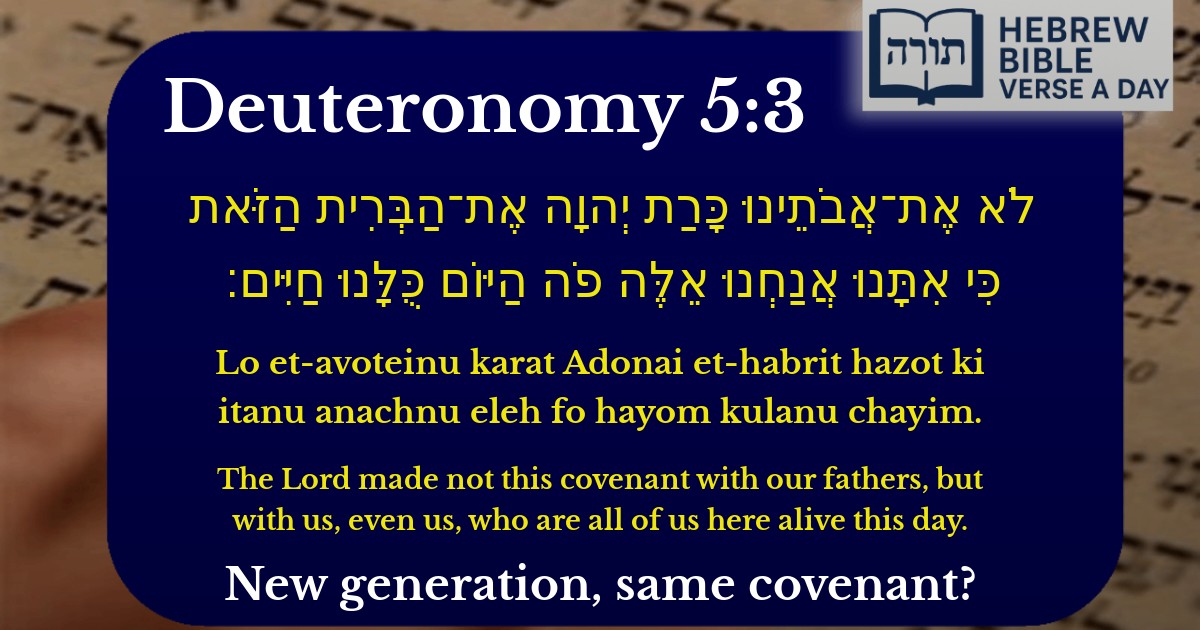
לֹא אֶת־אֲבֹתֵינוּ כָּרַת יְהוָה אֶת־הַבְּרִית הַזֹּאת כִּי אִתָּנוּ אֲנַחְנוּ אֵלֶּה פֹה הַיּוֹם כֻּלָּנוּ חַיִּים׃
English Translation
The Lord made not this covenant with our fathers, but with us, even us, who are all of us here alive this day.
Transliteration
Lo et-avoteinu karat Adonai et-habrit hazot ki itanu anachnu eleh fo hayom kulanu chayim.
Hebrew Leining Text
לֹ֣א אֶת־אֲבֹתֵ֔ינוּ כָּרַ֥ת יְהֹוָ֖ה אֶת־הַבְּרִ֣ית הַזֹּ֑את כִּ֣י אִתָּ֔נוּ אֲנַ֨חְנוּ אֵ֥לֶּה פֹ֛ה הַיּ֖וֹם כֻּלָּ֥נוּ חַיִּֽים׃
🎵 Listen to leining
Parasha Commentary
📚 Talmud Citations
This verse is quoted in the Talmud.
📖 Berakhot 5a
The verse is referenced in the context of discussing the covenant and the living presence of the people at the time of the covenant.
📖 Sanhedrin 90b
The verse is cited in a discussion about the resurrection of the dead and the eternal nature of the covenant.
Context in Devarim (Deuteronomy)
The verse (Devarim 5:3) appears in Moshe's recounting of Ma'amad Har Sinai (the Revelation at Sinai) to Bnei Yisrael before entering Eretz Yisrael. It emphasizes that the covenant was not only with the previous generation who experienced Matan Torah but applies equally to the current generation standing before Moshe.
Rashi's Explanation
Rashi clarifies that "our fathers" refers to Avraham, Yitzchak, and Yaakov, to whom Hashem made covenants—but not this specific covenant of Torah acceptance at Har Sinai. The covenant at Sinai was made directly with those standing there ("us"), binding all future generations as well.
The Ramban's Insight
Ramban explains that while the Avot had personal covenants with Hashem, this was the first national covenant binding the entire Jewish people collectively. The phrase "who are all of us here alive this day" teaches that the covenant extends to all Jewish souls present at Sinai—including those not yet born, as our Sages teach all Jewish souls were present at Matan Torah.
Talmudic Perspective (Shevuot 39a)
The Talmud derives from this verse the principle of arvut (mutual responsibility)—that all Jews are guarantors for one another in Torah observance. Since all souls were present at Sinai, every Jew bears responsibility for their fellow's mitzvah observance.
Midrashic Interpretation (Sifrei Devarim)
The Midrash emphasizes that the covenant's obligations apply equally to all generations. Though the physical generation changed from Sinai to Moav, the spiritual commitment remained binding because the covenant was made with "us"—the eternal Jewish people.
Practical Implications