

Join Our Newsletter To Be Informed When New Videos Are Posted
Hebrew Text
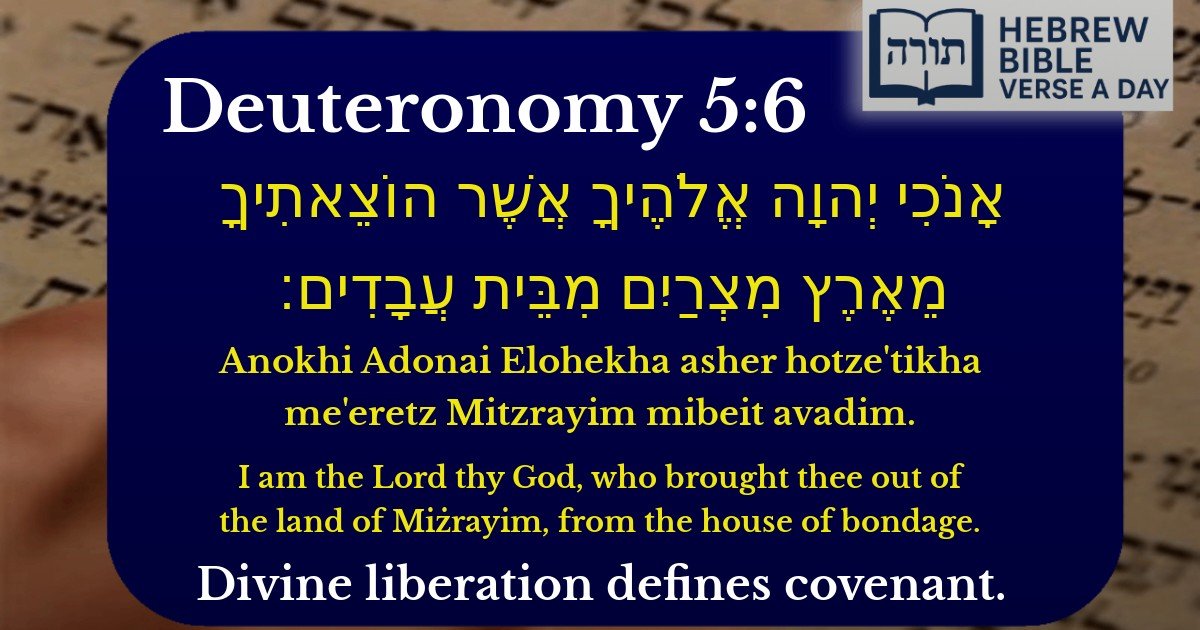
אָנֹכִי יְהוָה אֱלֹהֶיךָ אֲשֶׁר הוֹצֵאתִיךָ מֵאֶרֶץ מִצְרַיִם מִבֵּית עֲבָדִים׃
English Translation
I am the Lord thy God, who brought thee out of the land of Miżrayim, from the house of bondage.
Transliteration
Anokhi Adonai Elohekha asher hotze'tikha me'eretz Mitzrayim mibeit avadim.
Hebrew Leining Text
אָֽנֹכִ֖י֙ יְהֹוָ֣ה אֱלֹהֶ֑֔יךָ אֲשֶׁ֧ר הוֹצֵאתִ֛יךָ מֵאֶ֥רֶץ מִצְרַ֖יִם מִבֵּ֣֥ית עֲבָדִ֑͏ֽים׃
🎵 Listen to leining
Parasha Commentary
📚 Talmud Citations
This verse is quoted in the Talmud.
📖 Berakhot 12b
The verse is discussed in the context of the recitation of the Shema and the importance of remembering the Exodus from Egypt.
📖 Makkot 23b
The verse is referenced in a discussion about the Ten Commandments and their significance in Jewish law.
📖 Shabbat 105b
The verse is mentioned in a discussion about the prohibition of idolatry and the uniqueness of God's commandments.
The First Commandment: Foundation of Faith
The verse "I am the Lord thy God, who brought thee out of the land of Egypt, from the house of bondage" (Exodus 20:2) serves as the opening of the Ten Commandments and establishes the fundamental principle of Jewish belief in Hashem. Rashi explains that this declaration is not merely an introduction but a commandment in itself—to know and acknowledge the existence and sovereignty of G-d.
Divine Revelation and Historical Experience
Rambam (Maimonides) in Sefer HaMitzvot counts this as the first positive commandment: to believe in Hashem as the One who took us out of Egypt. The mention of the Exodus is significant because, as the Talmud (Berachot 21b) teaches, it serves as tangible proof of G-d's intervention in history. The Midrash (Mechilta) emphasizes that the redemption from Egypt was witnessed by the entire nation, making it an irrefutable basis for faith.
The Nature of G-d's Relationship with Israel
The phrasing "I am the Lord thy God" (אָנֹכִי ה' אֱלֹהֶיךָ) establishes a personal covenant. The Kli Yakar notes that the use of "Anochi" (I) rather than "Ani" suggests a more intimate, direct revelation, as this was the language heard at Sinai. The Vilna Gaon adds that the dual description of Egypt—"the land of Egypt" and "the house of bondage"—highlights both physical and spiritual liberation.
Key Lessons from the Verse