Frequently Asked Questions
Q: What does the verse 'Thou shalt not make for thyself any carved idol' mean?
A: This verse, from Deuteronomy 5:8, is the second of the Ten Commandments. It prohibits creating or worshipping any physical representation of G-d or false deities, whether in the form of images from the heavens (like the sun or stars), the earth (animals or humans), or the waters (fish or sea creatures). Rashi explains that this commandment emphasizes that G-d is beyond any physical form and must be worshipped in spirit and truth.
Q: Why is the prohibition against idols so important in Judaism?
A: The prohibition against idolatry is fundamental in Judaism because it upholds the belief in one, incorporeal G-d who cannot be represented by any physical form. The Rambam (Maimonides) teaches in Hilchot Avodah Zarah that rejecting idolatry is the foundation of Torah, as it directs our worship solely to the true Creator. The Talmud (Sanhedrin 74a) also states that avoiding idolatry is so crucial that one must give up their life rather than transgress it.
Q: Does this verse mean Jews cannot make any sculptures or artwork?
A: No, this verse specifically forbids creating images for the purpose of worship. The Talmud (Avodah Zarah 43b) clarifies that artistic representations—such as sculptures or paintings—are permitted as long as they are not worshipped or made to represent G-d. However, some authorities, like the Rambam, advise caution with human forms to avoid any resemblance to idolatrous practices.
Q: How does this commandment apply to modern technology, like photos or videos?
A: The prohibition applies to images made for worship, not general photography or media. The Mishnah Berurah (Orach Chaim 307:23) discusses that photographs or digital images are permissible since they are not idols. However, one must still avoid using any image—even of holy people or places—as an object of worship or reverence that replaces devotion to G-d.
Q: What can we learn from this commandment today?
A: This teaches us to focus our worship on G-d alone, not on physical objects or material representations. The Midrash (Sifrei Devarim) explains that idolatry is not just about statues but also about misplaced priorities—anything we prioritize over serving G-d can become a modern 'idol.' Today, this reminds us to direct our faith inward, toward spiritual connection rather than external symbols.

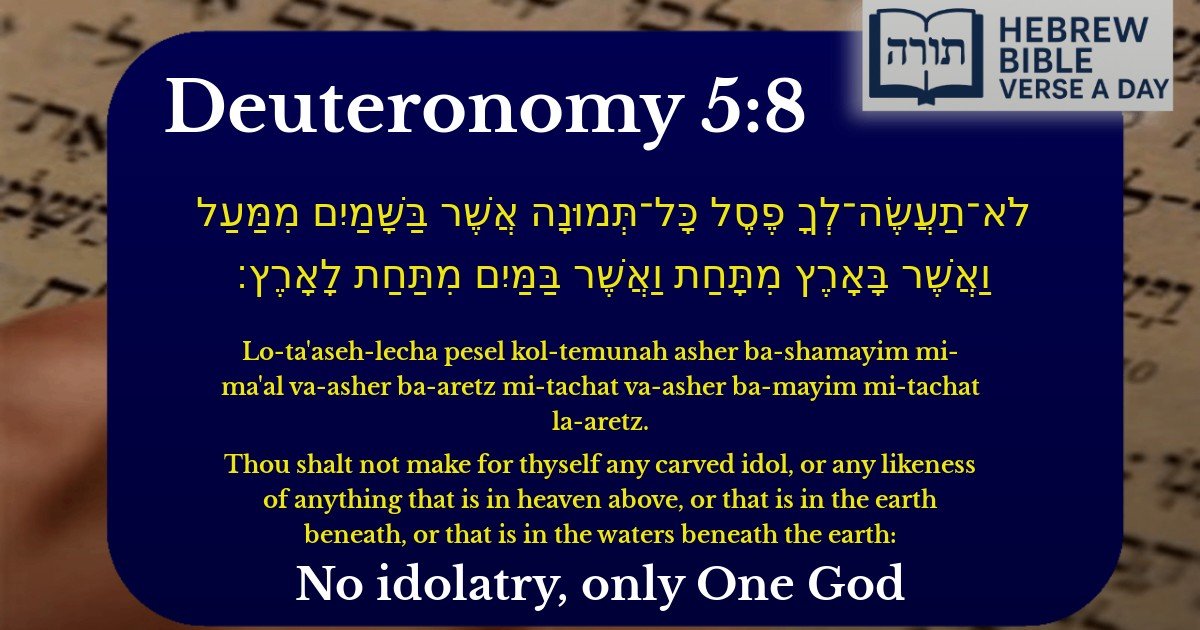

Prohibition Against Idolatry
The verse (Exodus 20:4) is the second of the Ten Commandments and establishes a strict prohibition against creating or worshipping physical representations of divinity. This commandment is foundational to Jewish belief, emphasizing the incorporeal and transcendent nature of Hashem.
Rashi's Explanation
Rashi comments that this prohibition extends not only to idols worshipped by others but even to forms that one might intend for aesthetic purposes, if there is a risk they could lead to idolatrous worship. He emphasizes that the phrase "any likeness of anything that is in heaven above" includes celestial bodies like the sun, moon, and stars, which were commonly worshipped in ancient times.
Rambam's Perspective
In Mishneh Torah (Hilchos Avodah Zarah 3:10), the Rambam explains that this prohibition includes any image, even if not worshipped, if it is made in a form typically associated with idolatry. He further states that this mitzvah serves to distance the Jewish people from any practice that could lead to avodah zarah (foreign worship).
Talmudic and Midrashic Insights
Halachic Applications
Poskim (halachic decisors) derive from this verse that:
Philosophical Significance
The Sefer HaChinuch (Mitzvah 26) explains that this prohibition trains us to recognize that Hashem cannot be contained or represented by physical forms. By abstaining from images, we cultivate a pure, intellectual connection to the Divine that transcends the material world.