Frequently Asked Questions
Q: What does Deuteronomy 6:8 mean?
A: Deuteronomy 6:8 refers to the mitzvah (commandment) of wearing Tefillin. Tefillin are small black leather boxes containing parchment scrolls with verses from the Torah, which are worn on the arm and head during weekday morning prayers. The verse instructs us to bind them 'as a sign upon your hand' and 'as frontlets between your eyes,' symbolizing our commitment to G-d's commandments with both our actions (hand) and thoughts (mind).
Q: Why is wearing Tefillin important in Judaism?
A: Wearing Tefillin is a fundamental mitzvah in Judaism, as it serves as a physical reminder of our connection to G-d and His commandments. The Rambam (Maimonides) explains that Tefillin help focus our minds on serving G-d with both our actions and intellect. The Talmud (Menachot 44a) also teaches that wearing Tefillin is one of the mitzvot that demonstrate our devotion to G-d in a tangible way.
Q: What do the Tefillin on the arm and head represent?
A: The Tefillin shel yad (on the arm) represents dedicating our physical actions to serving G-d, while the Tefillin shel rosh (on the head) symbolizes directing our thoughts and intellect toward Him. Rashi explains that the placement on the arm (near the heart) and the head reminds us to subjugate our emotions and intellect to G-d's will.
Q: How do we fulfill the commandment of Tefillin today?
A: Today, Jewish men (from the age of Bar Mitzvah) fulfill this mitzvah by wearing Tefillin during Shacharit (morning prayers) on weekdays (not on Shabbat or holidays). The Tefillin must be hand-written by a qualified scribe (sofer) and placed correctly—the arm Tefillin on the weaker arm and the head Tefillin centered above the forehead. The details of how to wear them are derived from the Oral Torah (Talmud, Menachot).
Q: What is inside the Tefillin boxes?
A: Inside the Tefillin are parchment scrolls inscribed with four Torah passages: Exodus 13:1-10, Exodus 13:11-16, Deuteronomy 6:4-9 (the Shema), and Deuteronomy 11:13-21. These verses emphasize remembering the Exodus, accepting G-d's unity, and committing to His commandments. The scrolls must be written with precise calligraphy by a trained scribe, as detailed in the Talmud (Sanhedrin 89b).

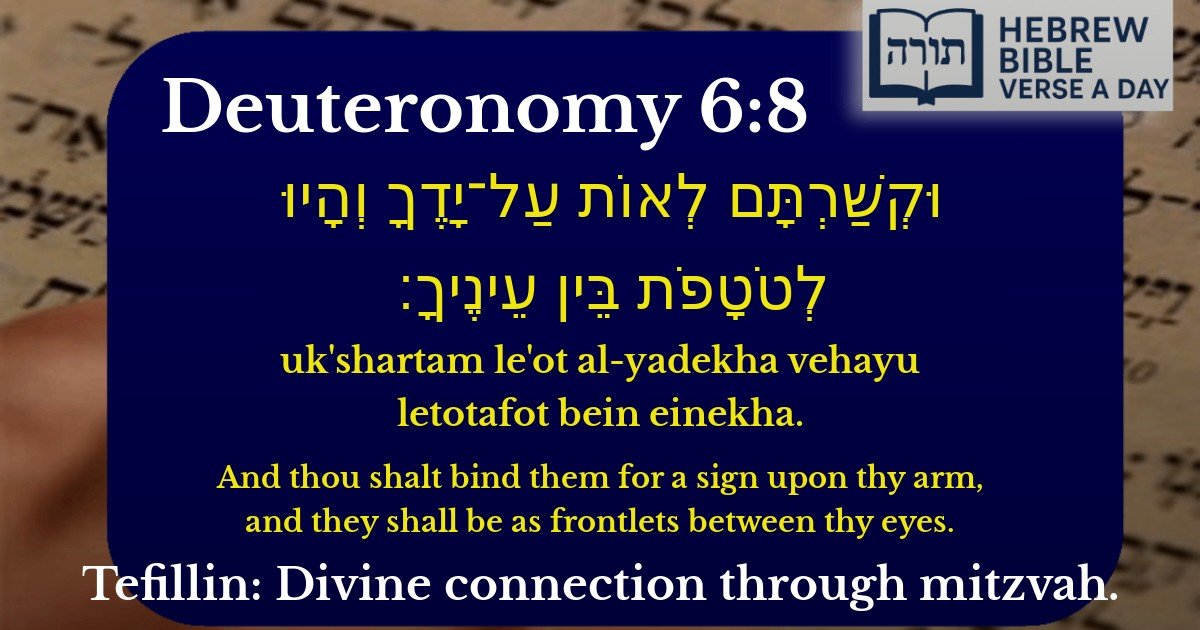

The Mitzvah of Tefillin
The verse (Devarim 6:8) commands the Jewish people to bind the words of Torah as a sign upon the hand and as frontlets between the eyes. This is the mitzvah of tefillin, a physical embodiment of our connection to Hashem and His Torah.
Rashi's Explanation
Rashi explains that the phrase "לְאוֹת עַל־יָדֶךָ" (as a sign upon your hand) refers to the tefillin shel yad (hand tefillin), which is placed on the weaker arm (left arm for right-handed people). The term "טֹטָפֹת" (frontlets) refers to the tefillin shel rosh (head tefillin), positioned above the forehead between the eyes.
Symbolism of Tefillin
Halachic Details from the Talmud
The Talmud (Sanhedrin 4b) derives from this verse that the tefillin must contain four parshiyot (sections of Torah):
Midrashic Insight
The Midrash (Sifrei Devarim 34) explains that the tefillin serve as testimony to the world that the Shechinah (Divine Presence) rests upon Israel. When we wear tefillin properly, we demonstrate our commitment to being a mamlechet kohanim (kingdom of priests) and a goy kadosh (holy nation).