Frequently Asked Questions
Q: What does Deuteronomy 8:9 mean when it describes the Land of Israel?
A: Deuteronomy 8:9 describes the Land of Israel as a blessed land where there is no lack of sustenance ('you shall eat bread without scarceness') and where even the natural resources like iron and copper (translated as 'brass') are abundant. Rashi explains that this verse highlights the material and spiritual bounty of the land, emphasizing that it is a gift from Hashem for the Jewish people to thrive in.
Q: Why is the mention of iron and copper (brass) important in this verse?
A: The mention of iron and copper in Deuteronomy 8:9 symbolizes the land's richness and potential for prosperity. According to the Ramban (Nachmanides), these metals represent the land's ability to support industry and economic strength. The Talmud (Bava Batra 122a) also notes that these materials were essential for building the Mishkan (Tabernacle) and later the Beit HaMikdash (Holy Temple), showing how the land provides for both physical and spiritual needs.
Q: How does Deuteronomy 8:9 apply to us today?
A: This verse reminds us to recognize and appreciate the blessings of the Land of Israel, both in biblical times and today. The Sforno teaches that the verse also warns against taking these gifts for granted—just as the Israelites were commanded to remember Hashem's kindness, we too must acknowledge the divine providence in our sustenance and resources. Modern Israel's agricultural and technological achievements can be seen as a fulfillment of this promise.
Q: What lesson can we learn from 'you shall not lack any thing in it'?
A: The phrase 'you shall not lack any thing in it' (Deuteronomy 8:9) teaches that when the Jewish people follow Hashem's commandments, the Land of Israel will provide all their needs. The Midrash (Sifrei Devarim) connects this to the idea of spiritual and physical completeness—when we are faithful to Torah, Hashem ensures our wellbeing. This encourages gratitude and trust in divine providence.
Q: Why does the Torah emphasize eating bread 'without scarceness' in this verse?
A: The Torah emphasizes eating bread 'without scarceness' (Deuteronomy 8:9) to contrast the Israelites' previous struggles in the desert with the abundance they would experience in the Land of Israel. Rashi explains that this promise was meant to inspire confidence in Hashem's care. Bread, as a staple food, represents basic sustenance, showing that the land would fully provide for their needs when they upheld their covenant with Hashem.

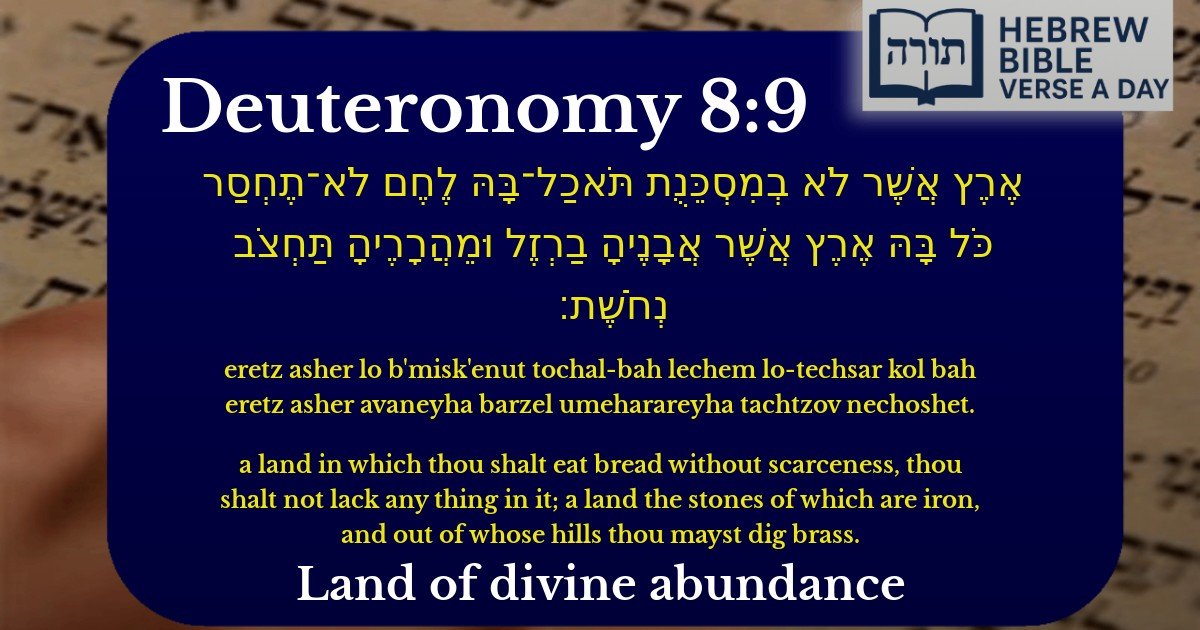

Overview of the Verse
The verse describes the abundant blessings of Eretz Yisrael (the Land of Israel), emphasizing its material and spiritual richness. It highlights that the land provides sustenance without scarcity and contains valuable natural resources like iron and copper (nechoshet). This description appears in Devarim (Deuteronomy) 8:9 as part of Moshe Rabbeinu's exhortation to Bnei Yisrael before their entry into the land.
Commentary on "Bread Without Scarceness"
Rashi explains that the phrase "לֹא בְמִסְכֵּנֻת תֹּאכַל־בָּהּ לֶחֶם" ("you shall eat bread without scarceness") means that even when there is famine in other lands, Eretz Yisrael will sustain its inhabitants. The Sifrei (a halachic Midrash) adds that this blessing is contingent upon the Jewish people observing the mitzvot—when they fulfill Hashem's commandments, the land flourishes.
Interpretation of "You Shall Not Lack Any Thing"
The Ramban (Nachmanides) comments that this phrase underscores the completeness of Eretz Yisrael’s blessings—not only in food but in all necessities of life. The Talmud (Ketubot 112a) teaches that living in Eretz Yisrael is equivalent to observing all the mitzvot, as the land itself facilitates spiritual and physical fulfillment.
Significance of Iron and Copper
The verse mentions that the land’s stones are iron and its hills yield copper. Rashi explains that these metals symbolize strength and durability, reflecting the land’s inherent richness. The Kli Yakar adds that these materials were essential for the construction of the Beit HaMikdash (Holy Temple), indicating that Eretz Yisrael provides not only physical sustenance but also the means for divine service.
Spiritual Lessons from the Verse
The Or HaChaim teaches that the description of Eretz Yisrael’s abundance serves as a reminder that material blessings come from Hashem and should inspire gratitude and devotion. The Sforno emphasizes that the land’s fertility is a reward for righteousness, reinforcing the principle of "הַכֹּל בִּזְכוּת" ("everything is in the merit of mitzvot").