Frequently Asked Questions
Q: What does 'they made their lives bitter with hard bondage' mean in Exodus 1:14?
A: This verse describes the harsh slavery the Egyptians imposed on the Israelites. According to Rashi, the Egyptians deliberately made the work grueling—forcing them to do backbreaking labor like mixing mortar and making bricks, as well as fieldwork. The Torah emphasizes how the Egyptians oppressed them 'with rigor' (בְּפָרֶךְ), meaning with extreme cruelty and without mercy.
Q: Why did the Egyptians make the Israelites' work so difficult?
A: The Midrash (Shemot Rabbah 1:11) explains that Pharaoh and the Egyptians feared the growing Israelite population and sought to weaken them through exhausting labor. Rambam (Hilchot Avadim 9:8) also notes that oppressive labor was a tactic to break their spirit. However, despite the suffering, the Israelites continued to multiply, showing divine protection.
Q: What is the significance of 'mortar and brick' in this verse?
A: Rashi explains that 'mortar and brick' symbolize the most degrading forms of labor. The Egyptians forced the Israelites to do construction work—mixing clay and straw to make bricks—while also assigning them exhausting fieldwork. This was meant to crush them physically and emotionally, but it ultimately set the stage for their redemption.
Q: How does this verse relate to Jewish teachings about suffering?
A: The Talmud (Berachot 5a) teaches that suffering can refine a person and bring them closer to Hashem. The oppression in Egypt was a test, but it also prepared the Israelites for receiving the Torah. The verse reminds us that even in hardship, there is a divine plan, as the slavery ultimately led to the Exodus and redemption.
Q: What lesson can we learn from this verse today?
A: This verse teaches the importance of recognizing oppression and standing against cruelty. Jewish tradition (Rambam, Hilchot De'ot 6:1) emphasizes compassion and justice. Just as Hashem saw the suffering of the Israelites, we must be aware of injustice in our time and work to alleviate suffering, following the Torah's values of kindness and righteousness.

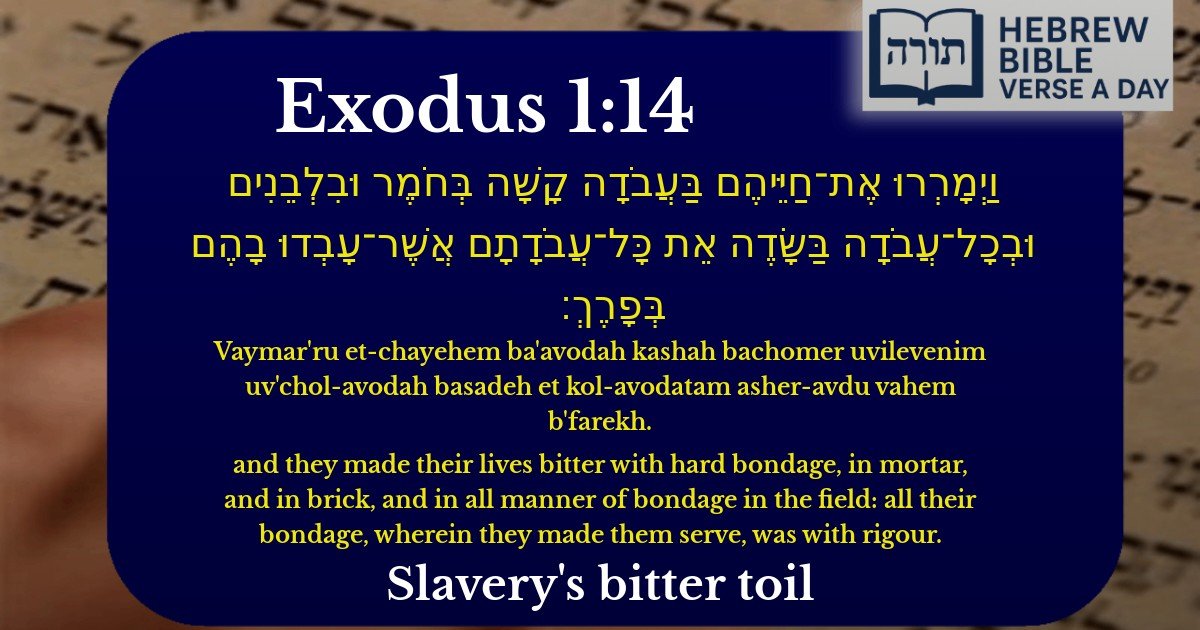

Understanding the Harsh Labor
The verse (Shemot 1:14) describes the bitter servitude imposed upon Bnei Yisrael in Mitzrayim. The phrase "וַיְמָרְרוּ אֶת־חַיֵּיהֶם" ("they made their lives bitter") emphasizes the psychological and physical torment inflicted by the Egyptians. Rashi explains that the Egyptians deliberately sought to embitter their lives, not merely to oppress them physically but to break their spirits.
Types of Labor: Mortar, Bricks, and Field Work
The verse specifies three forms of labor:
The Severity of "בְּפָרֶךְ" (With Rigour)
The term "בְּפָרֶךְ" denotes extreme harshness. The Talmud (Sotah 11b) interprets this as labor that was "פה רך" (soft in speech but cruel in action), meaning the Egyptians deceived Bnei Yisrael with false promises while intensifying their suffering. The Ibn Ezra adds that this word implies labor that crushes the body and spirit, leaving no respite.
Spiritual Significance of the Oppression
The Sforno teaches that this suffering was a divine preparation for Yetziat Mitzrayim—by experiencing hardship, Bnei Yisrael would later appreciate their redemption and the Torah’s commandments. The Or HaChaim further notes that the bitterness of slavery purified them, making them worthy of becoming Hashem’s chosen nation.