Frequently Asked Questions
Q: What does Exodus 1:16 mean?
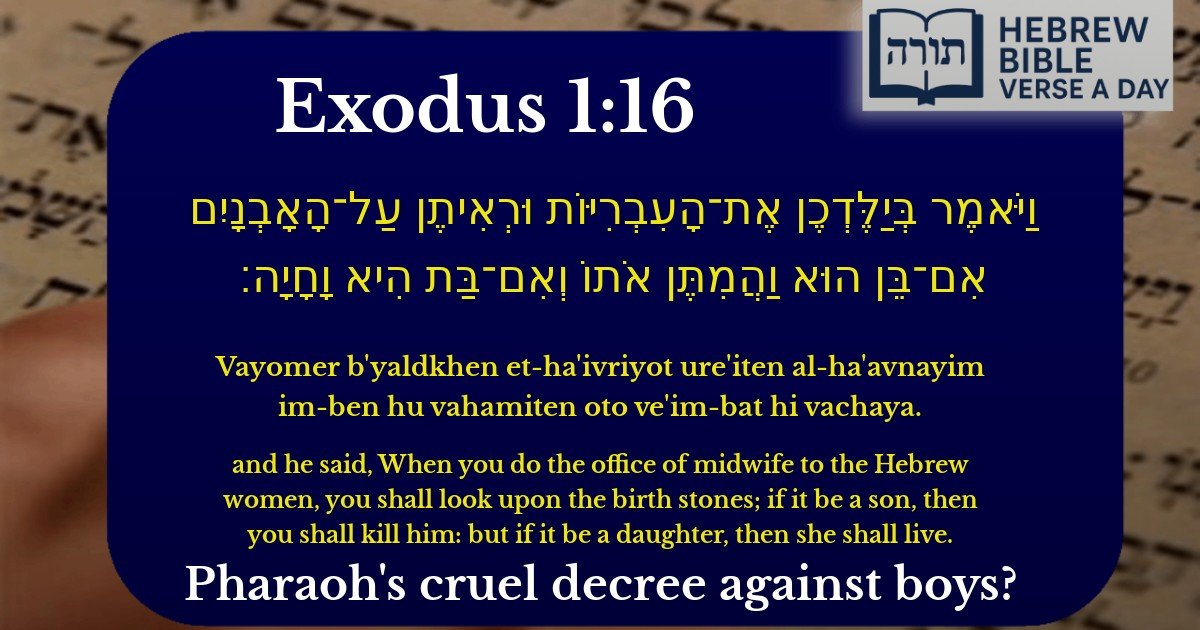
A: Exodus 1:16 describes Pharaoh's command to the Hebrew midwives, Shifra and Puah, to kill all newborn Hebrew boys but let the girls live. This was part of Pharaoh's plan to weaken the Jewish people by preventing their male population from growing. The verse highlights the cruelty of Pharaoh's decree and sets the stage for the eventual redemption of the Jewish people from Egypt.
Q: Why did Pharaoh want to kill the Hebrew boys?
A: Pharaoh feared the growing population of the Hebrews (Exodus 1:9-10) and saw them as a potential threat. By killing the male infants, he hoped to prevent future generations of Hebrew men who could rebel or join Egypt's enemies. The Midrash (Shemot Rabbah 1:18) explains that Pharaoh was also influenced by his astrologers, who foresaw that a Hebrew boy would eventually challenge his rule (referring to Moshe).
Q: Who were Shifra and Puah, the midwives mentioned in this verse?
A: Shifra and Puah were the righteous Hebrew midwives who defied Pharaoh's orders (Exodus 1:17). According to Rashi, Shifra was another name for Yocheved (Moshe's mother), and Puah was Miriam (Moshe's sister). The Talmud (Sotah 11b) praises their bravery and explains that they not only refused to kill the babies but also provided them with food and water, ensuring their survival.
Q: What lesson can we learn from the midwives' actions in this verse?
A: The midwives teach us the importance of fearing Hashem more than human authority (Exodus 1:17). Despite Pharaoh's deadly decree, they risked their lives to save the Jewish children. The Talmud (Sotah 11b) emphasizes that their righteousness was rewarded—Hashem established 'houses' of priesthood and royalty (the lineages of Aharon and David) from their descendants as a merit for their bravery.
Q: How does this verse connect to the broader story of the Exodus?
A: This verse sets in motion the events leading to the Exodus. Pharaoh's decree ultimately fails because of the midwives' defiance and Hashem's plan. Moshe, who would later lead the Jews out of Egypt, is born during this time (Exodus 2:1-2). The Midrash (Shemot Rabbah 1:24) teaches that even in darkness, Hashem prepares the redemption—the very oppression Pharaoh intended to destroy the Jews ultimately led to their liberation.


Context of the Verse
This verse (Exodus 1:16) describes Pharaoh's command to the Hebrew midwives, Shifra and Puah, to kill all newborn Israelite boys while allowing the girls to live. This decree was part of Pharaoh's strategy to suppress the growth of the Israelite population in Egypt.
Rashi's Commentary
Rashi explains that "עַל־הָאָבְנָיִם" (upon the birthstones) refers to the stones upon which women would sit during childbirth. He notes that Pharaoh instructed the midwives to observe the gender of the child at the moment of birth—if it was a boy, they were to kill him immediately. Rashi also highlights that Shifra and Puah were righteous women who feared Hashem and did not carry out Pharaoh's orders (Exodus 1:17).
Midrashic Interpretation
The Midrash (Shemot Rabbah 1:15) elaborates on Pharaoh's reasoning: he targeted the boys because he feared the fulfillment of the prophecy that a male savior would arise to liberate the Israelites. The Midrash also identifies Shifra and Puah as Yocheved and Miriam (Moshe's mother and sister), who risked their lives to save Jewish children.
Rambam's Perspective
Rambam (Hilchot Yesodei HaTorah 5:4) discusses the principle of Kiddush Hashem (sanctification of G-d's name) in the context of this story. The midwives' refusal to obey Pharaoh's immoral decree, despite the danger, exemplifies the obligation to prioritize divine commandments over human laws when they conflict.
Halachic Implications
Symbolism of the Birthstones
Some commentators suggest that the "אָבְנָיִם" (birthstones) symbolize the foundation (even means "stone") of the Jewish people. By defying Pharaoh at this critical moment, the midwives ensured the continuity of the Israelite nation, laying the groundwork for the eventual Exodus.