

Join Our Newsletter To Be Informed When New Videos Are Posted
Hebrew Text
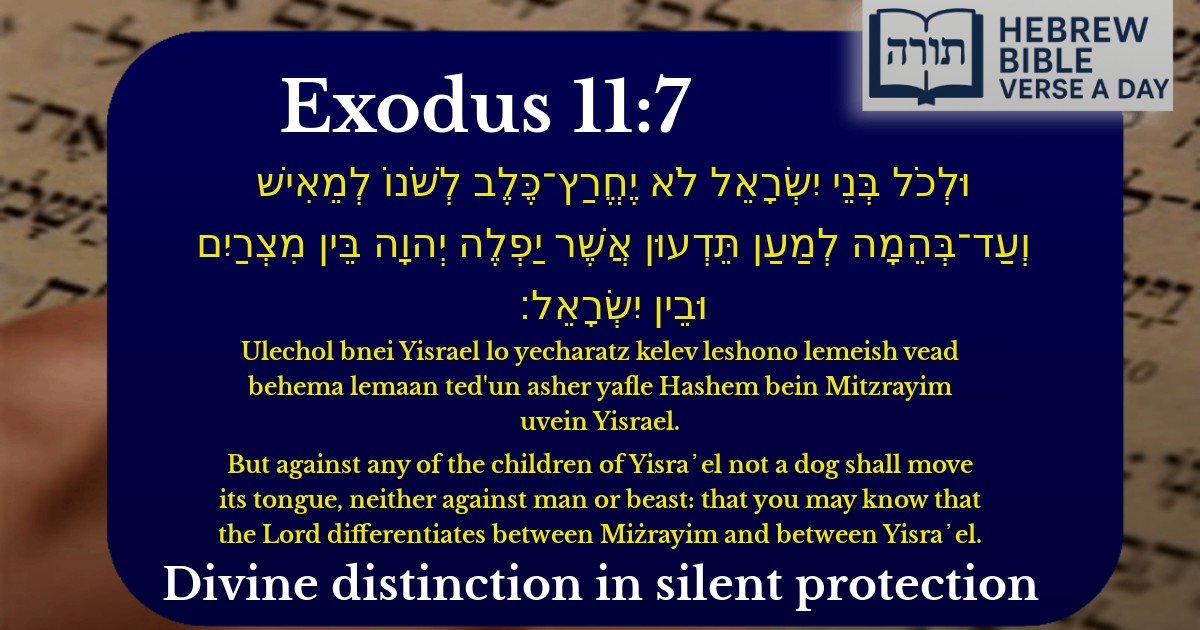
וּלְכֹל בְּנֵי יִשְׂרָאֵל לֹא יֶחֱרַץ־כֶּלֶב לְשֹׁנוֹ לְמֵאִישׁ וְעַד־בְּהֵמָה לְמַעַן תֵּדְעוּן אֲשֶׁר יַפְלֶה יְהוָה בֵּין מִצְרַיִם וּבֵין יִשְׂרָאֵל׃
English Translation
But against any of the children of Yisra᾽el not a dog shall move its tongue, neither against man or beast: that you may know that the Lord differentiates between Miżrayim and between Yisra᾽el.
Transliteration
Ulechol bnei Yisrael lo yecharatz kelev leshono lemeish vead behema lemaan ted'un asher yafle Hashem bein Mitzrayim uvein Yisrael.
Hebrew Leining Text
וּלְכֹ֣ל&thinsp
🎵 Listen to leining
Parasha Commentary
📚 Talmud Citations
This verse is quoted in the Talmud.
📖 Mekhilta d'Rabbi Yishmael Bo, Parsha 11
The verse is discussed in the context of the miracles during the Exodus, emphasizing how even the dogs did not bark at the Israelites, highlighting God's distinction between Egypt and Israel.
📖 Exodus Rabbah 14:4
The verse is referenced to illustrate the divine protection over the Israelites during the plague of the firstborn, showing that not even the dogs harmed them.
Context in the Exodus Narrative
This verse (Shemot 11:7) appears in the context of the final plague—the death of the firstborn—before Bnei Yisrael's departure from Mitzrayim. Hashem assures that no harm will come to Bnei Yisrael, emphasizing His divine protection and distinction between them and the Egyptians.
Rashi's Explanation
Rashi (Rabbi Shlomo Yitzchaki) comments that the phrase "לֹא יֶחֱרַץ־כֶּלֶב לְשֹׁנוֹ" ("not a dog shall move its tongue") signifies complete peace and safety. Even the dogs, known for barking at disturbances, will remain silent during the plague, demonstrating that Bnei Yisrael were entirely unaffected. This silence itself serves as a miraculous sign of Hashem's differentiation.
Midrashic Insights
Rambam's Perspective
Rambam (Maimonides) in Moreh Nevuchim (3:46) interprets this as a demonstration of Divine Providence (Hashgacha Pratit). The silence of the dogs was not a natural phenomenon but a deliberate act of Hashem to manifest His control over creation and His unique relationship with Bnei Yisrael.
Theological Significance
The verse underscores the concept of havdalah (separation)—Hashem's ability to distinguish between His people and others, even in the natural world. This theme recurs throughout Jewish tradition, emphasizing that kedushah (holiness) requires separation for a divine purpose.
Practical Lesson
Chazal derive from this verse that one must recognize and acknowledge Hashem's intervention in history. The silence of the dogs was a visible sign of divine justice, teaching Bnei Yisrael—and future generations—to perceive Hashem's hand in both salvation and judgment.