Frequently Asked Questions
Q: Who were the midwives mentioned in Exodus 1:20?
A: According to Rashi and the Midrash, the midwives were Shifra and Puah, who were righteous Jewish women. Some opinions suggest they may have been Yocheved (Moshe's mother) and Miriam (his sister). They courageously defied Pharaoh's orders to kill Jewish baby boys.
Q: Why did God reward the midwives in Exodus 1:20?
A: As explained in the Talmud (Sotah 11b), God rewarded the midwives because they feared Heaven more than Pharaoh. Despite the danger, they saved Jewish babies by providing care and even bringing them food. Their selfless actions demonstrated true faith and commitment to preserving Jewish life.
Q: What does it mean that 'the people multiplied and grew very mighty' in this verse?
A: The Ramban explains that this shows God's blessing on the Jewish people despite Pharaoh's oppression. Even when the Egyptians tried to weaken them through slavery, the Jews thrived and became numerous - fulfilling God's promise to Avraham that his descendants would be as numerous as the stars (Genesis 15:5).
Q: What lesson can we learn from the midwives in Exodus 1:20?
A: The Midrash teaches that the midwives' actions show the importance of risking oneself to save lives (pikuach nefesh). Their example demonstrates that we must follow God's laws even when facing powerful opposition, and that God rewards those who stand up for what is right.
Q: How does Exodus 1:20 relate to Jewish values today?
A: This verse establishes fundamental Jewish principles: the sanctity of life (even under threat), the importance of civil disobedience against immoral decrees, and trust that God blesses those who uphold righteousness. These values remain central to Orthodox Jewish life, especially when facing persecution or moral challenges.

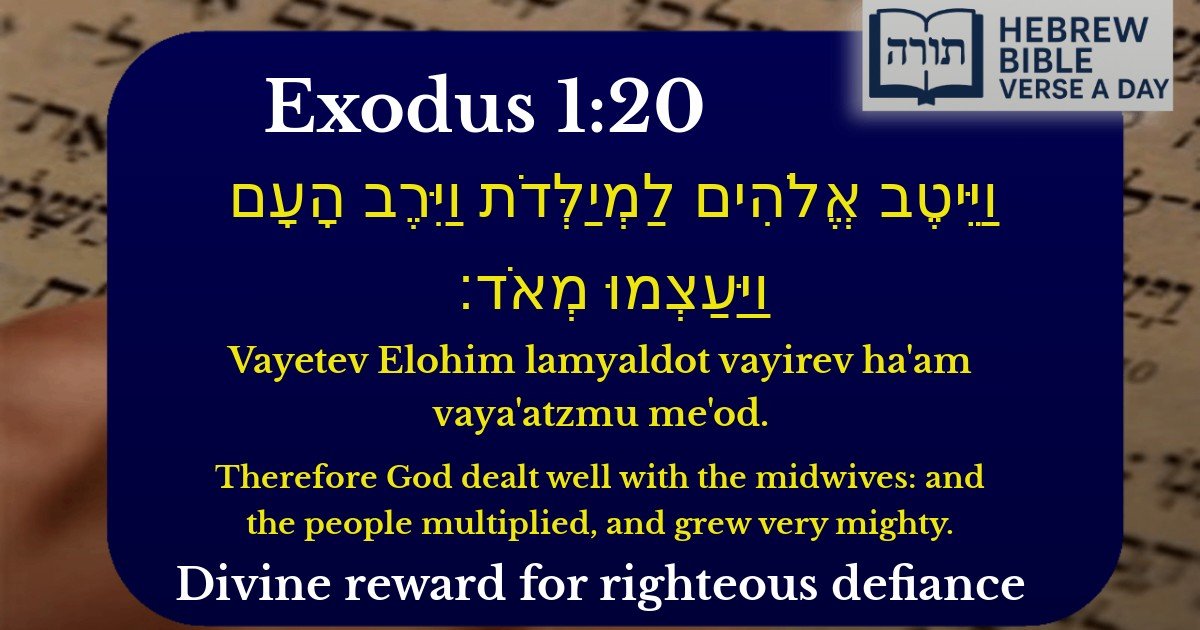

Context of the Verse
The verse (Shemot 1:20) describes Hashem's reward to the Hebrew midwives, Shifra and Puah, who defied Pharaoh's decree to kill newborn Israelite boys. Despite the king's command, they acted righteously, leading to divine favor and the continued growth of Bnei Yisrael.
Rashi's Explanation
Rashi (Rabbi Shlomo Yitzchaki) explains that the phrase "וַיֵּיטֶב אֱלֹהִים לַמְיַלְּדֹת" ("God dealt well with the midwives") refers to Hashem establishing households for them. Since they valued life, they were blessed with descendants—some say they became the matriarchs of priestly and Levitical dynasties (Rashi on Shemot 1:20).
Midrashic Interpretation
The Midrash (Shemot Rabbah 1:15) elaborates that Shifra and Puah were none other than Yocheved (Moshe’s mother) and Miriam (his sister). Their bravery in preserving Jewish lives earned them great reward, including:
Rambam's Perspective on Reward
The Rambam (Maimonides) in Hilchot De'ot (1:7) teaches that performing mitzvot with pure intentions brings divine blessing. The midwives acted out of yirat Shamayim (fear of Heaven), not for personal gain, and thus merited Hashem's kindness.
Growth of Bnei Yisrael
The continuation of the verse—"וַיִּרֶב הָעָם וַיַּעַצְמוּ מְאֹד" ("the people multiplied and grew very mighty")—demonstrates that Pharaoh’s decrees could not thwart Hashem’s promise to Avraham of numerous descendants (Bereishit 15:5). The Malbim notes that their growth was both in numbers (וַיִּרֶב) and strength (וַיַּעַצְמוּ), defying oppression.