
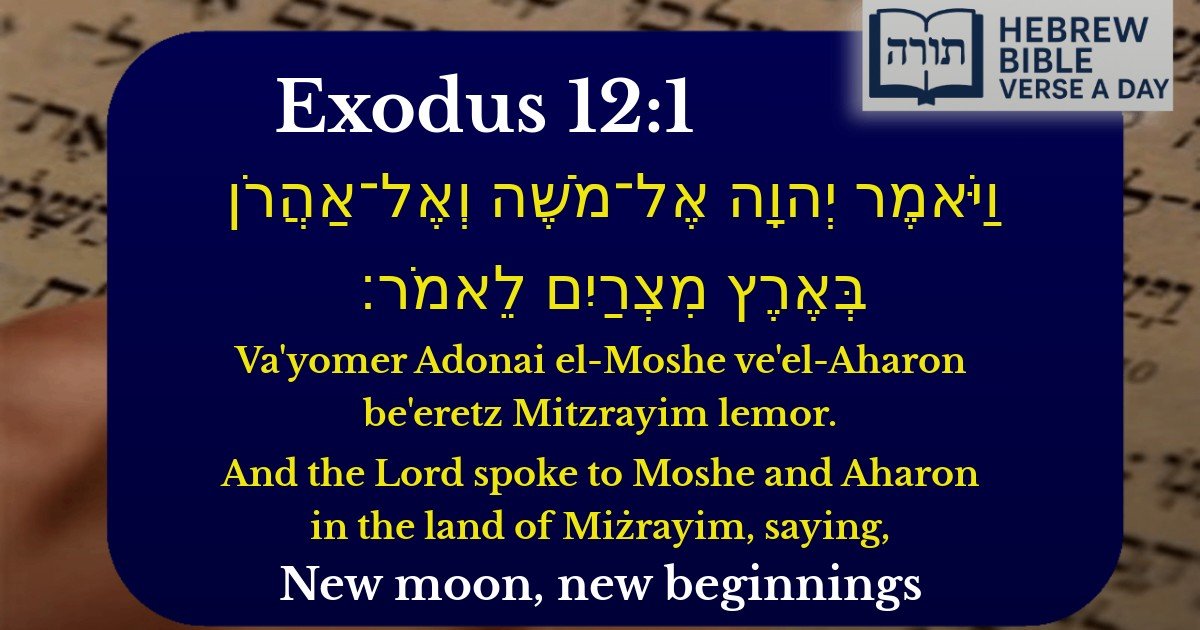

Exodus 12:1 - New moon, new beginnings

Exodus 12:1 - שמות 12:1

Hebrew Text

וַיֹּאמֶר יְהוָה אֶל־מֹשֶׁה וְאֶל־אַהֲרֹן בְּאֶרֶץ מִצְרַיִם לֵאמֹר׃

English Translation

And the Lord spoke to Moshe and Aharon in the land of Miżrayim, saying,

Transliteration

Va'yomer Adonai el-Moshe ve'el-Aharon be'eretz Mitzrayim lemor.

Hebrew Leining Text

וַיֹּ֤אמֶר יְהֹוָה֙ אֶל־מֹשֶׁ֣ה וְאֶֽל־אַהֲרֹ֔ן בְּאֶ֥רֶץ מִצְרַ֖יִם לֵאמֹֽר׃

🎵 Listen to leining

Parasha Commentary

Introduction to the Verse

The verse (Shemot 12:1) marks the beginning of the commandments regarding the Korban Pesach (Paschal Lamb) and the Exodus from Egypt. It is significant that Hashem speaks to both Moshe and Aharon together, emphasizing their joint leadership role in transmitting these mitzvot to Bnei Yisrael.

Why Mention "In the Land of Egypt"?

Rashi explains that the phrase "בְּאֶרֶץ מִצְרַיִם" ("in the land of Egypt") teaches us that Hashem's word came to them while they were still in Egypt, before the Exodus had begun. This underscores that the mitzvot of Pesach were given in anticipation of redemption, demonstrating that geulah (redemption) begins with adherence to Hashem's commandments.

The Joint Address to Moshe and Aharon

The Ramban notes that while Moshe was the primary prophet, Aharon was included here because:

  • Aharon played a crucial role as Moshe's spokesman to Pharaoh and the people.
  • This mitzvah required both brothers to instruct the people collectively, as it was foundational for the entire nation.
  • It foreshadowed Aharon's future role as Kohen Gadol, as the Korban Pesach relates to the Temple service.

Chronological Context

Ibn Ezra points out that this communication occurred on Rosh Chodesh Nissan, marking the beginning of the month of redemption. The Sforno adds that this date was chosen to establish Nissan as the first of months, symbolizing a new era for Bnei Yisrael as a nation.

The Significance of "Lemor"

The Ohr HaChaim highlights the word "לֵאמֹר" ("saying"), explaining that Moshe and Aharon were commanded to transmit these laws not just to that generation, but for all future generations. This establishes the eternal nature of the Pesach observance.

📚 Talmud Citations

This verse is not quoted in the Talmud.

Frequently Asked Questions

Q: Why did Hashem speak to Moshe and Aharon specifically in the land of Egypt?
A: Rashi explains that this teaches us that even though Moshe and Aharon were in Egypt, a place of impurity, Hashem's presence was still with them. This shows that the Divine Presence (Shechinah) is not limited by location and can be found even in difficult circumstances.
Q: What is the significance of Hashem speaking to both Moshe and Aharon together in this verse?
A: The Ramban notes that this emphasizes their shared leadership role in bringing the Jewish people out of Egypt. Aharon served as Moshe's spokesman (as mentioned earlier in Shemos 4:16), and here they are addressed together to show unity in fulfilling Hashem's commandments regarding the Exodus.
Q: Why does the Torah mention that this communication happened in Egypt? Isn't it obvious?
A: The Midrash teaches that this detail comes to highlight that the commandments about the Exodus (which follow this verse) were given while still in Egypt, showing that the redemption process began even before leaving. This teaches us that spiritual growth can start even in challenging environments.
Q: What practical lesson can we learn from this verse today?
A: The Seforno explains that just as Hashem communicated with our ancestors in Egypt, He continues to guide us even in our own 'narrow places' (Mitzrayim literally means 'narrow straits'). This teaches that we should seek Divine guidance in all situations, no matter how difficult our circumstances may seem.
Q: Why does the verse say 'saying' at the end if no speech follows immediately?
A: Rashi explains that this is a common Torah style where 'saying' introduces commandments that will be given. Here it refers to the upcoming mitzvos about the Passover lamb (Korban Pesach) and the Exodus that begin in the next verses, showing these were Divine commandments given in Egypt before the redemption.