

Join Our Newsletter To Be Informed When New Videos Are Posted
Hebrew Text
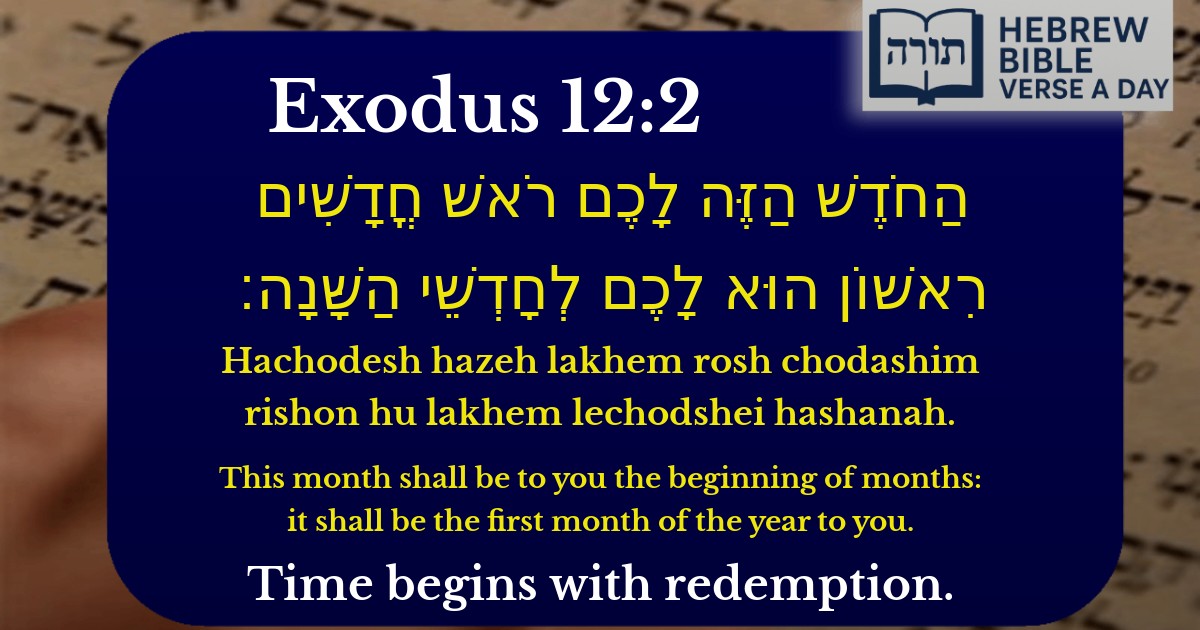
הַחֹדֶשׁ הַזֶּה לָכֶם רֹאשׁ חֳדָשִׁים רִאשׁוֹן הוּא לָכֶם לְחָדְשֵׁי הַשָּׁנָה׃
English Translation
This month shall be to you the beginning of months: it shall be the first month of the year to you.
Transliteration
Hachodesh hazeh lakhem rosh chodashim rishon hu lakhem lechodshei hashanah.
Hebrew Leining Text
הַחֹ֧דֶשׁ הַזֶּ֛ה לָכֶ֖ם רֹ֣אשׁ חֳדָשִׁ֑ים רִאשׁ֥וֹן הוּא֙ לָכֶ֔ם לְחׇדְשֵׁ֖י הַשָּׁנָֽה׃
🎵 Listen to leining
Parasha Commentary
📚 Talmud Citations
This verse is quoted in the Talmud.
📖 Rosh Hashanah 2b
The verse is discussed in the context of establishing the new moon and the beginning of months, particularly focusing on the commandment to sanctify the new moon.
📖 Megillah 5a
Referenced in a discussion about the significance of the month of Nisan as the first month and its implications for the calendar and festivals.
📖 Sanhedrin 42a
Mentioned in a broader discussion about the authority of the Sanhedrin in declaring the new month and the biblical basis for such authority.
The Significance of the First Month
The verse "הַחֹדֶשׁ הַזֶּה לָכֶם רֹאשׁ חֳדָשִׁים" (This month shall be to you the beginning of months) marks the establishment of Nissan as the first month of the Jewish calendar. Rashi explains that this commandment was given to Moshe and Aharon in Egypt, signifying a new era for Bnei Yisrael as they prepared for the Exodus. The counting of months from Nissan emphasizes the centrality of Yetzias Mitzrayim (the Exodus) in Jewish consciousness, as it is the foundational event of our national identity.
The Torah's Calendar Revolution
Rambam (Hilchos Kiddush HaChodesh 1:1-2) elaborates that this mitzvah represents a departure from the natural solar calendar, instituting a lunar-based system sanctified by human witnesses and Beis Din. The Sforno adds that this shift underscores the Jewish people's transcendence of nature, as our months are determined by divine commandment rather than celestial cycles alone.
Nissan as the Head of Months
The Mechilta derives from "רִאשׁוֹן הוּא לָכֶם" (it shall be the first to you) that:
Spiritual Dimensions
The Ohr HaChaim highlights that "לָכֶם" (to you) indicates this calendar belongs specifically to the Jewish people. The Kli Yakar connects this to the renewal process - just as the moon renews itself monthly, so too must we constantly renew our spiritual commitment. The lunar cycle thus becomes a metaphor for Jewish history's pattern of exile and redemption.
Practical Halachic Implications
The Rambam (Hilchos Kiddush HaChodesh 5:1) rules that even after the fixed calendar was established, we still reference months by their Exodus-based numbering (e.g., "first month" for Nissan) to fulfill this eternal commandment. The Sefer HaChinuch (Mitzvah 4) counts this as one of the 613 mitzvos - to establish Nissan as ראש חדשים and count months accordingly.