Frequently Asked Questions
Q: What does Exodus 14:15 mean when Hashem tells Moshe 'Why are you crying out to Me?'
A: Rashi explains that Hashem was telling Moshe that this wasn't a time for lengthy prayer, but rather a time for action. The Jewish people needed to move forward with faith, showing their trust in Hashem by taking the first step into the sea before it would split.
Q: Why is Exodus 14:15 important in Jewish tradition?
A: This verse teaches the important Jewish concept of 'hishtadlus' - making human effort while relying on Hashem. As the Midrash explains, we must take the first steps in our own redemption, just as Nachshon ben Aminadav did by entering the water before it split, demonstrating that faith requires action.
Q: What lesson can we learn today from Exodus 14:15?
A: The Rambam teaches that this verse shows we must balance prayer with practical action. When facing challenges, we pray to Hashem but must also take concrete steps to improve our situation, just as the Israelites needed to actually start moving toward the sea.
Q: Why did Hashem tell Moshe to stop praying at this moment?
A: The Talmud (Sotah 37a) explains that there are times when extended prayer is inappropriate when immediate action is required. At this critical moment of redemption, action took precedence over prayer, teaching us to recognize when we need to shift from prayer to doing.
Q: How does Exodus 14:15 relate to Jewish leadership?
A: The verse teaches that a Jewish leader must know when to pray and when to act. As Rashi notes, Moshe was praying at length while the people were in distress, and Hashem directed him to lead them forward instead, showing that leadership sometimes requires decisive action more than extended prayer.

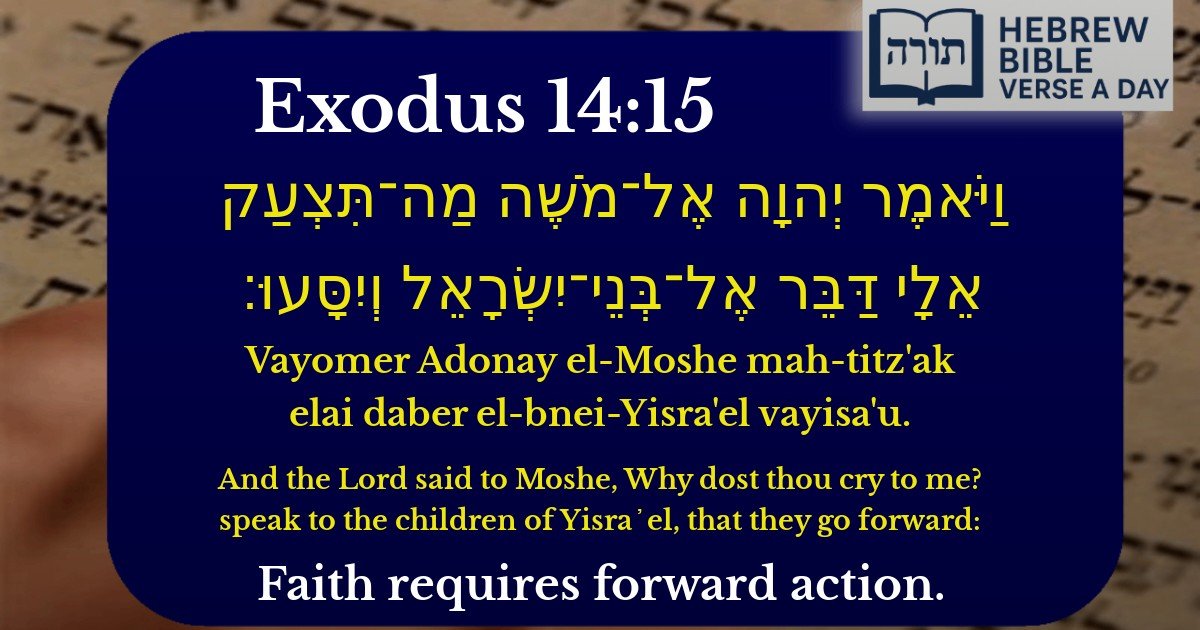

Context of the Verse
This verse (Shemot 14:15) appears during the dramatic moment when Bnei Yisrael are trapped between the pursuing Egyptian army and the Yam Suf (Red Sea). Moshe Rabbeinu had been praying to Hashem, and this is Hashem's response.
Rashi's Explanation
Rashi explains that Hashem's question "Why dost thou cry to me?" indicates that this was not the time for lengthy prayer when Bnei Yisrael were in distress. Rashi cites the Mechilta which states that Moshe had taken hold of the attribute of prayer, and Hashem told him that now was the time for action rather than extended prayer.
Rambam's Perspective
Rambam (Hilchot Tefillah 1:1) teaches that while prayer is always important, there are times when action must take precedence. This verse serves as a paradigm for understanding that when one is capable of taking action to solve a problem, one should not rely solely on prayer.
Midrashic Interpretation
The Midrash (Shemot Rabbah 21:8) elaborates that Hashem told Moshe: "My children are in distress, the sea is blocking their way, the enemy is pursuing, and you stand and prolong your prayer? There is a time to lengthen prayer and a time to shorten it."
Nachmanides' Insight
Ramban explains that Hashem was telling Moshe that the proper response in this situation was to demonstrate leadership by moving forward with faith, as the miracle would occur through their action of stepping into the sea.
Practical Lessons
Chassidic Perspective
The Baal Shem Tov taught that this verse teaches us about the balance between prayer and action. While prayer connects us to Hashem, we must also take concrete steps in the physical world to bring about redemption.