

Join Our Newsletter To Be Informed When New Videos Are Posted
Hebrew Text
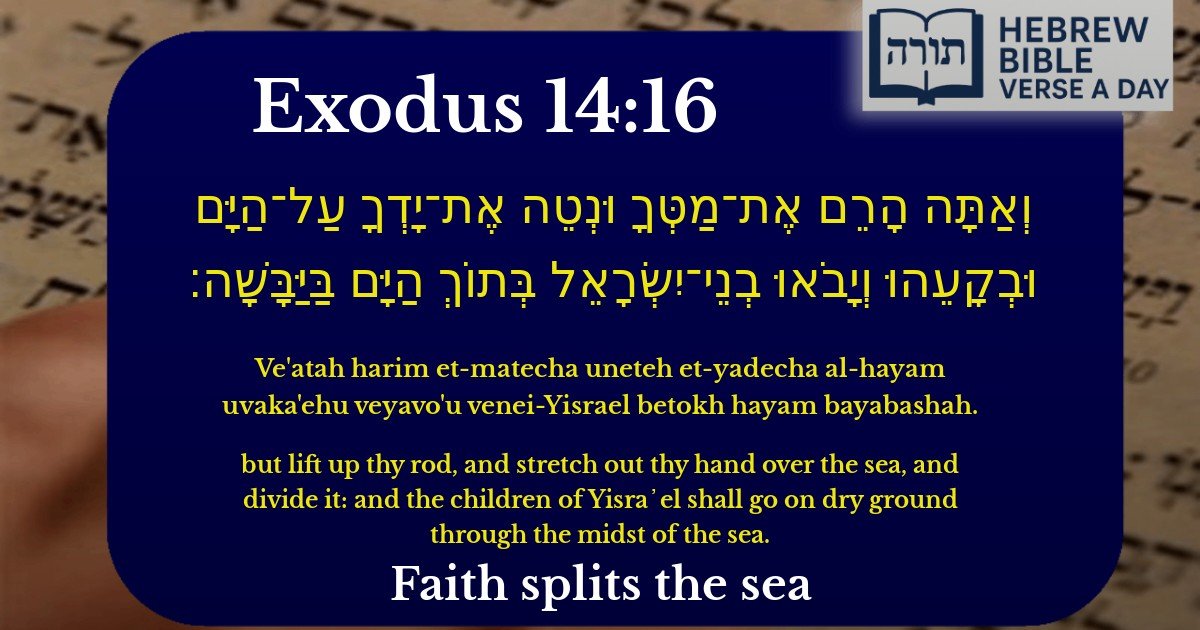
וְאַתָּה הָרֵם אֶת־מַטְּךָ וּנְטֵה אֶת־יָדְךָ עַל־הַיָּם וּבְקָעֵהוּ וְיָבֹאוּ בְנֵי־יִשְׂרָאֵל בְּתוֹךְ הַיָּם בַּיַּבָּשָׁה׃
English Translation
but lift up thy rod, and stretch out thy hand over the sea, and divide it: and the children of Yisra᾽el shall go on dry ground through the midst of the sea.
Transliteration
Ve'atah harim et-matecha uneteh et-yadecha al-hayam uvaka'ehu veyavo'u venei-Yisrael betokh hayam bayabashah.
Hebrew Leining Text
וְאַתָּ֞ה הָרֵ֣ם אֶֽת־מַטְּךָ֗ וּנְטֵ֧ה אֶת־יָדְךָ֛ עַל־הַיָּ֖ם וּבְקָעֵ֑הוּ וְיָבֹ֧אוּ בְנֵֽי־יִשְׂרָאֵ֛ל בְּת֥וֹךְ הַיָּ֖ם בַּיַּבָּשָֽׁה׃
🎵 Listen to leining
Parasha Commentary
📚 Talmud Citations
This verse is quoted in the Talmud.
📖 Sotah 36b
The verse is referenced in the context of discussing the miracles performed during the Exodus, particularly the splitting of the Red Sea.
📖 Megillah 10b
The verse is mentioned in a discussion about the greatness of God's miracles and the deliverance of the Israelites from Egypt.
Context of the Verse
This verse (Shemot 14:16) is part of the narrative of Kriyat Yam Suf (the Splitting of the Red Sea), where Hashem commands Moshe to perform a miracle to save Bnei Yisrael from the pursuing Egyptian army. The verse emphasizes Moshe's role as the conduit for Hashem's miracles, demonstrating that the redemption was not through human power but through divine intervention.
Rashi's Explanation
Rashi (Shemot 14:16) explains that Moshe was instructed to raise his staff (mateh) and stretch his hand over the sea to initiate the miracle. Rashi notes that the phrase "וּבְקָעֵהוּ" ("and divide it") implies that the sea would split into multiple paths, not just one. This aligns with Midrashic sources (e.g., Shemot Rabbah 21:10), which describe twelve distinct paths for each of the tribes.
Rambam on Miracles and Nature
Rambam (Moreh Nevuchim 2:29) discusses how miracles are preordained in creation, suggesting that the splitting of the sea was not an arbitrary suspension of nature but a divinely embedded potential. The raising of the staff symbolized that the miracle was executed through Moshe as Hashem's agent, reinforcing the principle that nature itself follows Hashem's will.
Midrashic Insights
Symbolism of the Staff
The staff (mateh) represents authority and divine power, as seen in earlier plagues (e.g., Shemot 7:9-12). Here, its use reinforces that Moshe acted solely as Hashem's messenger. The Kli Yakar (Shemot 14:16) adds that the staff was a reminder of the covenant with the Avot, ensuring the redemption of their descendants.
Theological Implications
The phrase "בְּתוֹךְ הַיָּם בַּיַּבָּשָׁה" ("through the midst of the sea on dry land") underscores the miraculous nature of the event—Bnei Yisrael walked on dry ground while the sea remained parted, defying natural law. The Ohr HaChaim (Shemot 14:16) explains that this demonstrated Hashem's absolute control over creation, a foundational lesson for emunah (faith).