Frequently Asked Questions
Q: Why did Hashem harden Pharaoh's heart?
A: According to Rashi and other commentators, Hashem hardened Pharaoh's heart after he repeatedly chose evil on his own (Exodus 7:13-14, 8:15, etc.). This was a measure-for-measure response - since Pharaoh stubbornly refused to let the Israelites go despite witnessing Hashem's miracles, Hashem removed his ability to repent, leading to the final showdown at the Red Sea where Hashem's full glory would be revealed.
Q: What does it mean that Hashem will 'gain honor' through Pharaoh?
A: The Midrash explains that through Pharaoh's continued resistance and the dramatic splitting of the Red Sea, Hashem's supreme power and mastery over nature would be displayed to the entire world (Mechilta Beshalach 3). The Rambam notes this public demonstration of divine providence established core principles of Jewish faith for all generations.
Q: Why mention Pharaoh's chariots and horsemen specifically?
A: Rashi explains this emphasizes Pharaoh's military might - his elite chariot corps was the pride of Egypt (Exodus 14:7). By defeating this specific symbol of Egyptian power, Hashem demonstrated that no force can oppose His will. The Talmud (Sotah 36b) also sees this as hinting to future events where Hashem similarly overpowers enemies who pursue Israel.
Q: How does this verse connect to free will?
A: The Rambam (Hilchot Teshuvah 6:3) explains that while people have free will, after someone consistently chooses evil, Hashem may remove their ability to repent as a form of divine justice. This doesn't negate initial free will - Pharaoh made many evil choices before this point (Exodus 7-10), and only then did Hashem harden his heart.
Q: What lesson can we learn from this verse today?
A: The Sforno teaches that this shows how even when evil seems powerful (symbolized by Pharaoh's army), Hashem can instantly reverse situations for His purposes. The verse reminds us that what appears as human conflict is often part of a larger divine plan to reveal truth and justice in the world.

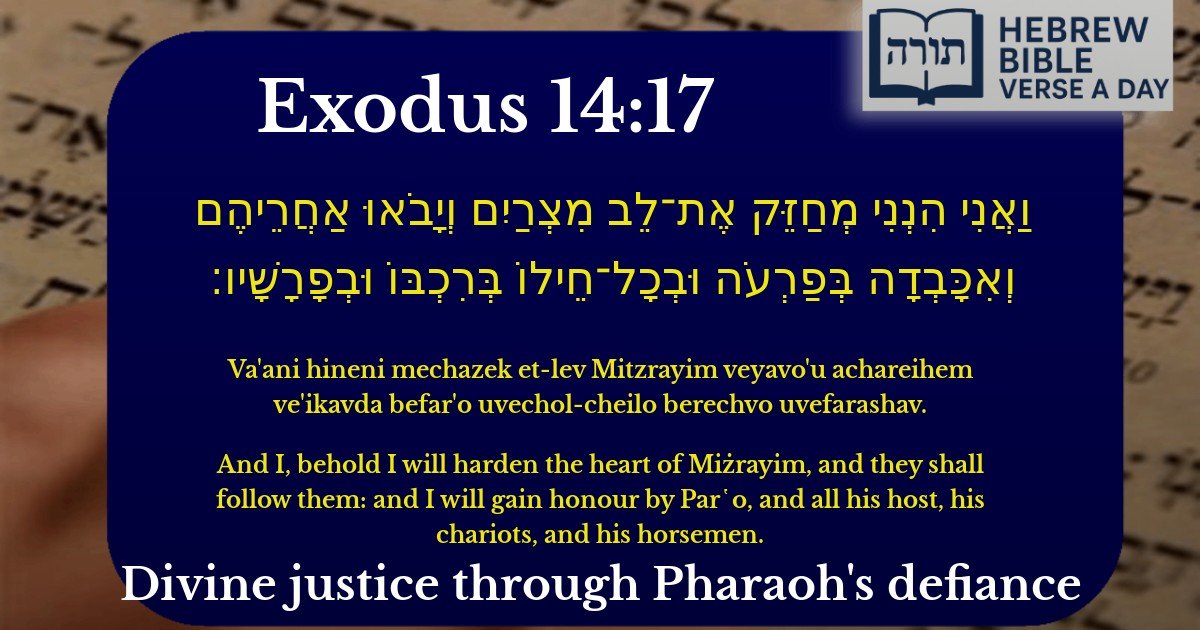

Context in Shemot (Exodus)
This verse (Shemot 14:17) appears during the narrative of Kriyat Yam Suf (the splitting of the Red Sea), where Hashem informs Moshe of His plan to harden Pharaoh's heart once more, leading to the final confrontation between the Egyptians and Bnei Yisrael. The hardening of Pharaoh's heart is a recurring theme in the Exodus story, demonstrating divine justice and the fulfillment of Hashem's promise to redeem His people.
Rashi's Explanation
Rashi (Shemot 14:17) explains that Hashem strengthened Pharaoh's resolve to pursue Bnei Yisrael so that the Egyptians would be utterly destroyed in the sea, thereby magnifying Hashem's glory. Rashi emphasizes that this was a measure-for-measure response (middah k'neged middah): just as Pharaoh hardened his own heart earlier (Shemot 8:11), now Hashem completed the process to bring about justice.
Rambam's Perspective on Free Will
Rambam (Hilchot Teshuvah 6:3) addresses the theological question of Pharaoh's free will. He explains that when a sinner repeatedly rejects opportunities to repent, Hashem may "harden" their heart as a form of divine punishment, removing their ability to repent. This does not negate free will initially but is a consequence of persistent wickedness.
Midrashic Interpretation
The Midrash (Shemot Rabbah 21:5) elaborates that Hashem allowed Pharaoh to pursue Bnei Yisrael to demonstrate His complete mastery over creation. By drowning the Egyptians in the very waters they worshipped (the Nile), Hashem revealed His supremacy over false deities.
Kli Yakar's Insight
The Kli Yakar (Shemot 14:17) notes that the phrase "וְאִכָּבְדָה" ("I will be glorified") implies that the Egyptians' defeat would serve as an eternal testimony to Hashem's power. Their destruction was not merely punitive but a revelation of divine justice for all generations.
Key Themes