Frequently Asked Questions
Q: What does Exodus 14:23 mean?
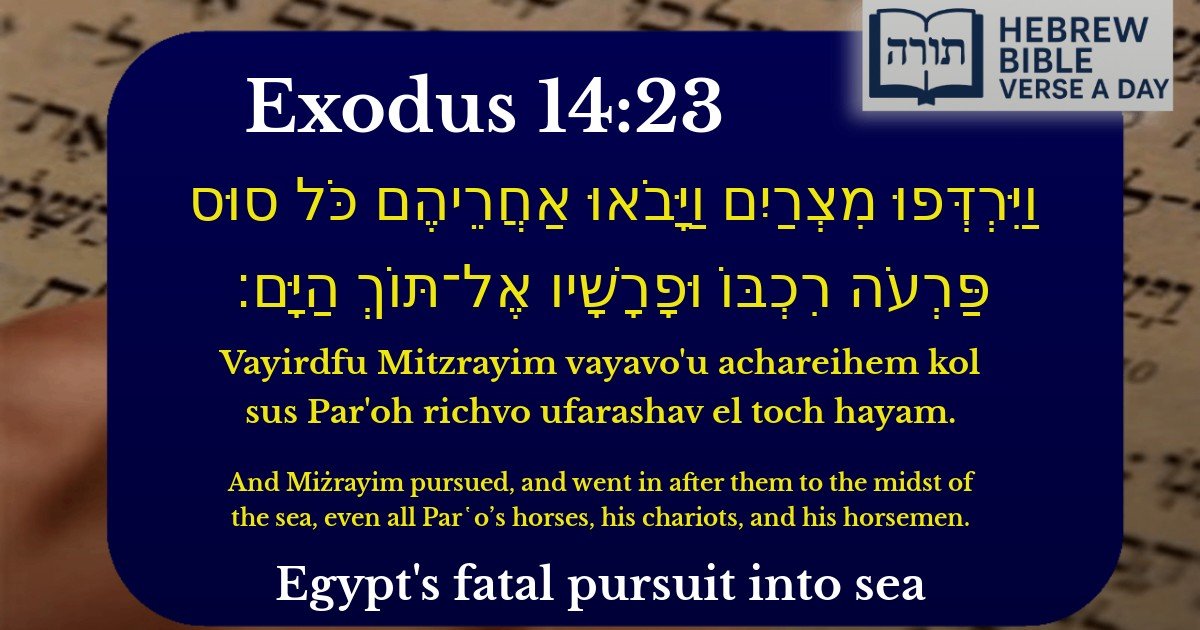
A: Exodus 14:23 describes how the Egyptians, led by Pharaoh, chased the Israelites into the Red Sea after they had crossed on dry land. According to Rashi, this verse shows Pharaoh's stubbornness and arrogance, as he and his army ignored the miracles they had already witnessed and pursued the Israelites into the sea, where they would ultimately drown.
Q: Why is this verse important in the Exodus story?
A: This verse is important because it marks the moment when Pharaoh and his army fully committed to chasing the Israelites into the sea, setting the stage for the miraculous drowning of the Egyptians. The Midrash teaches that this was the final act of defiance against Hashem's will, demonstrating that Pharaoh refused to repent even after the Ten Plagues.
Q: What can we learn from Exodus 14:23?
A: We learn from this verse the dangers of stubbornness and refusing to recognize Hashem's power. The Rambam teaches that Pharaoh's hardened heart led to his downfall. This serves as a lesson that when people persistently ignore divine signs and continue in wrongdoing, it can lead to their own destruction.
Q: How does this verse apply to us today?
A: This verse reminds us to avoid the trait of arrogance (known as 'gasus ha'ruach' in Jewish thought) and to recognize when we are wrong. The Talmud (Sotah 5a) warns that arrogance is akin to idol worship. Like Pharaoh, those who refuse to humble themselves may face consequences for their actions.
Q: Why did Pharaoh's horses and chariots go into the sea?
A: According to the Midrash (Shemot Rabbah 21:8), the Egyptians were so consumed by hatred and desire to recapture the Israelites that they irrationally followed them into the sea. The verse emphasizes 'all of Pharaoh's horses' to show that not a single Egyptian held back—they were all equally guilty and thus all met the same fate.


Rashi's Explanation
Rashi (Exodus 14:23) explains that the Egyptians pursued Bnei Yisrael with great intensity, entering the sea even after witnessing the miraculous splitting of the waters. He notes that the phrase "כֹּל סוּס פַּרְעֹה" ("all of Pharaoh’s horses") emphasizes that not a single horse or chariot was held back—Pharaoh committed his entire military force to this pursuit. Rashi also highlights that the Egyptians entered "אֶל־תּוֹךְ הַיָּם" ("into the midst of the sea"), showing their reckless determination, as they ventured deep into the miraculously parted sea despite the obvious divine intervention.
Midrashic Insights
The Midrash (Shemot Rabbah 21:8) elaborates on the Egyptians' mindset, stating that they were driven by a combination of arrogance and divine hardening of Pharaoh’s heart. The Midrash compares their pursuit to a person chasing after a lost cause, blinded by their own stubbornness. Additionally, the Midrash teaches that the sea did not immediately close upon them to allow them to fully enter, demonstrating Hashem’s precision in judgment—they were punished measure for measure for drowning Israelite children in the Nile.
Rambam's Perspective
Rambam (Moreh Nevuchim 1:24) discusses the nature of miracles and free will in this event. He explains that while Hashem hardened Pharaoh’s heart, the Egyptians still exercised their free will in choosing to pursue Bnei Yisrael. Their decision to chase them into the sea, despite witnessing the plagues and the splitting of the sea, was a result of their own moral corruption and refusal to acknowledge Hashem’s power.
Chizkuni’s Additional Commentary
Chizkuni (Exodus 14:23) observes that the verse specifies "רִכְבּוֹ וּפָרָשָׁיו" ("his chariots and his horsemen") to indicate that Pharaoh’s elite forces were involved in the chase. This underscores the severity of the threat Bnei Yisrael faced and the extent of Pharaoh’s desperation to recapture them. The inclusion of all military branches—horses, chariots, and cavalry—shows that Egypt’s full might was deployed in this final attempt.
Lessons from the Talmud