Frequently Asked Questions
Q: What does 'morning watch' mean in Exodus 14:24?
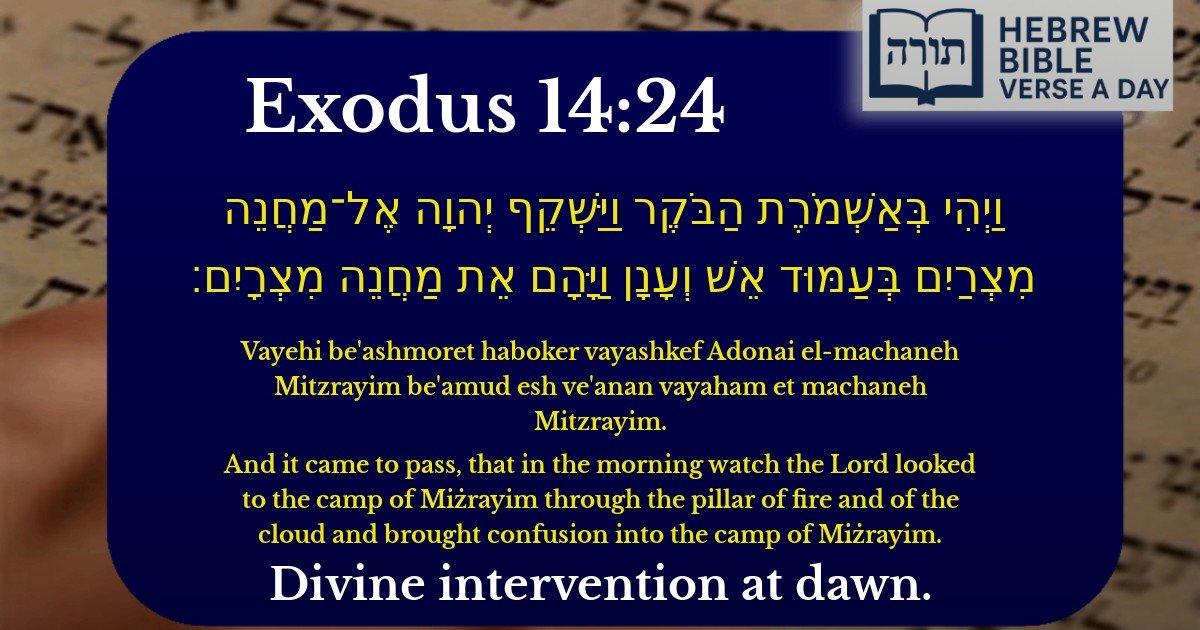
A: The 'morning watch' (אַשְׁמֹרֶת הַבֹּקֶר) refers to the last third of the night, just before dawn. According to Rashi, this was the time when Hashem intervened to confuse the Egyptian camp, showing His constant protection over Bnei Yisrael even in the darkest hours.
Q: Why did Hashem look at the Egyptians through a pillar of fire and cloud?
A: The pillar of fire and cloud (עַמּוּד אֵשׁ וְעָנָן) symbolized Hashem's presence and guidance. The Midrash explains that the cloud brought darkness to the Egyptians while providing light for Bnei Yisrael, showing Divine justice—protecting the righteous while punishing the wicked.
Q: What does it mean that Hashem 'brought confusion' to the Egyptian camp?
A: The 'confusion' (וַיָּהָם) refers to the panic and disarray Hashem caused among the Egyptians. Ramban explains that this included chariot wheels getting stuck, soldiers fighting each other, and general chaos—making it impossible for them to pursue Bnei Yisrael further.
Q: Why is this moment in the Exodus story important?
A: This verse marks the turning point where Hashem actively intervenes to save Bnei Yisrael. The Talmud (Sotah 11a) teaches that this miracle reinforced the people's faith, proving that Hashem fights for them even when escape seems impossible.
Q: How can we apply the lesson of this verse today?
A: Just as Hashem protected Bnei Yisrael in their time of need, we learn to trust in Divine help during challenges. The Sforno notes that this event teaches us that salvation can come suddenly, even at the darkest hour ('morning watch'), if we maintain faith.


Understanding the Time: "Ashmoret HaBoker"
The phrase "בְּאַשְׁמֹרֶת הַבֹּקֶר" (in the morning watch) refers to the last third of the night, as explained by Rashi (Shemot 14:24). This time is significant because it is when Hashem often performs miracles for His people, as seen in other instances (e.g., the downfall of Sancheriv in Melachim II 19:35). The ashmoret is a time of transition from darkness to light, symbolizing the shift from oppression to redemption.
The Divine Gaze: "Vayashkef Hashem"
The term "וַיַּשְׁקֵף" (and He looked) implies a focused, judgmental gaze, as noted by the Malbim. This is not a passive observation but an active intervention, as Hashem "looked down" to execute justice upon Mitzrayim. The Midrash (Shemot Rabbah 21:5) compares this to a king who inspects his enemies before exacting punishment.
The Pillar of Fire and Cloud
The "עַמּוּד אֵשׁ וְעָנָן" (pillar of fire and cloud) represents Hashem's presence and protection. Rashi explains that the cloud brought darkness to the Egyptians while providing light for Bnei Yisrael (Shemot 14:20). The Ramban adds that these pillars were constant miracles, demonstrating Hashem's unwavering commitment to His people.
Confusion in the Camp: "Vayahaam"
The word "וַיָּהָם" (and He brought confusion) is interpreted by the Ibn Ezra as causing disarray and panic. The Mechilta (Beshalach 6) elaborates that this confusion included:
Spiritual Significance
The Sforno teaches that this event was not merely a physical battle but a spiritual reckoning. The Egyptians, who had oppressed Bnei Yisrael with harsh labor (avodat parech), were now subjected to divine chaos. The Ohr HaChaim highlights that the pillar of fire symbolized strict justice (din), while the cloud represented mercy (rachamim) for Israel—a duality of Hashem's attributes in action.