
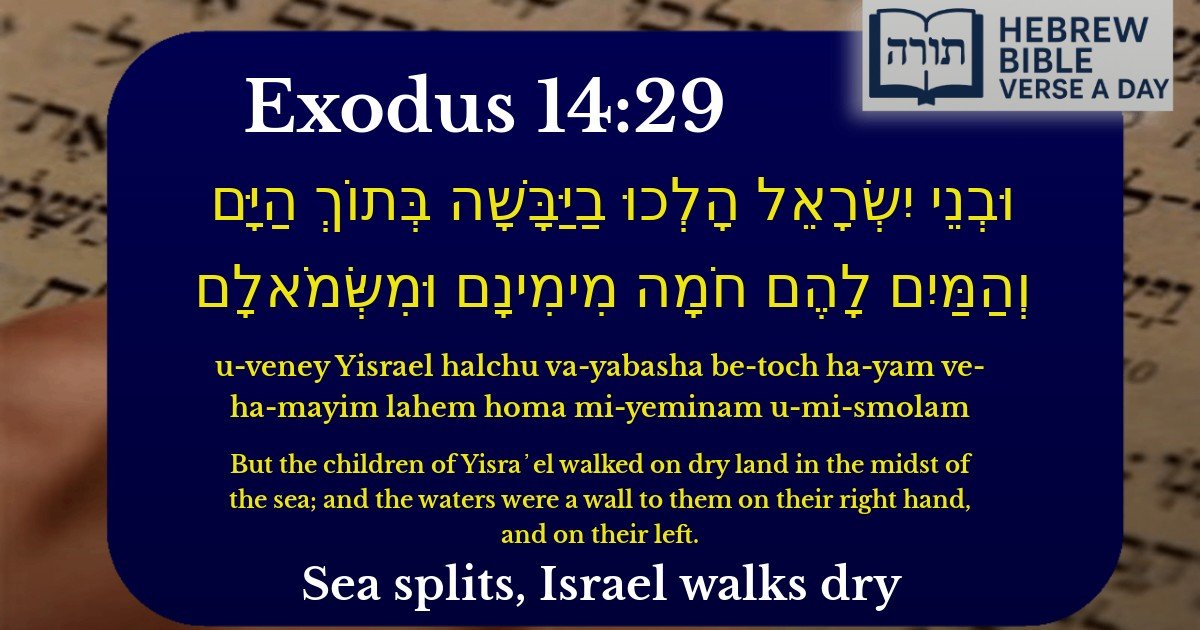

Exodus 14:29 - Sea splits, Israel walks dry

Exodus 14:29 - שמות 14:29

Hebrew Text

וּבְנֵי יִשְׂרָאֵל הָלְכוּ בַיַּבָּשָׁה בְּתוֹךְ הַיָּם וְהַמַּיִם לָהֶם חֹמָה מִימִינָם וּמִשְּׂמֹאלָם

English Translation

But the children of Yisra᾽el walked on dry land in the midst of the sea; and the waters were a wall to them on their right hand, and on their left.

Transliteration

U-veney Yisrael halchu va-yabasha be-toch ha-yam ve-ha-mayim lahem homa mi-yeminam u-mi-smolam

Hebrew Leining Text

וּבְנֵ֧י יִשְׂרָאֵ֛ל הָלְכ֥וּ בַיַּבָּשָׁ֖ה בְּת֣וֹךְ הַיָּ֑ם וְהַמַּ֤יִם לָהֶם֙ חֹמָ֔ה מִֽימִינָ֖ם וּמִשְּׂמֹאלָֽם׃

🎵 Listen to leining

Parasha Commentary

The Miracle of Crossing the Sea

The verse describes the miraculous crossing of the Red Sea by the children of Israel, emphasizing the supernatural nature of the event. According to Rashi (Shemot 14:22), the phrase "בְּתוֹךְ הַיָּם" ("in the midst of the sea") indicates that the sea split into twelve separate paths, one for each tribe, allowing them to walk through safely. This interpretation is based on the Midrash (Mechilta Beshalach 4), which teaches that the sea did not merely part into two walls but formed multiple pathways, demonstrating Hashem's precision in guiding His people.

The Walls of Water

The phrase "וְהַמַּיִם לָהֶם חֹמָה" ("and the waters were a wall to them") is interpreted in several ways by our sages:

  • Rashi explains that the word "חֹמָה" (wall) implies a solid, protective barrier, like a fortress, ensuring the Israelites' safety from the surrounding waters.
  • The Mechilta adds that the walls were transparent, allowing the tribes to see one another as they crossed, reinforcing unity during the miracle.
  • Rambam (Moreh Nevuchim 2:29) discusses the natural order being suspended, emphasizing that this was a clear display of divine intervention beyond the laws of nature.

Right and Left: Symbolism of Divine Protection

The mention of "מִימִינָם וּמִשְּׂמֹאלָם" ("on their right hand and on their left") carries deeper meaning:

  • The Zohar (Shemot 54a) teaches that the right side symbolizes chesed (kindness), while the left represents gevurah</strong (judgment). The walls of water thus reflected Hashem's balance of mercy and justice in redeeming Israel.
  • Rabbeinu Bachya notes that this phrasing hints at the complete protection afforded to Bnei Yisrael—no danger could approach from any direction.

The Dry Land in the Midst of the Sea

The Torah emphasizes that the Israelites walked "בַיַּבָּשָׁה" ("on dry land"), which the Midrash Tanchuma (Beshalach 10) explains was not merely damp ground but completely dry, as if no water had ever been there. This detail highlights the totality of the miracle—Hashem altered nature entirely for His people's sake.

📚 Talmud Citations

This verse is quoted in the Talmud.

📖 Sotah 36b
The verse is cited in a discussion about the miracles that occurred during the splitting of the Red Sea, emphasizing the protective nature of the waters as walls for the Israelites.
📖 Megillah 10b
Referenced in the context of recounting the wonders performed for the Israelites during the Exodus, highlighting the miraculous passage through the sea.

Frequently Asked Questions

Q: What does it mean that the waters were 'a wall' for the Israelites?
A: Rashi explains that the waters stood upright like solid walls on both sides of the Israelites as they crossed the Red Sea. This was a miraculous protection from Hashem, showing His complete control over nature to save His people.
Q: Why did the Israelites walk on dry land in the sea?
A: The Midrash teaches that this miracle demonstrated Hashem's love for Israel. Despite being trapped between the sea and Pharaoh's army, G-d split the sea to provide a dry path of escape, fulfilling His promise to bring them out of Egypt.
Q: How is the splitting of the sea relevant to us today?
A: The Rambam teaches that remembering this miracle strengthens our faith in Hashem's ability to save us from impossible situations. Just as He made a way through the sea, He can make a way through our challenges when we trust in Him.
Q: Why does the Torah mention the walls being on 'their right and left'?
A: The Talmud (Sotah 36b) explains that this detail shows the completeness of the miracle - the waters didn't just part, but formed protective barriers on both sides. Some commentaries suggest the right side represents kindness and the left represents judgment, showing G-d's balanced protection.
Q: What lesson can we learn from the Israelites walking through the sea?
A: The Sages teach that this event shows the power of faith in action. Nachshon ben Aminadav had to step into the water before it split (Mechilta). We learn that sometimes we must take the first step in faith before seeing Hashem's salvation.