
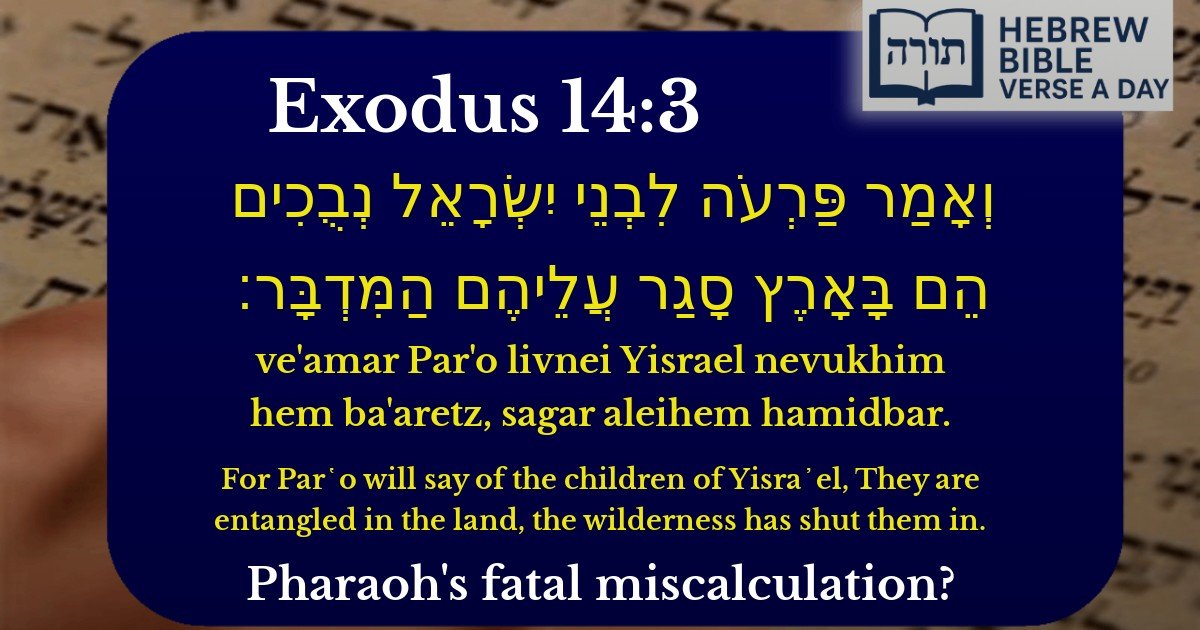

Exodus 14:3 - Pharaoh's fatal miscalculation?

Exodus 14:3 - שמות 14:3

Hebrew Text

וְאָמַר פַּרְעֹה לִבְנֵי יִשְׂרָאֵל נְבֻכִים הֵם בָּאָרֶץ סָגַר עֲלֵיהֶם הַמִּדְבָּר׃

English Translation

For Par῾o will say of the children of Yisra᾽el, They are entangled in the land, the wilderness has shut them in.

Transliteration

Ve'amar Par'o livnei Yisrael nevukhim hem ba'aretz, sagar aleihem hamidbar.

Hebrew Leining Text

וְאָמַ֤ר פַּרְעֹה֙ לִבְנֵ֣י יִשְׂרָאֵ֔ל נְבֻכִ֥ים הֵ֖ם בָּאָ֑רֶץ סָגַ֥ר עֲלֵיהֶ֖ם הַמִּדְבָּֽר׃

🎵 Listen to leining

Parasha Commentary

Understanding Pharaoh's Perspective

The verse (Shemot 14:3) describes Pharaoh's assumption that the Israelites were lost and trapped in the wilderness. Rashi explains that Pharaoh believed the Israelites were "נְבֻכִים" (confused or entangled) because they were wandering without a clear direction, making them vulnerable. This perception led him to pursue them, thinking they were easy prey.

The Wilderness as a Trap

The phrase "סָגַר עֲלֵיהֶם הַמִּדְבָּר" (the wilderness has shut them in) is interpreted by the Midrash (Shemot Rabbah 21:5) as part of Hashem's divine plan. By leading Bnei Yisrael into what appeared to be a dead end, Hashem set the stage for the miraculous splitting of the Yam Suf, demonstrating His complete control over nature and history.

Pharaoh's Misjudgment

Rambam (Moreh Nevuchim 3:24) discusses how Pharaoh's arrogance blinded him to the divine hand guiding the Israelites. His belief that they were trapped reflected his reliance on human logic rather than recognizing Hashem's providence. This overconfidence ultimately led to his downfall at the Yam Suf.

Spiritual Lessons

  • Divine Strategy: What appears as confusion or entrapment may be part of a greater divine plan (based on teachings of the Sforno).
  • Human Arrogance: Pharaoh's mistake serves as a warning against underestimating Hashem's ability to overturn natural circumstances (as discussed in the Talmud, Sotah 11a).
  • Emunah in Hardship: The Israelites' apparent困境 (entanglement) preceded their greatest redemption, teaching that challenges often precede salvation (a theme echoed in Midrash Tanchuma, Beshalach 10).

📚 Talmud Citations

This verse is not quoted in the Talmud.

Frequently Asked Questions

Q: What does it mean that Pharaoh said the Israelites were 'entangled in the land'?
A: Rashi explains that Pharaoh thought the Israelites were confused and lost in the wilderness, going around in circles without direction. This gave him false confidence to pursue them, as he believed they had no escape route (Rashi on Exodus 14:3).
Q: Why did Pharaoh say 'the wilderness has shut them in'?
A: According to the Midrash (Mechilta), Pharaoh saw the Israelites trapped between the sea, the desert, and his approaching army. He mistakenly believed they had no way to escape, not realizing that Hashem would miraculously split the sea for them.
Q: What lesson can we learn from Pharaoh's mistaken assumption about the Israelites?
A: The verse teaches that human calculations can be wrong when they don't account for Divine intervention. As the Talmud states (Berachot 10a), 'Do not trust in your own understanding' - Pharaoh relied on his military strategy but failed to recognize Hashem's power to save His people.
Q: How does this verse show Pharaoh's arrogance?
A: The Rambam (Hilchot De'ot 2:3) teaches that arrogance blinds a person. Pharaoh's boastful assumption that the Israelites were trapped shows his hubris in thinking he could defeat Hashem's plan to redeem the Jewish people from Egypt.
Q: Why is this verse important in the Exodus story?
A: This verse sets up the dramatic climax of the Exodus, showing how Pharaoh's mistaken belief led to his final confrontation with the Israelites at the sea. The Sages teach that this moment demonstrated Hashem's complete control over nature and history (Mechilta Beshalach 2).