

Join Our Newsletter To Be Informed When New Videos Are Posted
Hebrew Text
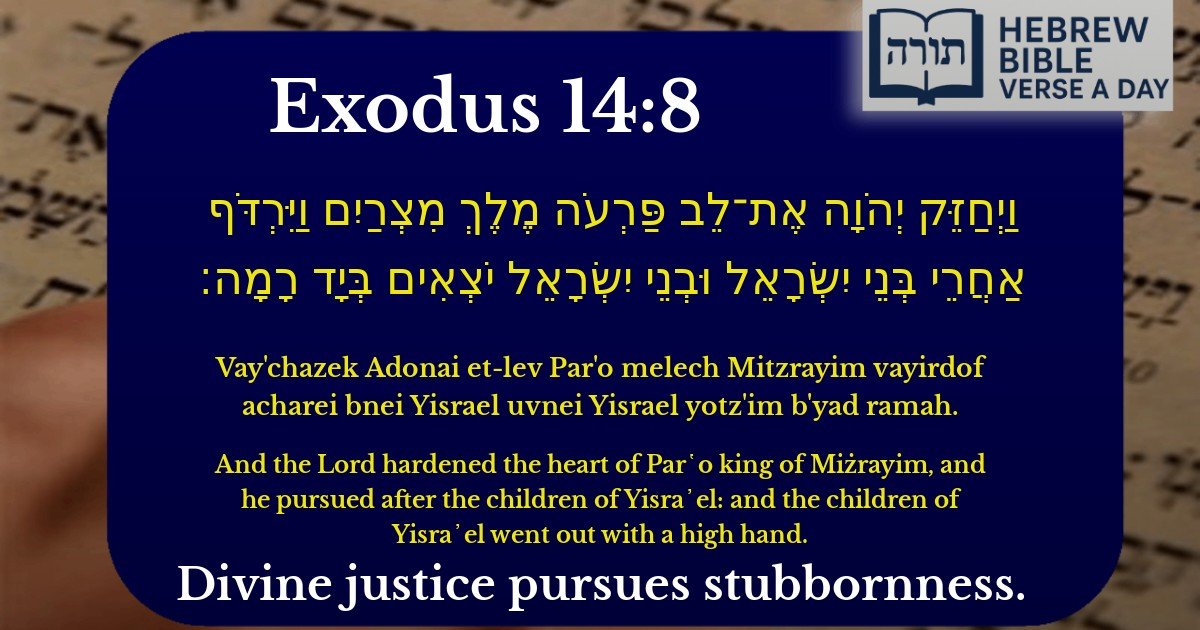
וַיְחַזֵּק יְהֹוָה אֶת־לֵב פַּרְעֹה מֶלֶךְ מִצְרַיִם וַיִּרְדֹּף אַחֲרֵי בְּנֵי יִשְׂרָאֵל וּבְנֵי יִשְׂרָאֵל יֹצְאִים בְּיָד רָמָה׃
English Translation
And the Lord hardened the heart of Par῾o king of Miżrayim, and he pursued after the children of Yisra᾽el: and the children of Yisra᾽el went out with a high hand.
Transliteration
Vay'chazek Adonai et-lev Par'o melech Mitzrayim vayirdof acharei bnei Yisrael uvnei Yisrael yotz'im b'yad ramah.
Hebrew Leining Text
וַיְחַזֵּ֣ק יְהֹוָ֗ה אֶת־לֵ֤ב פַּרְעֹה֙ מֶ֣לֶךְ מִצְרַ֔יִם וַיִּרְדֹּ֕ף אַחֲרֵ֖י בְּנֵ֣י יִשְׂרָאֵ֑ל וּבְנֵ֣י יִשְׂרָאֵ֔ל יֹצְאִ֖ים בְּיָ֥ד רָמָֽה׃
🎵 Listen to leining
Parasha Commentary
📚 Talmud Citations
This verse is quoted in the Talmud.
📖 Sotah 36b
The verse is referenced in a discussion about Pharaoh's pursuit of the Israelites and the hardening of his heart by God.
📖 Megillah 10b
The verse is mentioned in the context of discussing the miracles performed for the Israelites during the Exodus.
Hardening Pharaoh's Heart
The verse states that Hashem hardened Pharaoh's heart, leading him to pursue Bnei Yisrael. Rashi (Shemot 14:4) explains that this was a measure-for-measure response (middah k'neged middah): since Pharaoh hardened his own heart during the first five plagues (as indicated by the phrase "Pharaoh hardened his heart"), Hashem subsequently hardened his heart in the later plagues. This demonstrates the principle that when a person repeatedly sins despite warnings, Hashem may remove their ability to repent, sealing their fate.
Bnei Yisrael's Departure "With a High Hand"
The phrase "yotzim b'yad ramah" (went out with a high hand) is interpreted in multiple ways:
Theological Implications
The hardening of Pharaoh's heart raises questions about free will. The Rambam (Hilchot Teshuvah 6:3) clarifies that Pharaoh had already forfeited his free will through persistent wickedness. Hashem's intervention was not arbitrary but a consequence of Pharaoh's own choices, ensuring the full display of divine justice and power.
Pharaoh's Pursuit as Part of Divine Plan
The Midrash (Mechilta Beshalach 2) teaches that Pharaoh's pursuit was necessary to complete the redemption. Had Bnei Yisrael left without further conflict, some might have claimed they escaped due to Egypt's weakness rather than Hashem's intervention. The splitting of the sea later affirmed divine sovereignty beyond doubt.