
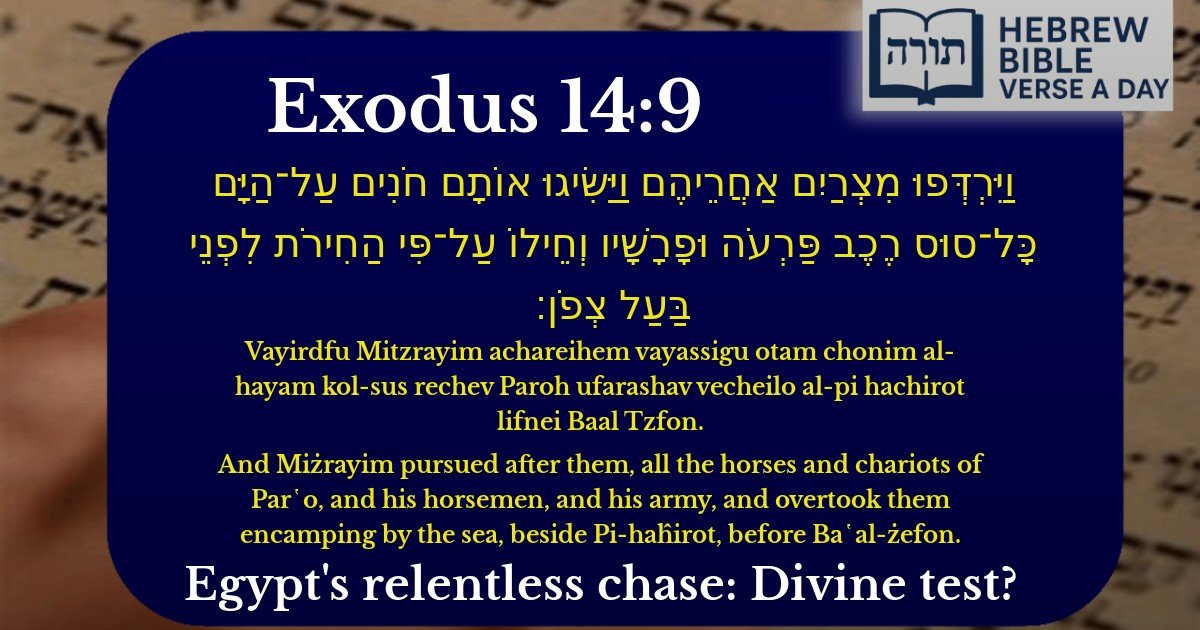

Exodus 14:9 - Egypt's relentless chase: Divine test?

Exodus 14:9 - שמות 14:9

Hebrew Text

וַיִּרְדְּפוּ מִצְרַיִם אַחֲרֵיהֶם וַיַּשִּׂיגוּ אוֹתָם חֹנִים עַל־הַיָּם כָּל־סוּס רֶכֶב פַּרְעֹה וּפָרָשָׁיו וְחֵילוֹ עַל־פִּי הַחִירֹת לִפְנֵי בַּעַל צְפֹן׃

English Translation

And Miżrayim pursued after them, all the horses and chariots of Par῾o, and his horsemen, and his army, and overtook them encamping by the sea, beside Pi-haĥirot, before Ba῾al-żefon.

Transliteration

Vayirdfu Mitzrayim achareihem vayassigu otam chonim al-hayam kol-sus rechev Paroh ufarashav vecheilo al-pi hachirot lifnei Baal Tzfon.

Hebrew Leining Text

וַיִּרְדְּפ֨וּ מִצְרַ֜יִם אַחֲרֵיהֶ֗ם וַיַּשִּׂ֤יגוּ אוֹתָם֙ חֹנִ֣ים עַל־הַיָּ֔ם כׇּל־סוּס֙ רֶ֣כֶב פַּרְעֹ֔ה וּפָרָשָׁ֖יו וְחֵיל֑וֹ עַל־פִּי֙ הַֽחִירֹ֔ת לִפְנֵ֖י בַּ֥עַל צְפֹֽן׃

🎵 Listen to leining

Parasha Commentary

Pursuit of the Egyptians

The verse describes the Egyptians chasing after Bnei Yisrael as they camped by the sea. Rashi (Shemot 14:9) explains that the Egyptians pursued with particular intensity ("וַיִּרְדְּפוּ")—using their finest military forces, including Pharaoh's elite chariots and cavalry. This demonstrates Pharaoh's stubbornness even after the Ten Plagues, as he personally led the chase with his most powerful warriors.

Location: Pi-HaChirot and Ba'al Tzefon

The Midrash (Shemot Rabbah 21:5) notes that the place names hold deeper meaning:

  • Pi-HaChirot ("פִּי הַחִירֹת")—literally "the mouth of freedom"—alludes to the impending liberation of Bnei Yisrael, as they were about to cross the sea to true freedom.
  • Ba'al Tzefon ("בַּעַל צְפֹן")—Rashi explains that this was the only Egyptian idol left standing after the plagues. Hashem deliberately led Bnei Yisrael there to test their faith, showing that even in the presence of idolatry, they would trust in Him.

Divine Strategy

The Rambam (Moreh Nevuchim 3:24) discusses how Hashem orchestrated events to maximize the miracle of Kriyat Yam Suf (the Splitting of the Sea). By allowing the Egyptians to overtake Bnei Yisrael in a seemingly trapped position, the eventual salvation would be even more miraculous. The Ibn Ezra adds that this was a tactical maneuver—forcing Pharaoh to commit his entire army, ensuring their complete downfall.

Military Composition

The verse lists:

  • Horses and chariots—symbolizing Pharaoh's pride (as seen in Yechezkel 29:3, where Egypt is rebuked for claiming "The Nile is mine, and I made myself").
  • Horsemen and army—showing a full mobilization. The Mechilta notes that this was an unusually large force, emphasizing the Egyptians' desperation to recapture their former slaves.

📚 Talmud Citations

This verse is not quoted in the Talmud.

Frequently Asked Questions

Q: Why did the Egyptians chase the Israelites after letting them go?
A: According to Rashi and the Midrash, Pharaoh and the Egyptians regretted letting the Israelites go after seeing them leave with great wealth (as promised in Exodus 12:36). Their greed and stubbornness led them to pursue the Israelites despite the plagues they had endured.
Q: What is the significance of the location 'Pi-haChirot' mentioned in this verse?
A: The name 'Pi-haChirot' (meaning 'mouth of freedom') is interpreted by our Sages as hinting at the paradox of the situation—though the Israelites were physically free, they now faced a new test of faith at this location. The Talmud (Sotah 2a) also connects this place with the concept of marriage (chuppah), symbolizing the bond between Hashem and Israel.
Q: Why does the verse specify 'all the horses and chariots of Pharaoh'?
A: The Torah emphasizes this detail to show the full military might that Pharaoh brought against the Israelites, making the upcoming miracle at the Red Sea even more remarkable. Ramban explains that this demonstrates how no human power could stand against Hashem's will to redeem His people.
Q: What lesson can we learn from the Egyptians pursuing the Israelites?
A: The Midrash teaches that this episode shows the danger of stubbornness and not learning from past mistakes. Despite ten plagues, Pharaoh returned to his wicked ways. For us, it's a reminder to internalize lessons from our experiences and not revert to negative behaviors.
Q: Why is Ba'al Tzefon mentioned specifically as the location?
A: Rashi explains that Ba'al Tzefon was the only Egyptian idol left standing after the plagues. Hashem deliberately led the Israelites there to show that even this remaining 'power' of Egypt was helpless against the Divine will—strengthening the Israelites' faith before the splitting of the sea.