
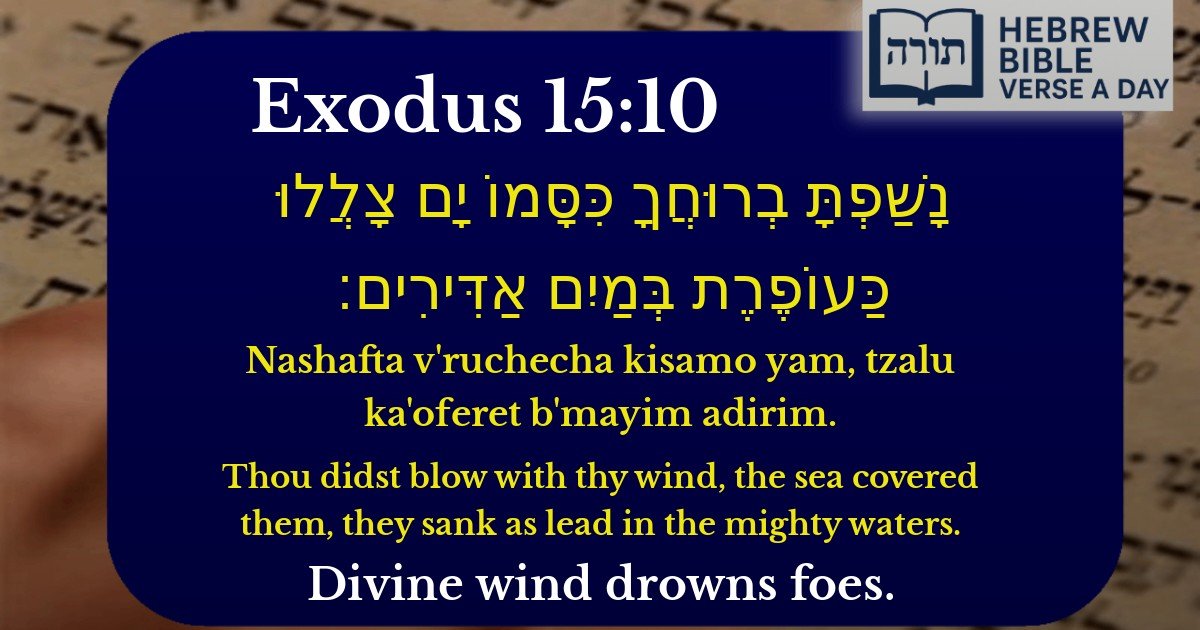

Exodus 15:10 - Divine wind drowns foes.

Exodus 15:10 - שמות 15:10

Hebrew Text

נָשַׁפְתָּ בְרוּחֲךָ כִּסָּמוֹ יָם צָלֲלוּ כַּעוֹפֶרֶת בְּמַיִם אַדִּירִים׃

English Translation

Thou didst blow with thy wind, the sea covered them, they sank as lead in the mighty waters.

Transliteration

Nashafta v'ruchecha kisamo yam, tzalu ka'oferet b'mayim adirim.

Hebrew Leining Text

נָשַׁ֥פְתָּ בְרוּחֲךָ֖ כִּסָּ֣מוֹ יָ֑ם&nbsp

🎵 Listen to leining

Parasha Commentary

Verse Context (Exodus 15:10)

This verse is part of Shirat HaYam (the Song of the Sea), sung by Bnei Yisrael after the miraculous splitting of the Red Sea. It describes Hashem's intervention in drowning the Egyptian army through a powerful wind (ruach), causing them to sink like lead in the mighty waters.

Rashi's Commentary

Rashi (Exodus 15:10) explains that the phrase "נָשַׁפְתָּ בְרוּחֲךָ" ("You blew with Your wind") refers to the east wind (ruach kadim) that Hashem used to divide the sea (Exodus 14:21). The Egyptians sank "כַּעוֹפֶרֶת" ("like lead")—a heavy metal—emphasizing their swift and irreversible descent, as lead sinks immediately without floating.

Ibn Ezra's Insight

Ibn Ezra notes that the comparison to lead highlights the Egyptians' complete helplessness. Just as lead cannot resist sinking, Pharaoh's forces were powerless against Hashem's judgment. The term "מַיִם אַדִּירִים" ("mighty waters") underscores the sea's overwhelming strength when directed by divine will.

Midrashic Interpretation (Mechilta)

  • The Midrash (Mechilta D'Rabbi Yishmael 15:10) teaches that the sea did not merely return to its natural state but actively pursued the Egyptians as an instrument of justice, fulfilling middah k'neged middah (measure for measure)—just as they drowned Israelite infants in the Nile (Exodus 1:22).
  • The "wind" (ruach) also alludes to the Ruach HaKodesh (Divine Spirit) that inspired Moshe and Bnei Yisrael to sing this song (Shemot Rabbah 23:9).

Rambam's Philosophical Perspective

In Moreh Nevuchim (1:24), Rambam interprets the "wind" as a natural force employed by Hashem to execute miracles within the framework of creation. The event demonstrates divine providence (hashgacha pratit), where nature itself serves Hashem's will to deliver justice.

📚 Talmud Citations

This verse is quoted in the Talmud.

📖 Megillah 10b
The verse is referenced in the context of discussing the miracles at the Red Sea, illustrating God's power over nature.
📖 Sotah 36b
The verse is cited in a discussion about the drowning of the Egyptians in the Red Sea, emphasizing the might of God's intervention.

Frequently Asked Questions

Q: What does Exodus 15:10 mean in the context of the Song of the Sea?
A: Exodus 15:10 is part of the 'Shirat HaYam' (Song of the Sea), sung by the Israelites after crossing the Red Sea. It describes how Hashem used a strong wind (רוּחַ) to drown the Egyptian army, causing them to sink like lead in the mighty waters. Rashi explains that this emphasizes the complete and swift destruction of Pharaoh's forces, demonstrating Hashem's absolute power over nature and enemies.
Q: Why is the comparison to lead ('ke-oferet') used in this verse?
A: The Torah compares the drowning Egyptians to lead ('ke-oferet') because lead is a heavy metal that sinks quickly and irreversibly in water. The Midrash (Mechilta) notes that this imagery shows the Egyptians had no chance of survival—just as lead cannot float, they could not escape Hashem's judgment once the sea closed upon them.
Q: How does this verse teach us about gratitude to Hashem?
A: This verse is part of the Israelites' song of thanksgiving after their miraculous salvation. The Rambam (Hilchot Berachot 1:3) teaches that recognizing Hashem's wonders—like the splitting of the sea—obligates us to offer praise. The vivid description of the Egyptians' downfall reminds us to acknowledge and thank Hashem for His ongoing protection in our lives.
Q: What is the significance of the 'mighty waters' (mayim adirim) mentioned in this verse?
A: The term 'mighty waters' (מַיִם אַדִּירִים) highlights the supernatural nature of the miracle. The Talmud (Megillah 10b) explains that the sea ordinarily obeys the laws of nature, but here it acted against its nature at Hashem's command. This teaches that Hashem can alter creation itself to fulfill His will and protect His people.
Q: How do we commemorate this event in Jewish practice today?
A: We recite the 'Shirat HaYam' daily in the morning prayers (Pesukei D'Zimrah) to remember the miracle. The Mechilta teaches that saying this song with joy is akin to experiencing the redemption itself. Additionally, on the seventh day of Passover, we read this passage in the Torah to mark the anniversary of the miracle.