Frequently Asked Questions
Q: What does Exodus 15:13 mean in simple terms?
A: Exodus 15:13 describes how Hashem (G-d) guided the Jewish people with kindness after redeeming them from Egypt, leading them with His strength toward the Holy Land. Rashi explains that this verse is part of the 'Song of the Sea,' sung after the splitting of the Red Sea, expressing gratitude for G-d's ongoing protection and guidance.
Q: Why is Exodus 15:13 important in Jewish tradition?
A: This verse is important because it highlights two key aspects of the Jewish relationship with G-d: His חסד (kindness) in redeeming us and His עוז (strength) in guiding us. The Talmud (Berachot 4b) connects this to daily prayer, reminding us to acknowledge G-d's constant care, just as He did during the Exodus.
Q: What can we learn from Exodus 15:13 today?
A: We learn that just as G-d guided the Jewish people through the wilderness with mercy and strength, He continues to guide us in our lives. The Midrash (Mechilta) teaches that this verse reminds us to trust in G-d's plan, even when the path forward isn't clear, as He ultimately leads us toward holiness.
Q: What does 'holy habitation' refer to in this verse?
A: According to traditional Jewish commentators like Ramban, 'holy habitation' refers to the Land of Israel and ultimately the Beit HaMikdash (Holy Temple). The verse shows that the Exodus wasn't just about leaving Egypt—it was about being brought to a place where we could serve G-d fully, as explained in the Sifrei on Deuteronomy.
Q: How does this verse connect to Shabbat or Jewish holidays?
A: This verse is part of the 'Az Yashir' song recited daily in Jewish prayers and prominently on Shabbat. The Sages (Talmud, Rosh Hashanah 31a) connect it to the future redemption, showing that just as G-d redeemed us from Egypt, He will redeem us again—a theme emphasized during Passover and other holidays.

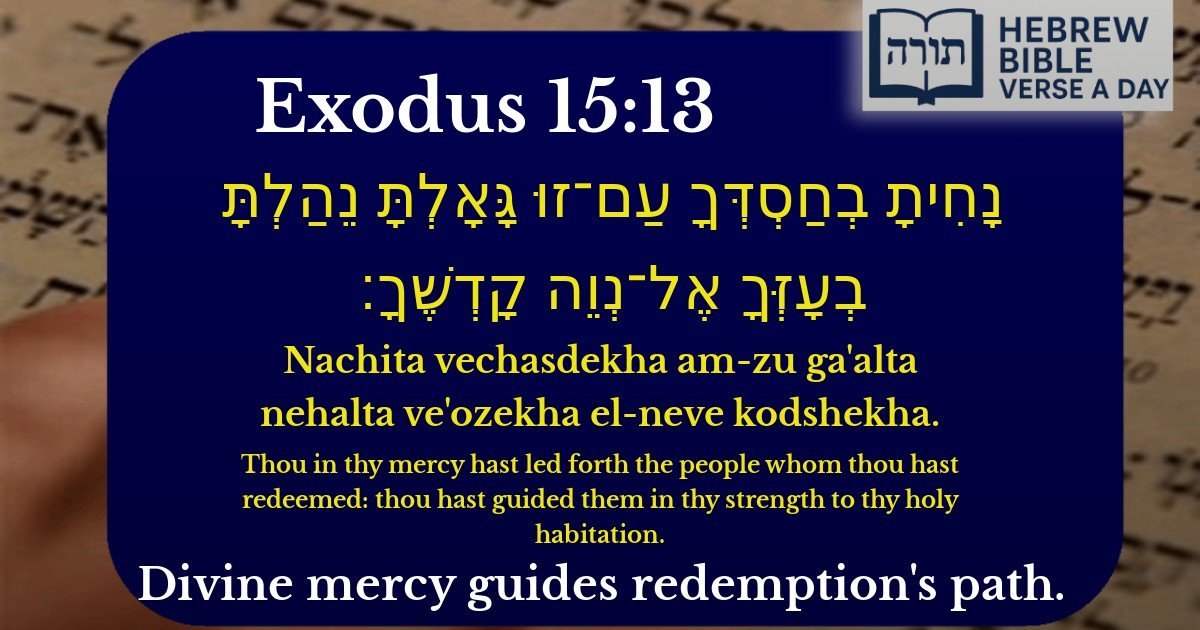

Verse Analysis (Exodus 15:13)
The verse "נָחִיתָ בְחַסְדְּךָ עַם־זוּ גָּאָלְתָּ נֵהַלְתָּ בְעָזְּךָ אֶל־נְוֵה קָדְשֶׁךָ" appears in Shirat HaYam (the Song of the Sea), sung by Bnei Yisrael after the splitting of the Red Sea. It reflects gratitude for Hashem's guidance during the Exodus and toward the future Beit HaMikdash.
Key Themes and Interpretations
Midrashic Insights
The Mechilta (Beshalach 3) teaches that this verse hints at the future redemption, paralleling the Exodus with the ultimate Geulah. The Sforno adds that the "strength" (עָזְּךָ) refers to the miracles that sustained Bnei Yisrael until they reached their spiritual destination.
Practical Lessons