Frequently Asked Questions
Q: What does 'The Lord shall reign for ever and ever' mean in Exodus 15:18?
A: This verse, sung by the Israelites after crossing the Red Sea, declares that Hashem's sovereignty is eternal and unchanging. Rashi explains that this emphasizes that His kingship is not temporary like human rulers, but everlasting. The Talmud (Berachot 12a) connects this to our daily acceptance of Hashem's reign through reciting Shema.
Q: Why is Exodus 15:18 important in Judaism?
A: This verse is the climax of the Song at the Sea (Shirat Hayam), one of the most fundamental texts in Jewish liturgy. The Rambam (Hilchot Kriat Shema 1:4) notes that we recite parts of this song daily to remember Hashem's eternal kingship and the miracle of the Exodus.
Q: How does Exodus 15:18 apply to our lives today?
A: The Midrash (Mechilta Beshalach) teaches that just as our ancestors acknowledged Hashem's eternal kingship after witnessing miracles, we must recognize His constant rule in our daily lives. This verse reminds us that all events - both miraculous and ordinary - are under Hashem's eternal sovereignty.
Q: What's the connection between Exodus 15:18 and Jewish prayer?
A: This verse is incorporated into the Kedusha of the Amidah prayer. The Talmud (Pesachim 117a) explains that we echo the angels' declaration of Hashem's eternal kingship. By reciting this verse in prayer, we reaffirm our acceptance of Hashem's everlasting rule, just as our ancestors did at the Red Sea.
Q: Why does the Torah emphasize that Hashem reigns 'forever and ever'?
A: The Sforno explains that this eternal perspective gives us comfort during difficult times, reminding us that temporary hardships don't negate Hashem's ultimate control. The Malbim adds that this phrase contrasts with Pharaoh's temporary dominion, showing that only Hashem's reign is truly everlasting.


Understanding the Verse
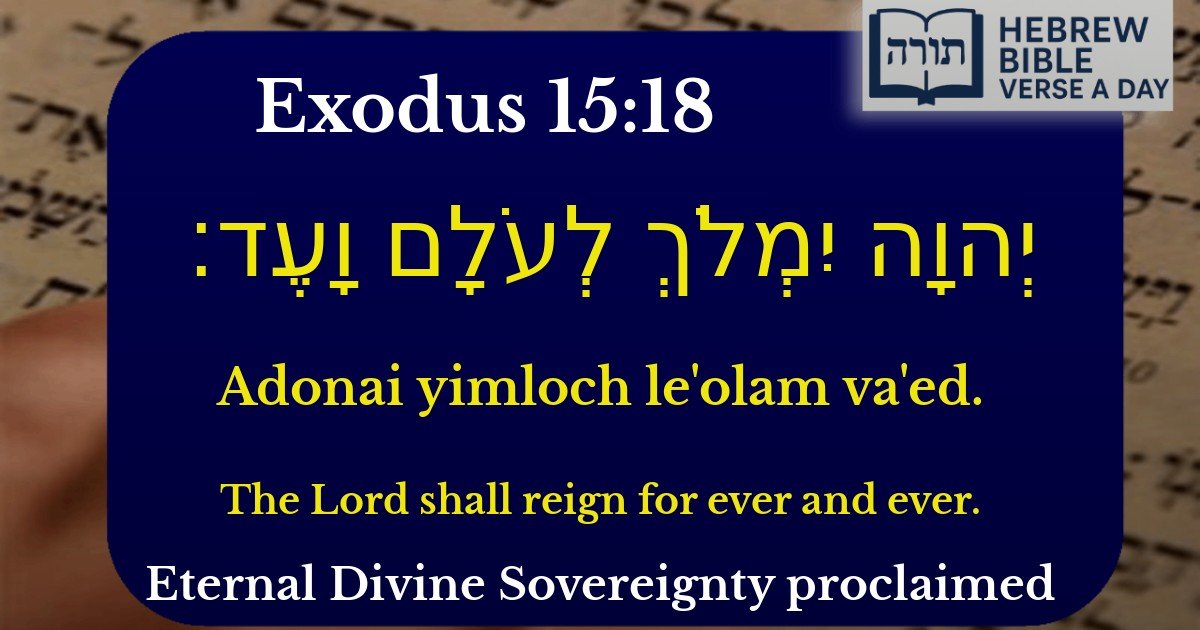
The verse "יְהוָה יִמְלֹךְ לְעֹלָם וָעֶד" ("The Lord shall reign for ever and ever") appears in Shemot (Exodus) 15:18, concluding the Shirat HaYam (Song of the Sea). This declaration emphasizes Hashem's eternal sovereignty, both in the present and in the future.
Rashi's Explanation
Rashi comments that this verse serves as a transition from the past miracles (such as the splitting of the Red Sea) to the eternal reign of Hashem. He explains that while the previous verses describe historical events, this verse affirms that Hashem's kingship is not limited to those moments but extends infinitely.
Rambam's Perspective
In Hilchot Melachim (Laws of Kings), Rambam (Maimonides) discusses the ultimate recognition of Hashem's kingship in the Messianic era. This verse alludes to the future universal acceptance of Hashem's rule, as prophesied by Zechariah (14:9): "וְהָיָה יְהוָה לְמֶלֶךְ עַל־כָּל־הָאָרֶץ" ("Hashem will be King over all the earth").
Midrashic Insights
The Mechilta (a halachic Midrash on Shemot) connects this verse to the idea that Hashem's reign is unchanging, unlike human kings whose rule is temporary. The Midrash emphasizes that even when other nations dominate, Hashem's sovereignty remains absolute.
Kabbalistic Interpretation
The Zohar teaches that this verse reflects the concept of Malchut (Divine Kingship) as an eternal aspect of Hashem's relationship with creation. The phrase "לְעֹלָם וָעֶד" ("for ever and ever") hints at both the revealed (olam) and hidden (ad) dimensions of time, indicating Hashem's dominion over all existence.
Practical Implications