Frequently Asked Questions
Q: What does Exodus 15:4 mean?
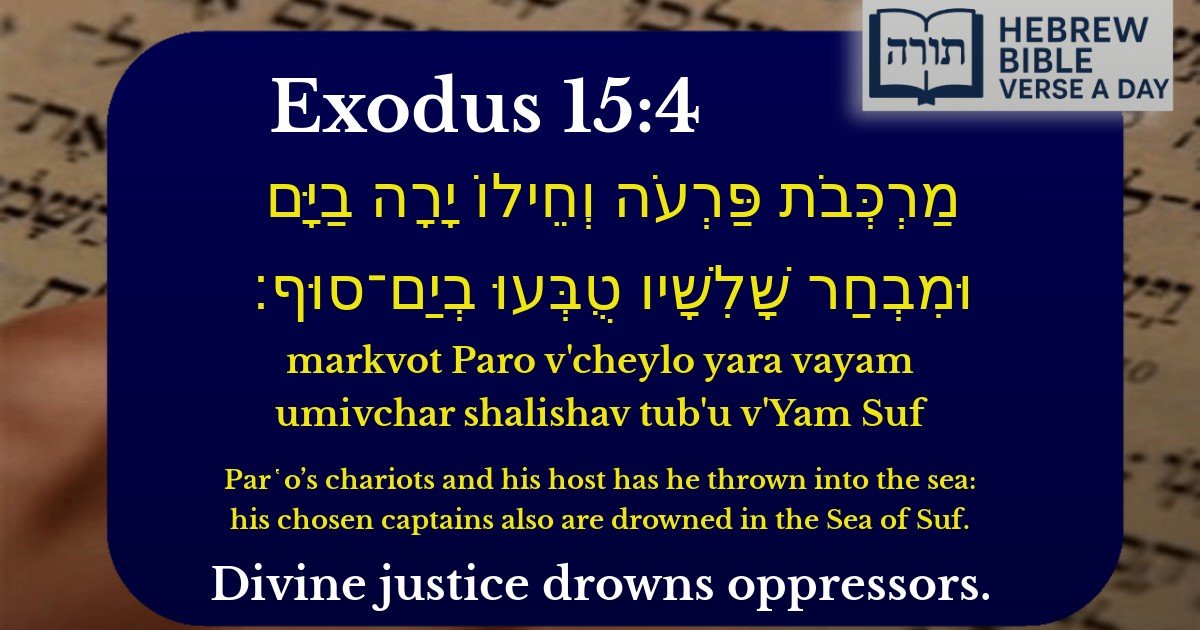
A: Exodus 15:4 describes the miraculous event at the Red Sea (Yam Suf), where Pharaoh's chariots, army, and elite officers drowned after the Israelites crossed safely. According to Rashi, this verse emphasizes Hashem's complete victory over Pharaoh's forces, showing divine justice for their oppression of the Jewish people.
Q: Why is the drowning of Pharaoh's army important in Jewish tradition?
A: The drowning of Pharaoh's army is central to the story of Yetziat Mitzrayim (the Exodus from Egypt). The Midrash (Mechilta) teaches that this event demonstrated Hashem's absolute power and fulfilled the promise to redeem Israel. It is commemorated daily in the 'Az Yashir' song (Exodus 15) recited in prayers.
Q: What lesson can we learn from Exodus 15:4 today?
A: The verse teaches bitachon (trust in Hashem)—even when facing impossible odds, like the Israelites trapped at the sea. The Rambam (Hilchot De'ot) explains that remembering miracles like this strengthens our faith in divine protection and justice in all generations.
Q: Why does the verse specify 'chosen captains' (מִבְחַר שָׁלִשָׁיו)?
A: Rashi notes that 'shalishim' refers to elite warriors (often third-in-command in chariots). Their drowning highlights that even Egypt's mightiest were powerless against Hashem. The Talmud (Sotah 11a) adds that these officers were particularly cruel taskmasters, making their punishment measure-for-measure.
Q: How is the miracle at the Red Sea relevant to modern Jewish practice?
A: The miracle is recalled daily in prayer (e.g., 'Mi Chamocha') and on Shabbat Shirah (when Exodus 15 is read). The Ramban teaches that just as Hashem redeemed us then, we trust in future redemption. Many also have the custom to recite 'Az Yashir' for protection during travel (based on Talmud, Berachot 54b).


Context in the Torah
This verse (Shemot 15:4) is part of Shirat HaYam (the Song of the Sea), sung by Bnei Yisrael after their miraculous deliverance from Pharaoh’s army at the Yam Suf (Red Sea). It describes the destruction of Pharaoh’s military might, emphasizing Hashem’s complete victory over Egypt.
Rashi’s Commentary
Rashi explains that "מַרְכְּבֹת פַּרְעֹה וְחֵילוֹ" refers not only to Pharaoh’s chariots but also to his entire military force. The term "יָרָה בַיָּם" (lit. "cast into the sea") indicates that Hashem hurled them into the depths with great force, as if shooting an arrow (yarah connotes shooting). Rashi further notes that "מִבְחַר שָׁלִשָׁיו" refers to Pharaoh’s elite officers—the "choice of his captains"—who were drowned alongside the rest of his army.
Ibn Ezra’s Insight
Ibn Ezra highlights the precision of the language: the verse specifies that Pharaoh’s chosen officers (mivchar shalishav) were drowned, indicating that even the most skilled and honored warriors could not escape divine judgment. The term shalishim refers to high-ranking officers, often third in command (from shalosh, "three"), underscoring the totality of Egypt’s defeat.
Midrashic Interpretation
The Midrash (Mechilta d’Rabbi Yishmael) elaborates that Pharaoh’s chariots were uniquely adorned with silver and gold, symbolizing Egypt’s arrogance. Their drowning demonstrates that no earthly power can resist Hashem’s decree. Additionally, the phrase "טֻבְּעוּ בְיַם־סוּף" ("drowned in the Sea of Suf") is interpreted as a measure-for-measure punishment: just as Pharaoh drowned Hebrew infants in the Nile, his own forces were drowned in the sea.
Rambam’s Philosophical Perspective
Rambam (Moreh Nevuchim 1:64) notes that this event was a public miracle (nes nigleh), designed to instill eternal faith in Hashem’s providence. The destruction of Egypt’s elite forces—described here in vivid detail—served as proof of divine intervention in history, reinforcing the covenant between Hashem and Israel.
Key Themes