Frequently Asked Questions
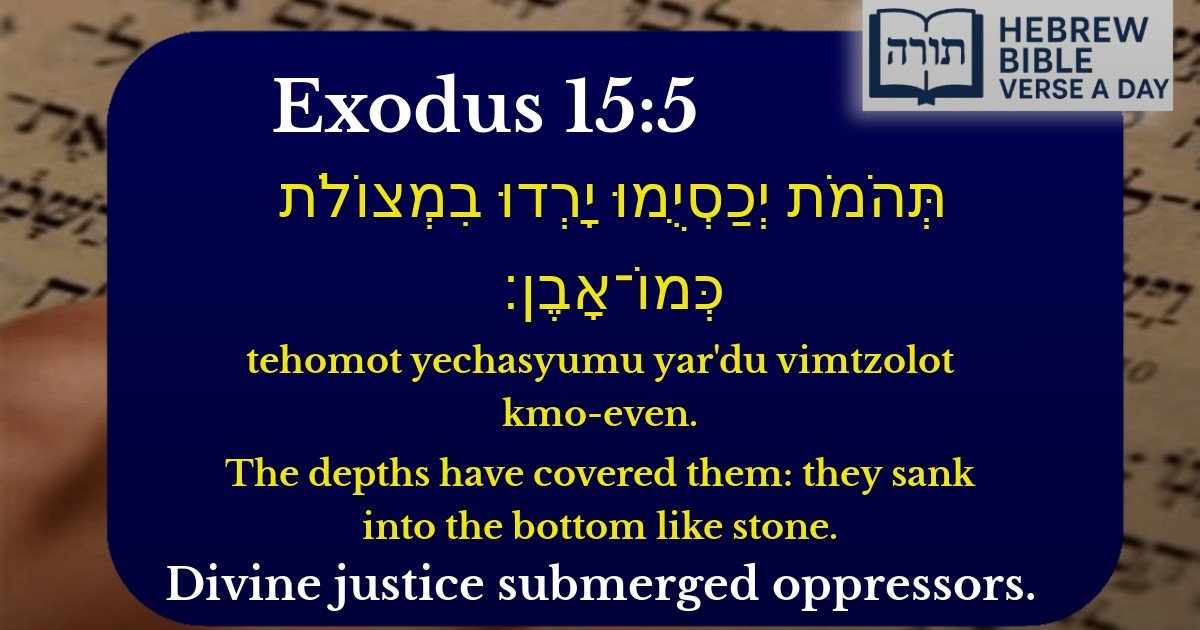
Q: What does Exodus 15:5 mean when it says 'they sank into the bottom like stone'?
A: This verse describes how the Egyptians drowned in the Red Sea during the Exodus. The comparison to a stone (כְּמוֹ־אָבֶן) emphasizes how quickly and decisively they sank, with no chance of floating or survival. Rashi explains that this was a miraculous punishment measure-for-measure, as the Egyptians had drowned Jewish babies in the Nile (Shemot Rabbah 21:5).
Q: Why is Exodus 15:5 important in Jewish tradition?
A: This verse is part of the 'Song of the Sea' (Shirat Hayam) which is recited daily in Jewish prayers. It commemorates one of the greatest miracles in Jewish history - the splitting of the Red Sea. The Talmud (Sotah 36b) teaches that even a maidservant at the sea perceived greater divine revelations than the prophet Yechezkel later did.
Q: What lesson can we learn from Exodus 15:5 today?
A: The verse teaches about divine justice - that those who oppress others will ultimately face consequences. The Mechilta notes that the Egyptians sank specifically 'like stone' (rather than something that might float) to show that their punishment was complete and irreversible. This reminds us that while justice may seem delayed, it is ultimately precise.
Q: How does Exodus 15:5 relate to the rest of the Song of the Sea?
A: This verse is part of a sequence describing the Egyptians' downfall. The Midrash (Mechilta Beshalach 6) explains that the Torah uses multiple terms ('depths,' 'bottom') to show they were punished through different aspects of water - some sank in deep waters, others in shallow, demonstrating comprehensive divine retribution.
Q: Why does the Torah compare the drowning Egyptians to a stone?
A: Rashi explains the stone metaphor serves two purposes: (1) A stone sinks immediately without resistance, showing how quickly the Egyptians were destroyed, and (2) Just as a stone doesn't decompose in water, the Egyptians' bodies remained intact so the Israelites could see their enemies' defeat (Shemot 15:12). This reinforced the miracle's impact.


Context in the Torah
This verse (Exodus 15:5) appears in Shirat HaYam (the Song of the Sea), sung by Bnei Yisrael after the miraculous splitting of the Red Sea and the drowning of Pharaoh's army. It poetically describes the fate of the Egyptians as they were submerged in the waters.
Rashi's Commentary
Rashi explains that the phrase "תְּהֹמֹת יְכַסְיֻמוּ" ("the depths have covered them") emphasizes that the Egyptians were not merely drowned, but entirely engulfed by the depths, leaving no trace. He further notes that "כְּמוֹ־אָבֶן" ("like a stone") implies they sank swiftly and decisively, as a stone does not float but immediately descends to the bottom.
Ibn Ezra's Insight
Ibn Ezra highlights the contrast between the Egyptians and Bnei Yisrael. While the Egyptians sank like a stone, the Jewish people were described earlier (Exodus 15:1) as having passed through the sea on dry land. This juxtaposition underscores the divine justice in their respective fates.
Midrashic Interpretation
The Midrash (Mechilta d'Rabbi Yishmael) elaborates that the Egyptians' descent was not only physical but also spiritual—like a stone, they were devoid of any merit that might have allowed them to float or be spared. Additionally, the Midrash compares their sinking to the fate of the wicked in the afterlife, who descend without hope of rising.
Rambam's Philosophical Perspective
Rambam (Maimonides) in Moreh Nevuchim (Guide for the Perplexed) interprets this verse as a lesson in divine retribution. The Egyptians' punishment was measure-for-measure: just as they sought to drown Jewish infants in the Nile (Exodus 1:22), they themselves drowned in the sea.
Symbolism in the Verse