Frequently Asked Questions
Q: What does Exodus 15:7 mean in the context of the Song of the Sea?
A: Exodus 15:7 is part of the 'Shirat HaYam' (Song of the Sea), sung by the Israelites after crossing the Red Sea. It describes how Hashem, in His supreme power ('gevurah'), destroyed the Egyptians who pursued them. Rashi explains that 'the greatness of Your excellency' refers to Hashem's unmatched strength, and 'consumed them as stubble' illustrates how quickly and completely the Egyptians were defeated, like dry straw burning up.
Q: Why is the comparison to 'stubble' (kash) used in this verse?
A: The metaphor of stubble (dry straw) emphasizes how swiftly and utterly Hashem defeated the Egyptians. The Midrash (Mechilta) notes that just as stubble burns easily and completely, the Egyptians were powerless against Hashem's judgment. Rambam also teaches that this imagery reminds us of divine justice—evil may seem strong, but it can be obliterated instantly by Hashem's will.
Q: How does this verse teach us about gratitude?
A: This verse is part of the Song of the Sea, a song of thanksgiving sung by the Israelites after their miraculous salvation. The Talmud (Sotah 30b) states that even the simplest among them experienced divine inspiration to sing this praise. It teaches us to recognize and thank Hashem for His interventions in our lives, especially when He protects us from adversaries.
Q: What lesson can we learn from Exodus 15:7 today?
A: The verse reminds us that no enemy, no matter how powerful, can stand against Hashem’s will. The Chofetz Chaim teaches that just as Hashem saved the Israelites from Pharaoh, He continues to protect the Jewish people from threats in every generation. Trusting in Hashem’s justice and power is a timeless lesson from this verse.
Q: Why does the verse mention Hashem's 'anger' (charoncha)?
A: The term 'charoncha' (Your anger) refers to Hashem's strict judgment against the Egyptians for their cruelty. Rashi explains that this anger was measured precisely—the Egyptians drowned only after the Israelites were safely on shore. The Talmud (Megillah 10b) notes that even in judgment, Hashem’s mercy is present, as He delayed punishment until the righteous were secure.


Context in the Song of the Sea
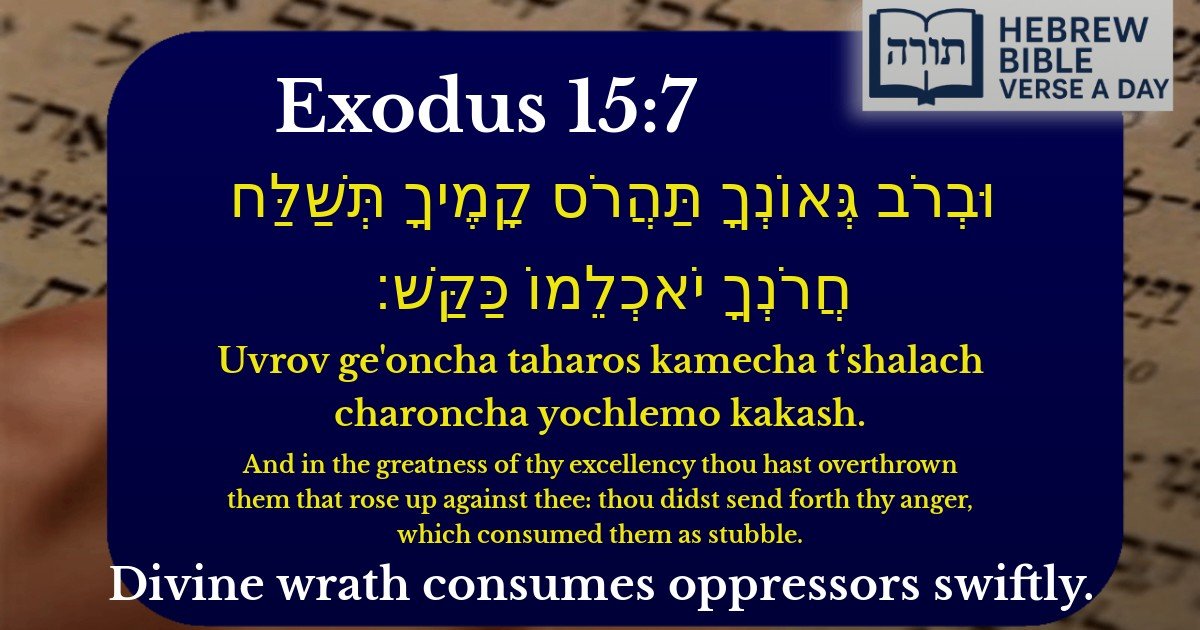
This verse (Exodus 15:7) appears in Shirat HaYam, the Song of the Sea, sung by Bnei Yisrael after their miraculous deliverance at the Red Sea. The verse describes Hashem's overwhelming power in defeating the Egyptians who pursued them.
Rashi's Explanation
Rashi interprets "וּבְרֹב גְּאוֹנְךָ" (in the greatness of Your excellency) as referring to Hashem's attribute of Gevurah (might), which was displayed when He drowned the Egyptians. He explains "תַּהֲרֹס קָמֶיךָ" (You overthrew those who rose against You) as referring to Pharaoh and his army, who arrogantly opposed Hashem's will.
Ibn Ezra on Divine Anger
Ibn Ezra notes that "תְּשַׁלַּח חֲרֹנְךָ" (You sent forth Your anger) uses the metaphor of fire, as anger is often compared to fire in Tanach. The phrase "יֹאכְלֵמוֹ כַּקַּשׁ" (consumed them as stubble) emphasizes how quickly and completely the Egyptians were destroyed, like dry straw in a blaze.
Midrashic Interpretation
The Mechilta teaches that this verse demonstrates how Hashem fights for Israel in ways beyond nature. The Egyptians, who saw themselves as mighty (גְּאוֹנְךָ can also mean "pride"), were humbled by Hashem's true might. The comparison to stubble (קַשׁ) appears elsewhere in Tanach (e.g., Isaiah 5:24) to describe the fleeting nature of those who oppose Hashem.
Rambam on Divine Justice
In Moreh Nevuchim (3:53), Rambam explains that such descriptions of divine anger are anthropomorphic language to help humans understand Hashem's perfect justice. The Egyptians' punishment was measure-for-measure for their cruelty to Bnei Yisrael.
Kabbalistic Insight
The Zohar (Beshalach 56a) connects this verse to the concept of Din (strict judgment) being unleashed against the Egyptians. The "anger" represents the removal of divine mercy, allowing strict justice to prevail against oppressors.