

Join Our Newsletter To Be Informed When New Videos Are Posted
Hebrew Text
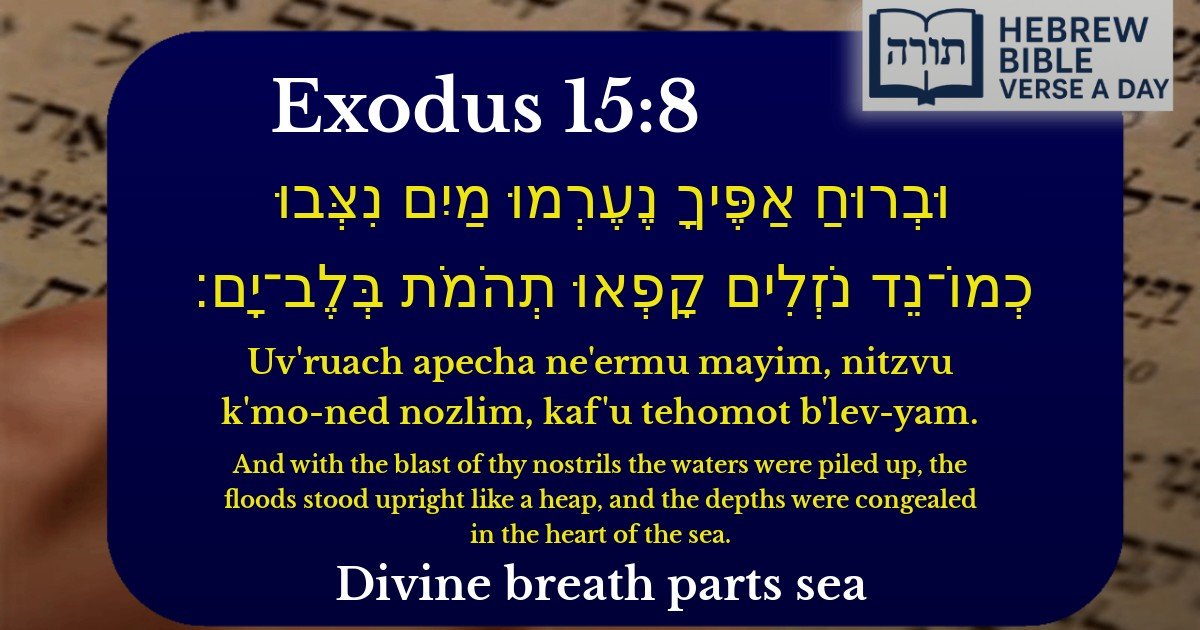
וּבְרוּחַ אַפֶּיךָ נֶעֶרְמוּ מַיִם נִצְּבוּ כְמוֹ־נֵד נֹזְלִים קָפְאוּ תְהֹמֹת בְּלֶב־יָם׃
English Translation
And with the blast of thy nostrils the waters were piled up, the floods stood upright like a heap, and the depths were congealed in the heart of the sea.
Transliteration
Uv'ruach apecha ne'ermu mayim, nitzvu k'mo-ned nozlim, kaf'u tehomot b'lev-yam.
Hebrew Leining Text
וּבְר֤וּחַ אַפֶּ֙יךָ֙ נֶ֣עֶרְמוּ מַ֔יִם 
🎵 Listen to leining
Parasha Commentary
📚 Talmud Citations
This verse is quoted in the Talmud.
📖 Megillah 10b
The verse is referenced in the context of discussing the miracles performed at the Red Sea, emphasizing God's power over nature.
📖 Sotah 36b
The verse is cited in a discussion about the splitting of the Red Sea, illustrating the miraculous nature of the event.
Rashi's Explanation
Rashi (Exodus 15:8) explains that the phrase "וּבְרוּחַ אַפֶּיךָ" ("with the blast of thy nostrils") refers to the strong wind that Hashem used to split the sea. He notes that this wind was not an ordinary natural phenomenon but a miraculous intervention, as the waters stood upright like a solid wall ("נִצְּבוּ כְמוֹ־נֵד"). Rashi emphasizes that the freezing of the depths ("קָפְאוּ תְהֹמֹת") demonstrates Hashem's complete control over nature, turning the sea into a solid mass to allow Bnei Yisrael to cross safely.
Ibn Ezra's Perspective
Ibn Ezra (Exodus 15:8) focuses on the poetic imagery of the verse, interpreting "נֶעֶרְמוּ מַיִם" ("the waters were piled up") as a description of the sea’s division into towering walls. He compares this to a heap ("נֵד"), suggesting an unnatural, miraculous formation. Ibn Ezra also highlights that the congealing of the depths ("קָפְאוּ תְהֹמֹת") signifies the suspension of natural laws, reinforcing the idea that Yetziat Mitzrayim (the Exodus) was entirely orchestrated by divine will.
Midrashic Interpretation
The Midrash (Shemot Rabbah 21:6) elaborates on the phrase "בְּלֶב־יָם" ("in the heart of the sea"), teaching that the sea split into twelve distinct paths, one for each tribe of Israel. The Midrash also describes how the waters solidified like glass, allowing Bnei Yisrael to see the wonders within the sea, including precious stones and marine life, as a display of Hashem’s glory.
Rambam's Philosophical Insight
Rambam (Moreh Nevuchim 2:29) discusses this verse in the context of divine providence. He explains that the splitting of the sea was not merely a physical miracle but a manifestation of Hashem’s direct involvement in guiding and protecting His people. The unnatural behavior of the waters ("נִצְּבוּ כְמוֹ־נֵד") serves as proof of divine intervention beyond the laws of nature.
Key Themes in Orthodox Jewish Thought