
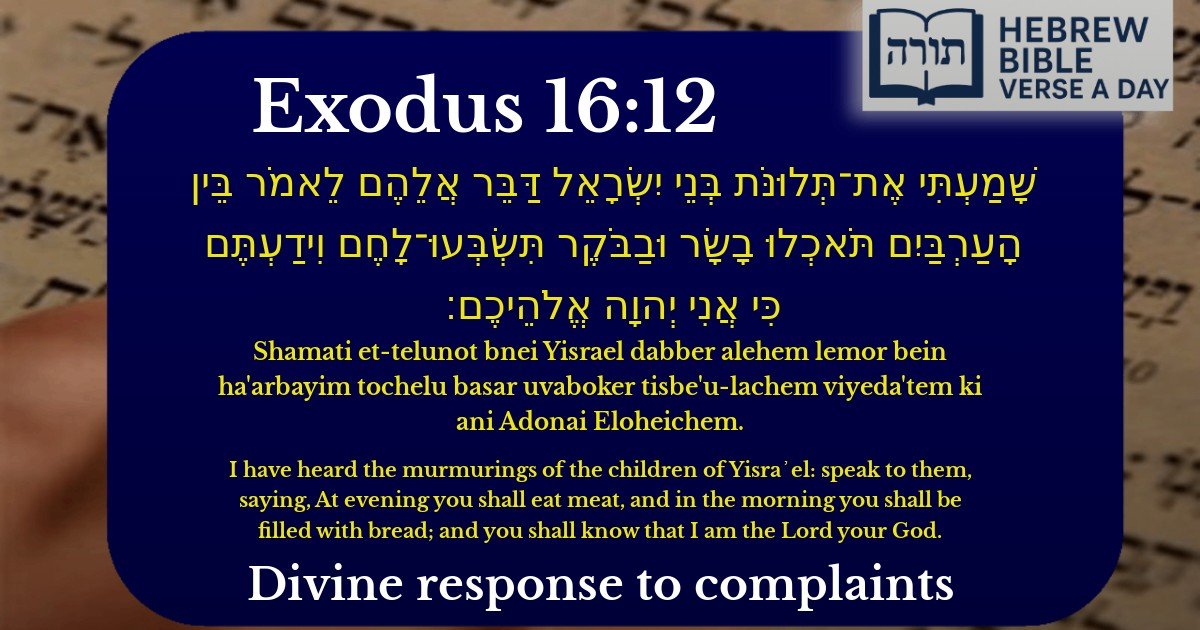

Exodus 16:12 - Divine response to complaints

Exodus 16:12 - שמות 16:12

Hebrew Text

שָׁמַעְתִּי אֶת־תְּלוּנֹּת בְּנֵי יִשְׂרָאֵל דַּבֵּר אֲלֵהֶם לֵאמֹר בֵּין הָעַרְבַּיִם תֹּאכְלוּ בָשָׂר וּבַבֹּקֶר תִּשְׂבְּעוּ־לָחֶם וִידַעְתֶּם כִּי אֲנִי יְהוָה אֱלֹהֵיכֶם׃

English Translation

I have heard the murmurings of the children of Yisra᾽el: speak to them, saying, At evening you shall eat meat, and in the morning you shall be filled with bread; and you shall know that I am the Lord your God.

Transliteration

Shamati et-telunot bnei Yisrael dabber alehem lemor bein ha'arbayim tochelu basar uvaboker tisbe'u-lachem viyeda'tem ki ani Adonai Eloheichem.

Hebrew Leining Text

שָׁמַ֗עְתִּי אֶת־תְּלוּנֹּת֮ בְּנֵ֣י יִשְׂרָאֵל֒ דַּבֵּ֨ר אֲלֵהֶ֜ם לֵאמֹ֗ר בֵּ֤ין הָֽעַרְבַּ֙יִם֙ תֹּאכְל֣וּ בָשָׂ֔ר וּבַבֹּ֖קֶר תִּשְׂבְּעוּ־לָ֑חֶם וִֽידַעְתֶּ֕ם כִּ֛י אֲנִ֥י יְהֹוָ֖ה אֱלֹהֵיכֶֽם׃

🎵 Listen to leining

Parasha Commentary

Context in Shemot (Exodus) 16:12

This verse appears during the Israelites' journey in the wilderness after leaving Egypt, where they complained about the lack of food. Hashem responds to their murmuring by promising to provide meat (slav) in the evening and manna in the morning.

Rashi's Explanation

Rashi (Rabbi Shlomo Yitzchaki) comments that the phrase "בין הערביים" (between the evenings) refers to the time when the sun begins to set, indicating the time for the quail (slav) to arrive. He also notes that the phrase "תשבעו־לחם" (you shall be filled with bread) refers to the manna, which would sustain them fully.

Rambam's Perspective

Rambam (Maimonides) in Moreh Nevuchim (Guide for the Perplexed) explains that the miracles of the manna and quail were designed to instill faith in Hashem's providence. The regularity of these miracles—meat in the evening and bread in the morning—taught the Israelites to rely on divine sustenance.

Midrashic Insights

  • Mechilta: The Midrash emphasizes that the quail (slav) was given in the evening as a temporary indulgence, while the manna in the morning was the primary sustenance, teaching discipline and gratitude.
  • Midrash Tanchuma: Highlights that the phrase "וידעתם כי אני ה' אלוקיכם" (and you shall know that I am the Lord your God) was meant to reinforce their recognition of Hashem's constant care and sovereignty.

Halachic Implications

The Talmud (Yoma 75b) discusses how the manna was given in exact measure to teach the principle of "המשתדל בפרנסתו" (one who strives for his livelihood), showing that sustenance comes from Hashem but requires human effort (collecting the manna daily).

Spiritual Lessons

  • Bitachon (Trust in Hashem): The verse teaches that even in times of uncertainty, Hashem provides for His people.
  • Gratitude: The daily provision of manna and quail required the Israelites to acknowledge and thank Hashem continually.
  • Discipline: The structure of receiving food at set times instilled order and faith in divine timing.

📚 Talmud Citations

This verse is quoted in the Talmud.

📖 Yoma 75a
The verse is discussed in the context of the manna and quails provided to the Israelites in the wilderness, illustrating God's providence.
📖 Sanhedrin 56b
The verse is referenced in a discussion about the commandments given to the Israelites and the recognition of God's sovereignty.

Frequently Asked Questions

Q: What does Exodus 16:12 mean?
A: Exodus 16:12 is part of the story where Hashem responds to the complaints of the Israelites in the desert by promising to provide them with meat (quail) in the evening and manna (bread) in the morning. This was to show His care for them and to strengthen their faith that He is their God. Rashi explains that the 'murmurings' refer to their complaints about lack of food, and Hashem answered with kindness by providing for their needs.
Q: Why is the timing of meat in the evening and bread in the morning significant?
A: The timing shows Hashem's precision in meeting their needs. The meat (quail) came in the evening when they craved something substantial, while the manna (bread) appeared in the morning as a daily sustenance. The Talmud (Yoma 75b) teaches that this arrangement demonstrated divine providence—Hashem provided what they needed exactly when they needed it, reinforcing trust in Him.
Q: What lesson can we learn from Exodus 16:12 today?
A: This verse teaches us about bitachon (trust in Hashem). Just as He provided for the Israelites in the desert, we must believe that He sustains us in all circumstances. The Rambam (Hilchot De'ot 3:11) emphasizes gratitude—recognizing that everything we have comes from Hashem, just as the manna and quail were direct gifts from Him.
Q: How does this verse show Hashem's relationship with the Jewish people?
A: The verse highlights Hashem's attentiveness to His people. Despite their complaints, He responded with kindness, proving that He listens and provides. The Midrash (Shemot Rabbah 25:6) explains that the phrase 'you shall know that I am the Lord your God' means these miracles were meant to deepen their faith and bond with Him.
Q: Why did Hashem provide both meat and bread?
A: The combination of meat (quail) and bread (manna) showed Hashem's complete care—meat for immediate satisfaction and manna as a steady, miraculous food source. Rashi notes that the quail was a one-time gift in response to their craving, while the manna was a daily miracle to teach them reliance on Hashem (Exodus 16:4).