

Join Our Newsletter To Be Informed When New Videos Are Posted
Hebrew Text
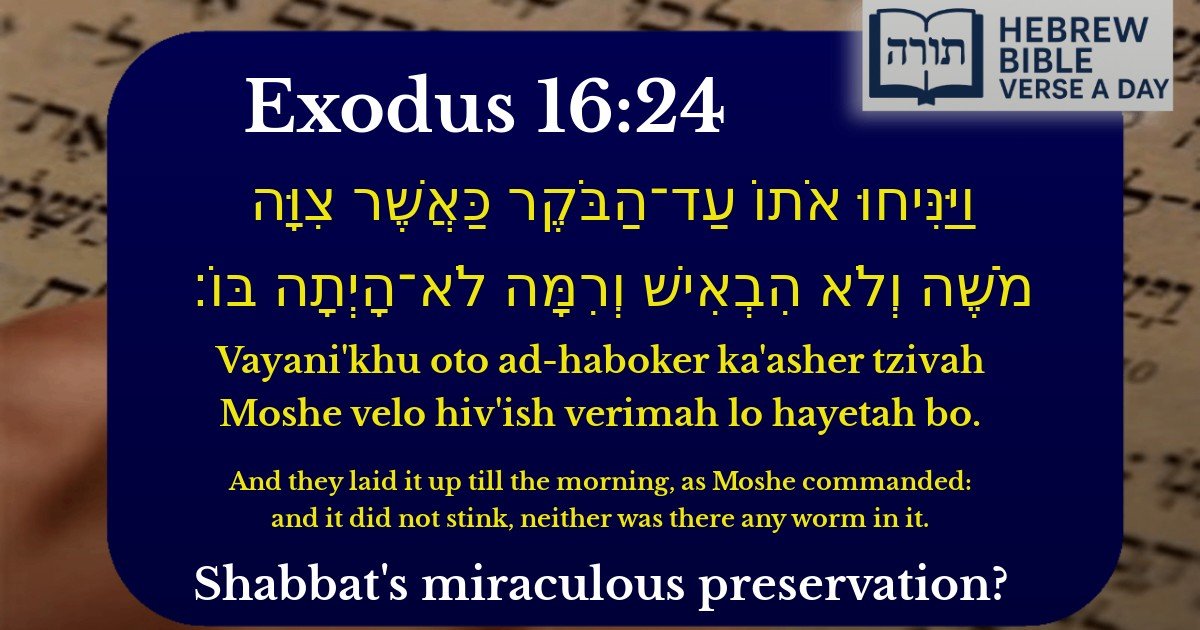
וַיַּנִּיחוּ אֹתוֹ עַד־הַבֹּקֶר כַּאֲשֶׁר צִוָּה מֹשֶׁה וְלֹא הִבְאִישׁ וְרִמָּה לֹא־הָיְתָה בּוֹ׃
English Translation
And they laid it up till the morning, as Moshe commanded: and it did not stink, neither was there any worm in it.
Transliteration
Vayani'khu oto ad-haboker ka'asher tzivah Moshe velo hiv'ish verimah lo hayetah bo.
Hebrew Leining Text
וַיַּנִּ֤יחוּ אֹתוֹ֙ עַד־הַבֹּ֔קֶר כַּאֲשֶׁ֖ר צִוָּ֣ה מֹשֶׁ֑ה וְלֹ֣א הִבְאִ֔ישׁ וְרִמָּ֖ה לֹא־הָ֥יְתָה בּֽוֹ׃
🎵 Listen to leining
Parasha Commentary
📚 Talmud Citations
This verse is quoted in the Talmud.
📖 Yoma 75a
The verse is cited in a discussion about the miracle of the manna, emphasizing how it remained fresh overnight as a sign of divine providence.
📖 Chullin 89a
Referenced in a broader discussion about the nature of miracles and divine commandments, illustrating the obedience of the Israelites to Moses' instructions.
Context of the Verse
The verse (Shemot 16:24) describes the miraculous preservation of the מן (manna) that Bnei Yisrael collected on Friday in preparation for Shabbat. Unlike other days, when leftover manna would spoil, the portion set aside for Shabbat remained fresh, fulfilling Moshe's command.
Rashi's Commentary
Rashi explains that this miracle demonstrated the sanctity of Shabbat. The manna did not rot or produce worms—a clear sign of divine intervention, as natural decay was suspended in honor of the day. Rashi also notes that this was a test of faith, ensuring Bnei Yisrael would trust in Hashem's commandments even when they defied natural expectations.
Rambam's Perspective
In Moreh Nevuchim (3:50), Rambam discusses how this miracle reinforced the principle of bitachon (trust in Hashem). The suspension of natural law served as a tangible reminder that Shabbat observance is rooted in divine decree, not human logic.
Midrashic Insights
Halachic Implications
The Mishnah Berurah (Orach Chaim 242:1) cites this verse to emphasize preparing for Shabbat in advance, as Bnei Yisrael did with the manna. The miracle underscores the importance of hachana l'Shabbat (preparation for Shabbat) as a foundational halachic principle.