Frequently Asked Questions
Q: Who was Amalek and why did Yehoshua fight them?
A: Amalek was a nation that attacked the Jewish people shortly after they left Egypt. The Torah describes them as attacking the weak and tired Israelites from behind (Deuteronomy 25:17-18). Yehoshua fought them because Moshe commanded him to defend the Jewish people, as Amalek represented cruelty and a denial of God's presence in the world (Rashi on Exodus 17:8).
Q: Why did Moshe, Aharon, and Hur go up the hill during the battle?
A: Moshe went up the hill to pray for the Jewish people's success in battle. When Moshe raised his hands, the Israelites prevailed, showing that their victory depended on divine assistance (Exodus 17:11). Aharon and Hur accompanied him to support him physically when he grew tired (Rashi on Exodus 17:12). This teaches us the power of prayer and communal support.
Q: What is the significance of this battle in Jewish tradition?
A: This battle established Amalek as the eternal enemy of the Jewish people. The Torah commands us to remember what Amalek did and to erase their memory (Deuteronomy 25:17-19). Jewish tradition sees Amalek as representing pure evil and the opposite of holiness. The battle teaches that we must actively oppose evil in the world (Rambam, Mishneh Torah, Laws of Kings 5:1).
Q: Why is Yehoshua specifically mentioned as leading the battle?
A: Yehoshua is mentioned because he would later become Moshe's successor. This was his first major leadership role, showing his qualifications to eventually lead the Jewish people into Israel (Rashi on Exodus 17:9). The Sages learn from here that leaders must be tested before assuming greater responsibilities (Midrash Tanchuma, Yitro 11).
Q: How does this story apply to our lives today?
A: This story teaches several important lessons: 1) We must stand up against evil (represented by Amalek), 2) Prayer and faith in God are essential during challenges, 3) Leaders need support (like Aharon and Hur supported Moshe), and 4) We must remember historical lessons about morality and survival (Talmud, Megillah 18a on the commandment to remember Amalek).

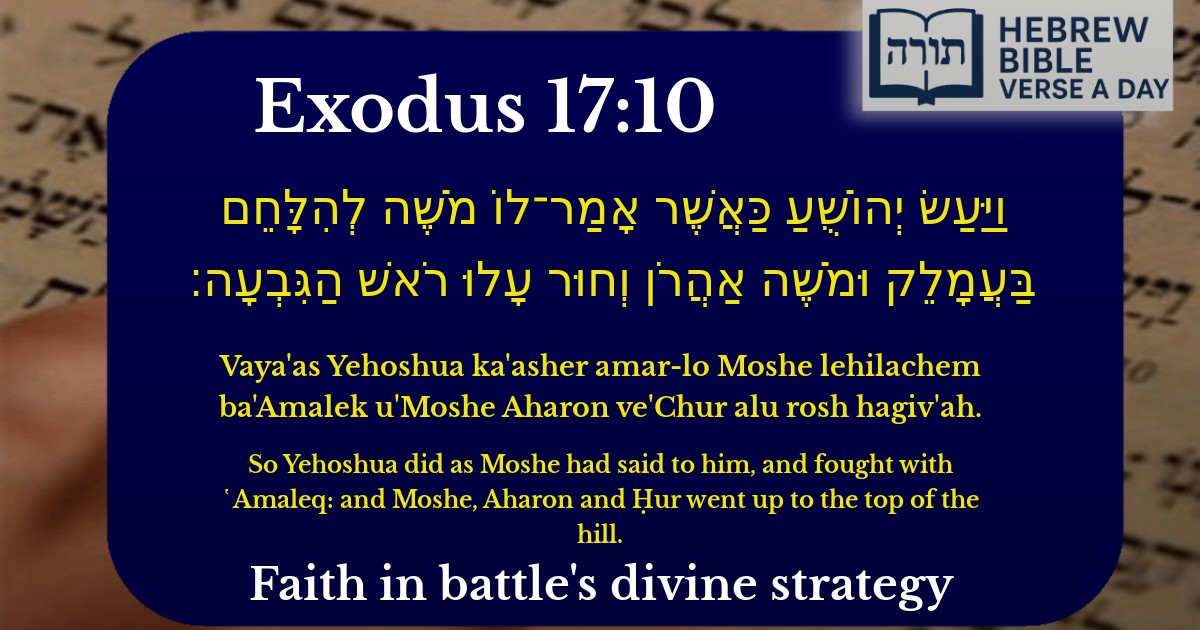

Yehoshua's Obedience to Moshe's Command
The verse states that Yehoshua did exactly as Moshe instructed him in battling Amaleq. Rashi (Shemot 17:10) emphasizes Yehoshua's complete fidelity to Moshe's directive, highlighting his role as a faithful disciple who carried out his Rebbe's instructions without deviation. This sets a precedent for the importance of following Torah leadership with precision.
The Battle Against Amaleq
The Midrash Tanchuma (Ki Teitzei 9) explains that Amaleq attacked Bnei Yisrael when they were spiritually vulnerable, exploiting their doubts ("הֲיֵשׁ ה' בְּקִרְבֵּנוּ אִם־אַיִן" - Shemot 17:7). The battle was not merely physical but represented the eternal struggle against those who seek to undermine emunah. Rambam (Hilchot Melachim 5:1) later codifies the ongoing mitzvah to eradicate Amaleq's memory as a spiritual imperative.
Moshe, Aharon, and Hur on the Hill
The ascent of Moshe, Aharon, and Hur to the hilltop carries deep symbolism:
The Significance of the Location
Ibn Ezra (Shemot 17:10) suggests the "rosh hagiv'ah" (hilltop) was chosen for its visibility, allowing the entire nation to witness Moshe's prayerful stance. The Kli Yakar adds that the elevation represents the need to rise above physicality during spiritual battles, as victory ultimately depends on heavenly mercy.
Historical Continuity
The Sforno connects this episode to Yehoshua's future leadership role, showing how his obedience here prepared him to succeed Moshe. This establishes the Torah principle that proper submission to current leadership qualifies one for future leadership positions (Avot 4:1).