

Join Our Newsletter To Be Informed When New Videos Are Posted
Hebrew Text
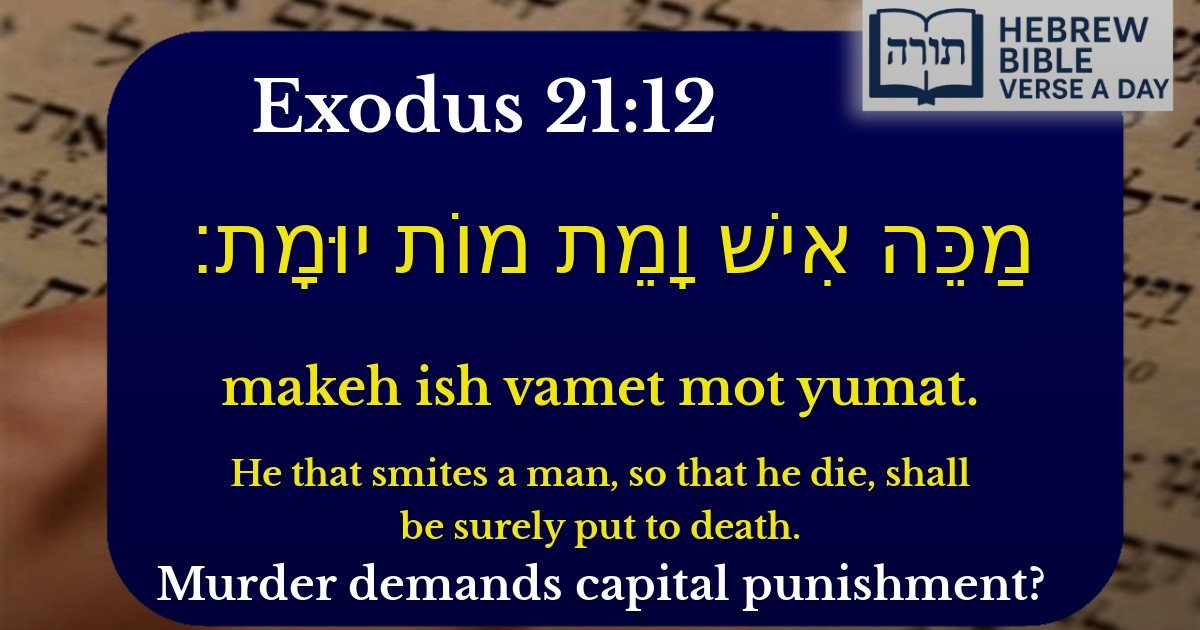
מַכֵּה אִישׁ וָמֵת מוֹת יוּמָת׃
English Translation
He that smites a man, so that he die, shall be surely put to death.
Transliteration
Makeh ish vamet mot yumat.
Hebrew Leining Text
מַכֵּ֥ה אִ֛ישׁ וָמֵ֖ת מ֥וֹת יוּמָֽת׃
🎵 Listen to leining
Parasha Commentary
📚 Talmud Citations
This verse is quoted in the Talmud.
📖 Sanhedrin 52b
The verse is cited in the context of discussing the laws of capital punishment, specifically the conditions under which one is liable for the death penalty for killing another person.
📖 Makkot 7a
The verse is referenced in a discussion about the severity of murder and the legal consequences as prescribed by the Torah.
Source and Context
The verse "מַכֵּה אִישׁ וָמֵת מוֹת יוּמָת" (Shemot 21:12) appears in Parashat Mishpatim, which outlines civil and criminal laws following the revelation at Har Sinai. This verse establishes the fundamental principle of capital punishment for intentional murder in Jewish law.
Literal Interpretation (Peshat)
Rashi explains the straightforward meaning: "One who strikes another with lethal intent, resulting in death, is subject to the death penalty." The Torah uses the term "מוֹת יוּמָת" (literally "death, he shall be put to death") to emphasize the severity of the crime and the inevitability of punishment.
Legal Requirements (Halachah)
The Rambam (Hilchot Rotzeach 1:1-4) elaborates on the conditions for implementing this law:
Philosophical Dimensions
The Sefer HaChinuch (Mitzvah 34) explains that this law teaches the infinite value of human life, created בצלם אלקים (in God's image). Taking a life unjustly violates the divine sanctity imbued in every person.
Restrictive Application
The Talmud (Makkot 7a) notes that a Sanhedrin that executed one person in seven years was called "destructive." This reflects the Torah's preference for preserving life and the high threshold for capital punishment in practice.
Comparative Analysis
Ibn Ezra contrasts this law with accidental killing (discussed in the next verse), highlighting the Torah's distinction between premeditated murder (רצח) and manslaughter (שגגה), with radically different legal consequences.