Frequently Asked Questions
Q: What does Exodus 21:14 mean?
A: Exodus 21:14 teaches that even if a murderer seeks refuge at the altar in the Mishkan (Tabernacle) or Beit HaMikdash (Temple), he must be taken from there to face justice. The Torah emphasizes that the sanctity of the altar does not protect someone who intentionally kills another person. Rashi explains that this verse specifically addresses someone who kills with premeditation ('be'ormah'—with cunning).
Q: Why is this verse important in Jewish law?
A: This verse establishes a key principle in Jewish law: intentional murder cannot be excused, even if the perpetrator seeks sanctuary in a holy place. The Rambam (Hilchos Rotzeach 4:8) rules based on this verse that courts must ensure justice is served, showing that human life and justice take precedence even over the sanctity of the altar.
Q: What can we learn from Exodus 21:14 today?
A: This verse teaches that true justice and accountability are central to Torah values. Even sacred spaces cannot be misused to evade punishment for severe crimes. The Talmud (Makkos 12a) discusses this concept, reinforcing that ethical behavior and justice must be upheld at all times, and no one is above the law.
Q: Does this verse apply only to the altar in the Temple?
A: While the verse specifically mentions the altar in the Mishkan or Beit HaMikdash, the principle applies broadly: no place, no matter how holy, can serve as a refuge for someone guilty of premeditated murder. The Midrash (Mechilta) explains that this law underscores the severity of taking a life intentionally.
Q: How does Jewish tradition interpret 'killing with guile' in this verse?
A: The phrase 'to slay him with guile' ('le'hargo be'ormah') refers to premeditated, deceitful murder, as opposed to accidental killing. Rashi explains that this includes cases where the murderer hides his intentions or plans the act carefully. The Torah distinguishes between such deliberate acts and unintentional killings, which have different legal consequences.

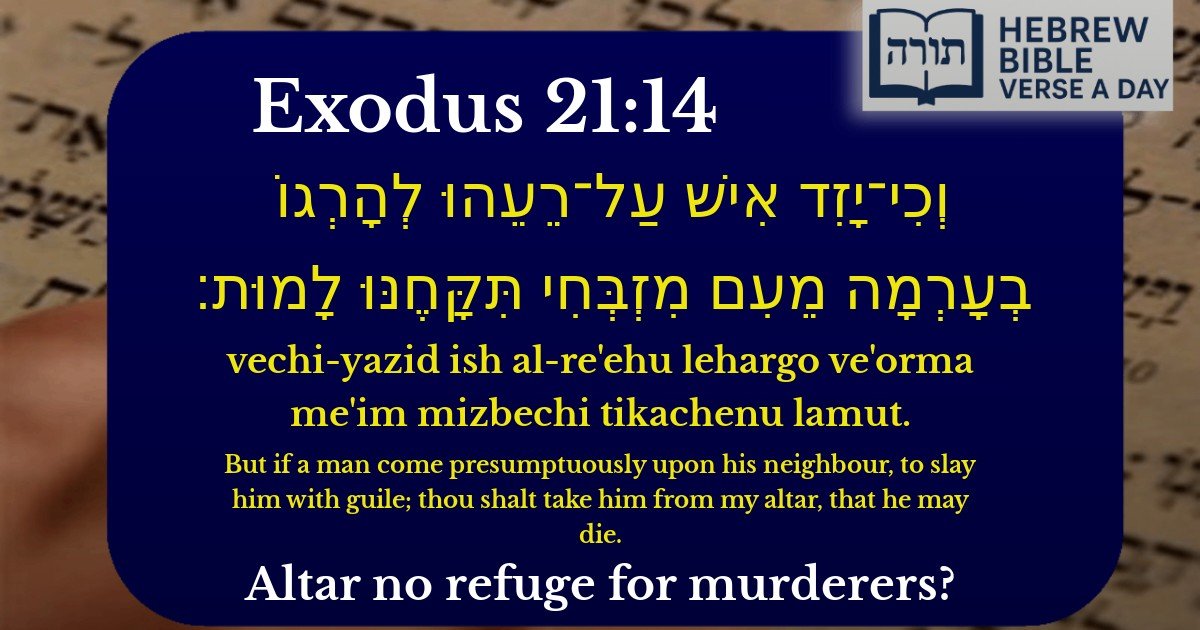

Context and General Meaning
The verse (Shemot 21:14) addresses the case of intentional murder with premeditation ("יָזִד"—acting presumptuously) and deceit ("בְעָרְמָה"—with guile). The Torah emphasizes that even if the murderer seeks refuge at the altar—a place typically associated with divine protection—he must be taken from there to face justice. This underscores the severity of intentional murder in Jewish law.
Rashi's Commentary
Rashi (Rabbi Shlomo Yitzchaki) explains that the phrase "מֵעִם מִזְבְּחִי" ("from My altar") teaches that even if the murderer is engaged in sacred service—such as a Kohen (priest) offering sacrifices—he is not granted immunity. The altar, which atones for unintentional sins (see Shemot 20:21), cannot protect one who sins deliberately. Rashi cites the example of Yoav, who clung to the horns of the altar (Melachim I 2:28-34) but was still executed for his crimes.
Rambam's Legal Perspective
In Hilchot Rotzeach U’Shemirat Nefesh (Laws of Murderers and Protecting Life 1:4), the Rambam (Maimonides) rules that intentional murder is among the gravest sins, and no sanctuary—not even the altar—can shield the perpetrator. The verse establishes that justice must be served regardless of the murderer's status or location.
Talmudic and Midrashic Insights
Moral and Ethical Lessons
The verse teaches that no religious act can absolve deliberate evil. The altar, a place of atonement, cannot be misused as a shield for wickedness. This aligns with the broader Torah principle that justice and morality must prevail, even in the most sacred spaces. The Kli Yakar (Rabbi Shlomo Ephraim Luntschitz) adds that the phrase "לָמוּת" ("that he may die") underscores the irrevocable nature of the punishment for intentional murder, reflecting the Torah’s uncompromising stance on the sanctity of life.