Frequently Asked Questions
Q: What does it mean to 'curse' one's parents in this verse?
A: According to Rashi and the Talmud (Sanhedrin 66a), 'cursing' here refers to verbally disrespecting or insulting one's parents, not just using foul language. The Torah takes this very seriously as it undermines the fundamental mitzvah of honoring parents.
Q: Why is cursing parents such a severe sin in Judaism?
A: The Rambam explains in Mishneh Torah (Hilchos Mamrim 5:1) that honoring parents is foundational to society and our relationship with Hashem. Since parents partner with G-d in bringing a child into the world, disrespecting them is akin to disrespecting the Divine.
Q: Does this law about cursing parents still apply today?
A: While Jewish courts haven't carried out capital punishments for centuries, the Torah prohibition remains fully in effect. The Chofetz Chaim emphasizes that the spiritual severity remains, and we must be extremely careful about how we speak to and about our parents.
Q: What's the difference between 'cursing' and 'not honoring' parents?
A: The Talmud (Kiddushin 31b) distinguishes between the positive commandment to 'honor' parents (which includes actions like feeding and respecting them) and the prohibition against 'cursing' them (which is verbal disrespect). Both are serious, but cursing carries the more severe penalty.
Q: How can we apply this verse's lesson in modern times?
A: The Sefer HaChinuch (Mitzvah 48) teaches that this verse reminds us to guard our speech carefully, especially regarding parents. Even when frustrated, we must find respectful ways to communicate. The mitzvah applies at all ages and even after a parent's passing.

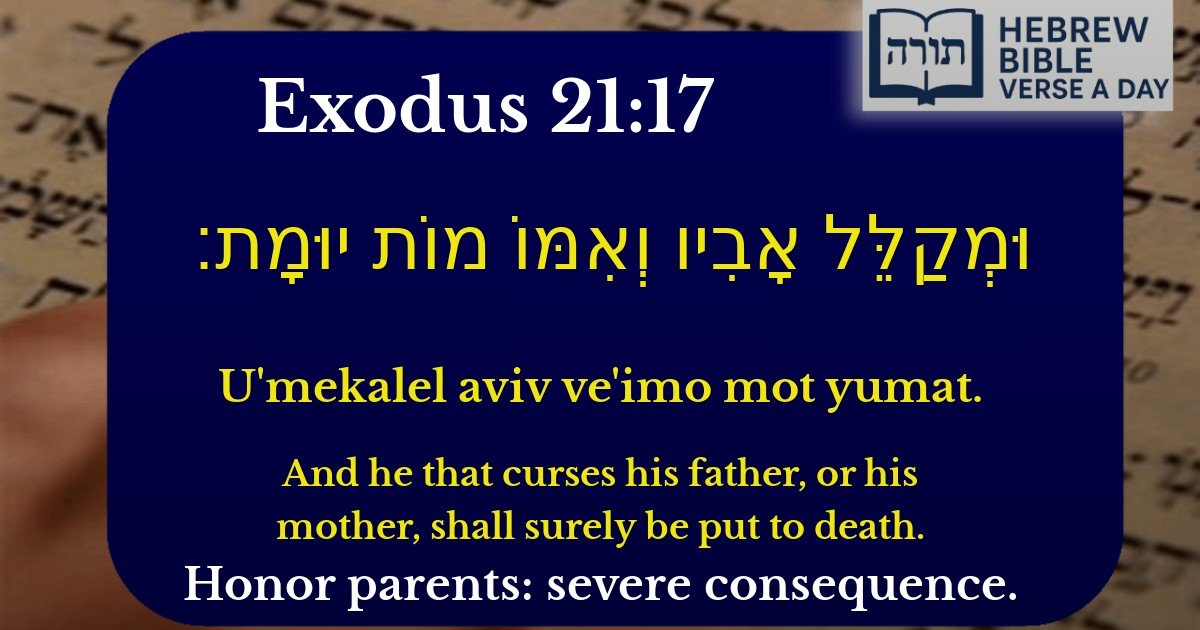

Severity of the Prohibition
The verse (Exodus 21:17) states unequivocally that one who curses their father or mother is subject to the death penalty. This underscores the gravity of dishonoring parents in Jewish law. Rashi explains that the term "וּמְקַלֵּל" (curses) refers to verbal abuse or invoking divine harm upon one's parents, which is considered a capital offense akin to idolatry and murder (Sanhedrin 66a). The Rambam (Hilchos Mamrim 5:1) further clarifies that this applies whether the curse is directed at a living or deceased parent.
Halachic Parameters
According to the Talmud (Sanhedrin 85b), the death penalty is only administered if the curse:
The Sefer HaChinuch (Mitzvah 48) adds that even when capital punishment is not implemented, the spiritual ramifications of this sin are severe, as it undermines the foundational mitzvah of kibud av v'em (honoring parents).
Philosophical Underpinnings
The Midrash (Sifra Kedoshim 7) compares cursing parents to blasphemy, as parents partner with Hashem in creation. The Kli Yakar emphasizes that this prohibition maintains societal order—if children disrespect those who nurtured them, all moral structure collapses. The Chatam Sofer notes that the verse's placement after laws of manslaughter suggests verbal abuse of parents is akin to physical violence in its destructive potential.
Contemporary Application
While Jewish courts haven't administered capital punishment for centuries, the Shulchan Aruch (Yoreh De'ah 240:1) rules that any expression of contempt for parents—including eye-rolling or public embarrassment—violates Torah law. Modern poskim like Rav Moshe Feinstein (Igros Moshe EH 4:65) apply this to digital communications, prohibiting disparaging parents online or in messaging.