

Join Our Newsletter To Be Informed When New Videos Are Posted
Hebrew Text
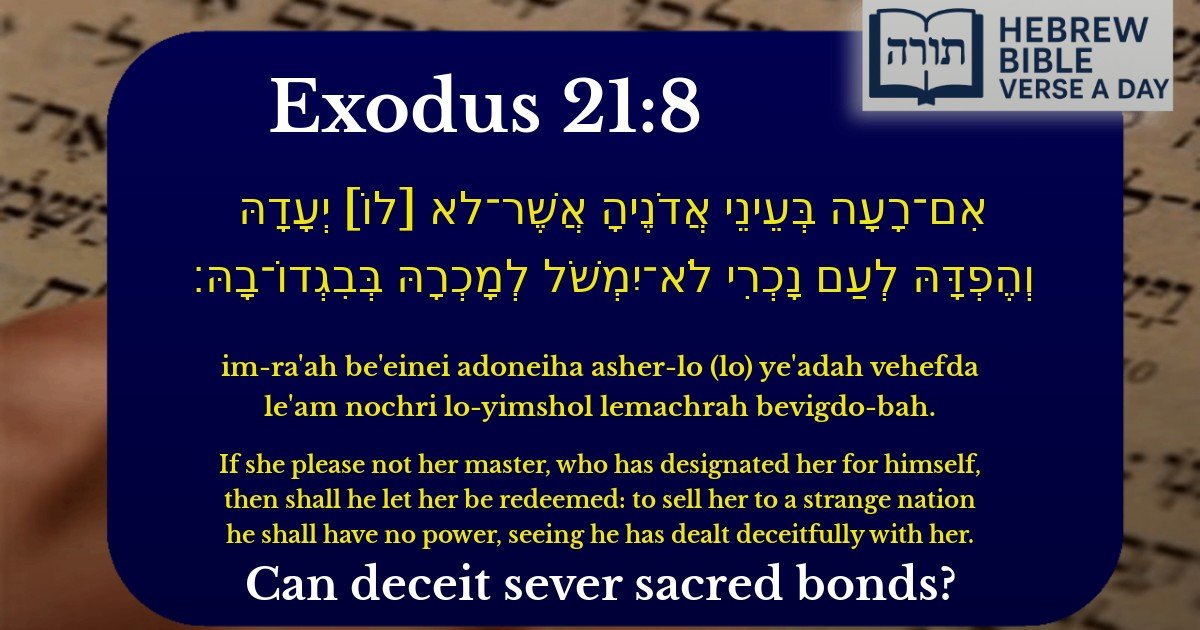
אִם־רָעָה בְּעֵינֵי אֲדֹנֶיהָ אֲשֶׁר־לא [לוֹ] יְעָדָהּ וְהֶפְדָּהּ לְעַם נָכְרִי לֹא־יִמְשֹׁל לְמָכְרָהּ בְּבִגְדוֹ־בָהּ׃
English Translation
If she please not her master, who has designated her for himself, then shall he let her be redeemed: to sell her to a strange nation he shall have no power, seeing he has dealt deceitfully with her.
Transliteration
Im-ra'ah be'einei adoneiha asher-lo (lo) ye'adah vehefda le'am nochri lo-yimshol lemachrah bevigdo-bah.
Hebrew Leining Text
אִם־רָעָ֞ה בְּעֵינֵ֧י אֲדֹנֶ֛יהָ אֲשֶׁר־[ל֥וֹ] (לא) יְעָדָ֖הּ וְהֶפְדָּ֑הּ לְעַ֥ם נׇכְרִ֛י לֹא־יִמְשֹׁ֥ל לְמׇכְרָ֖הּ בְּבִגְדוֹ־בָֽהּ׃
🎵 Listen to leining
Parasha Commentary
📚 Talmud Citations
This verse is quoted in the Talmud.
📖 Kiddushin 18a
The verse is discussed in the context of the laws regarding the sale of a Hebrew maidservant and the limitations on her master's rights to sell her to others.
📖 Gittin 45a
The verse is referenced in a discussion about the redemption of slaves and the prohibitions against selling them to foreign nations.
Context in Jewish Law
This verse (Exodus 21:8) deals with the laws concerning an ama ivriya (Hebrew maidservant), a topic extensively discussed in the Talmud (Kiddushin 14a-20a) and codified by Rambam (Hilchos Avadim, Chapter 4). The Torah establishes protections for a Jewish woman sold into servitude by her father, limiting the master's rights over her.
Rashi's Explanation
Rashi explains that if the master does not wish to marry the maidservant (as originally intended when acquiring her), he must allow her redemption - meaning her family may pay to free her. The phrase "lo yimshol lemochra b'vigdo bah" ("he shall have no power to sell her") is interpreted by Rashi as prohibiting the master from selling her to another Jew after having initially designated her for himself (or his son), as this would constitute betrayal (begidah).
Ibn Ezra's Additional Insight
Ibn Ezra emphasizes that the prohibition against selling her to "a strange nation" (non-Jews) is absolute, as this would compound the original wrong by potentially exposing her to idolatrous influences or harsher treatment.
Halachic Implications from Rambam
Moral Lesson from Midrash
The Mechilta (on this verse) derives that this law teaches the importance of keeping one's word, especially in matters affecting another person's life. The Torah uses strong language ("he has dealt deceitfully") to condemn exploiting vulnerable individuals.
Sforno's Ethical Dimension
Sforno notes that the verse establishes that personal relationships cannot be treated as mere commercial transactions. Once emotional/spiritual bonds are formed (through yi'ud), reverting to treating the woman as property violates fundamental Torah values.