Frequently Asked Questions
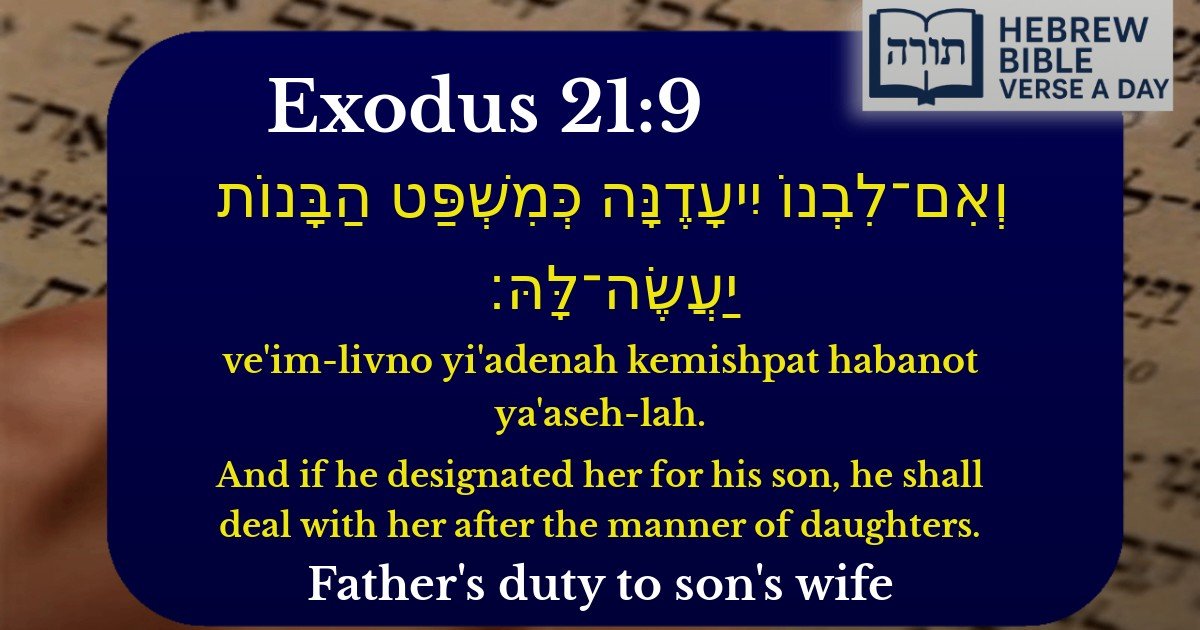
Q: What does Exodus 21:9 mean when it says 'he shall deal with her after the manner of daughters'?
A: This verse refers to the laws regarding a maidservant who was designated by her master to marry his son. The phrase 'after the manner of daughters' means the son must treat her with the same rights and dignity as he would treat his own daughters, including proper food, clothing, and marital rights (Rashi on Exodus 21:9).
Q: Why is Exodus 21:9 important in Jewish law?
A: This verse establishes important ethical guidelines for how a maidservant must be treated if she is designated for marriage to the master's son. It teaches that even in servitude, she retains basic human dignity and rights, reflecting Judaism's emphasis on compassion and fairness (Mechilta on Exodus 21:9).
Q: What can we learn from Exodus 21:9 about how to treat others?
A: This verse teaches that all people, regardless of social status, deserve dignified treatment. Even a maidservant must be treated with the same care as one's own family members. This reflects the Torah's broader values of kindness and justice in interpersonal relationships (Rambam, Hilchos Avadim 3:12).
Q: How does Exodus 21:9 apply to modern relationships?
A: While the specific case of a maidservant doesn't apply today, the principle remains relevant: we must treat all people in our care - employees, domestic helpers, or anyone dependent on us - with dignity, fairness and compassion, just as we would treat our own family members (Talmud, Kiddushin 20a).
Q: What does 'designated her for his son' mean in Exodus 21:9?
A: This refers to a situation where a Hebrew maidservant was originally acquired by a father, but then designated to marry his son instead. The Torah specifies that in such cases, the son must provide for her as he would for his own daughters, showing that marital commitments must be honored with proper care (Ibn Ezra on Exodus 21:9).


Context in Parashat Mishpatim
The verse (Shemot 21:9) appears in the section of the Torah dealing with the laws of an eved Ivri (Hebrew indentured servant) and specifically addresses the case where a father sells his daughter as an ama ivriya (Hebrew maidservant). The Torah outlines the rights and protections afforded to her, including this scenario where her master designates her for his son.
Rashi's Explanation
Rashi (ad loc.) explains that this verse teaches that if the master assigns the ama ivriya to his son as a wife, the son must treat her with the same dignity and rights as a daughter. This includes:
Ibn Ezra's Insight
Ibn Ezra emphasizes that the phrase "כְּמִשְׁפַּט הַבָּנוֹת" ("after the manner of daughters") means the son cannot treat her as a secondary wife or concubine, but must elevate her to full marital status with the privileges of a primary wife.
Halachic Implications (Rambam)
In Hilchos Avadim (4:11), the Rambam codifies this law, stating that if the master's son marries the ama ivriya, he may not later reduce her status or divorce her without cause. She retains all rights granted by Torah law to a Jewish wife.
Midrashic Perspective (Mechilta)
The Mechilta (Mishpatim 3) connects this verse to the broader ethical principle that the Torah demands compassionate treatment of those in vulnerable positions. Even when someone enters servitude, their human dignity must be preserved, especially in marital relationships.