Frequently Asked Questions
Q: What does the verse 'Thou shalt not suffer a witch to live' mean?
A: This verse from Exodus 22:17 prohibits the practice of witchcraft (kishuf) and commands that those who engage in it must not be allowed to live. According to Rashi and the Talmud (Sanhedrin 67a), this refers to one who performs actual acts of sorcery, not mere illusions. The Torah strictly forbids such practices because they contradict belief in Hashem's absolute control over the world.
Q: Why is witchcraft forbidden in Judaism?
A: Witchcraft is forbidden because it involves seeking supernatural power outside of Hashem, which is a form of idolatry (avodah zarah). The Rambam (Hilchos Avodah Zarah 11:16) explains that witchcraft is deceptive and leads people away from faith in Hashem. The Torah emphasizes that all power comes only from Hashem, and turning to other sources is a severe sin.
Q: Does this law about witches still apply today?
A: While the Torah's prohibition against witchcraft remains eternally valid, the death penalty for sorcery is not applied today due to the absence of the Sanhedrin (Jewish high court) and the strict evidentiary requirements needed for capital punishment (as detailed in the Talmud, Sanhedrin). However, Jews are still forbidden from engaging in or consulting with those who practice witchcraft.
Q: What counts as witchcraft according to Jewish law?
A: Jewish law (based on the Talmud, Sanhedrin 65a-67b) defines witchcraft as performing supernatural acts through incantations, charms, or rituals to manipulate reality outside of natural laws. Simple magic tricks or illusions are not included, but any attempt to access forbidden spiritual forces is prohibited. The Rambam (Hilchos Avodah Zarah 11:4) also warns against believing in or relying on omens and superstitions.
Q: How should Jews respond to witchcraft today?
A: Jews should completely avoid any involvement with witchcraft, including consulting fortune-tellers, using charms, or engaging in occult practices. Instead, we should strengthen our trust in Hashem through prayer, Torah study, and mitzvot. The Chofetz Chaim (in his writings on Jewish law) emphasizes that true protection comes only from Hashem, not from supernatural rituals.

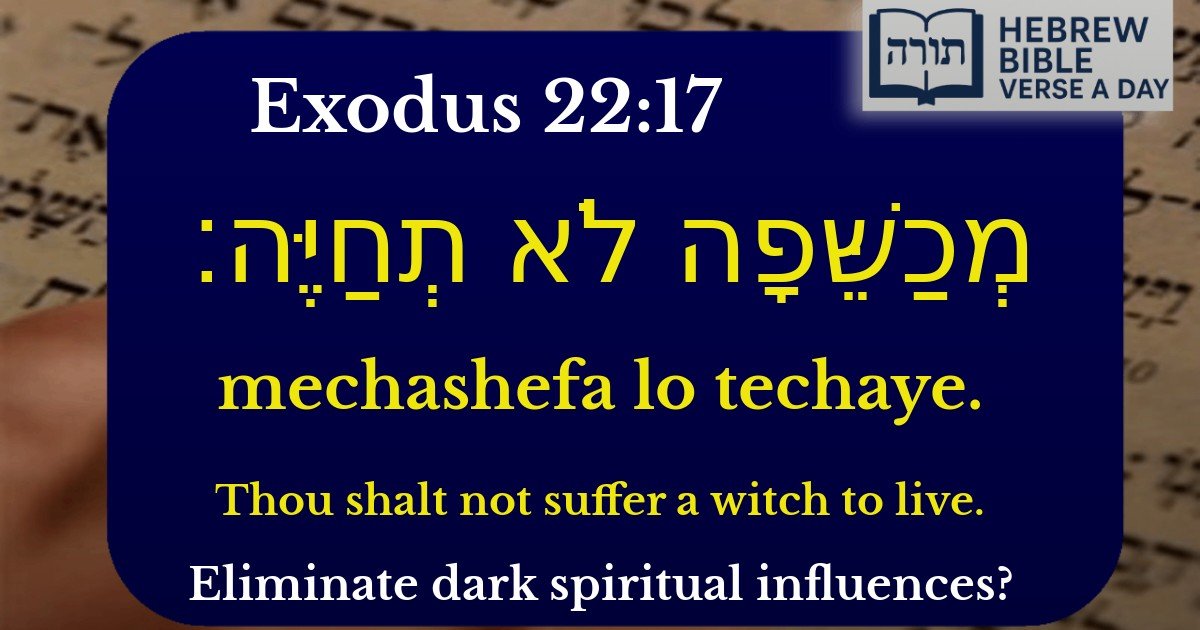

Prohibition of Witchcraft in Jewish Law
The verse "מְכַשֵּׁפָה לֹא תְחַיֶּה" (Exodus 22:17) establishes a strict prohibition against allowing a sorceress (or sorcerer) to live. This commandment is rooted in the Torah's broader rejection of occult practices and idolatry, which are considered severe transgressions against the sovereignty of Hashem.
Rashi's Explanation
Rashi (Exodus 22:17) clarifies that the term "מְכַשֵּׁפָה" refers specifically to one who engages in כְּשָׁפִים (witchcraft or sorcery), which involves manipulating supernatural forces through forbidden means. He emphasizes that the Torah uses the feminine form here not to exclude male practitioners but because witchcraft was more commonly associated with women in ancient times (as seen in the case of the witch of Ein-Dor in I Samuel 28).
Maimonides' Legal Perspective
Rambam (Maimonides) in Hilchot Avodah Zarah 11:16 elaborates that sorcery is a capital offense because it undermines the foundations of Torah belief by attributing power to forces other than Hashem. He writes that even if a sorcerer performs actual miracles through witchcraft, they are to be executed, as their actions lead people astray.
Talmudic Discussion
The Talmud (Sanhedrin 67a) discusses the parameters of this prohibition:
Midrashic Insights
The Mechilta (on Exodus 22:17) connects this verse to the broader theme of rejecting foreign influences, stating that witchcraft represents the corruption of moral and spiritual order. The Midrash warns that tolerating such practices leads to the erosion of Torah values in society.
Contemporary Halachic Considerations
While the literal capital punishment is not applied in the absence of the Sanhedrin, the prohibition remains in force. Modern poskim (halachic decisors) emphasize that: