Frequently Asked Questions
Q: What does Exodus 22:19 mean?
A: Exodus 22:19 prohibits sacrificing to any deity other than Hashem (G-d). The Torah teaches that idolatry is a severe sin, and this verse emphasizes that worship must be directed exclusively to G-d. Rashi explains that this commandment reinforces the fundamental Jewish belief in monotheism and rejects any form of idol worship.
Q: Why is this verse important in Judaism?
A: This verse is important because it establishes the absolute prohibition against idolatry (avodah zarah), which is one of the three cardinal sins in Judaism (along with murder and forbidden relations). The Rambam (Maimonides) teaches that rejecting idolatry is essential to Jewish identity, and this verse serves as a clear warning against any form of worship directed to false gods.
Q: How does this verse apply today if we don’t practice animal sacrifices?
A: Although we no longer bring sacrifices today, the principle of this verse still applies. The Talmud (Sanhedrin 60b) explains that idolatry includes not only physical sacrifices but also any form of worship or excessive devotion to false ideologies, materialism, or other modern 'gods.' The message remains to serve Hashem alone with complete loyalty.
Q: What is the punishment mentioned in this verse?
A: The verse states that one who sacrifices to other gods 'shall be utterly destroyed' (yacharam). According to Jewish law (Rambam, Hilchot Avodah Zarah), this refers to the death penalty administered by the Sanhedrin (when it existed) for intentional idolatry. The severity reflects how seriously Judaism views the rejection of idol worship.
Q: Does this verse relate to the Ten Commandments?
A: Yes, this verse reinforces the Second Commandment ('You shall have no other gods before Me'). The Midrash (Mechilta) connects them, teaching that both emphasize exclusive devotion to Hashem. While the Ten Commandments state the general principle, Exodus 22:19 specifies the consequence for violating it through idolatrous sacrifices.

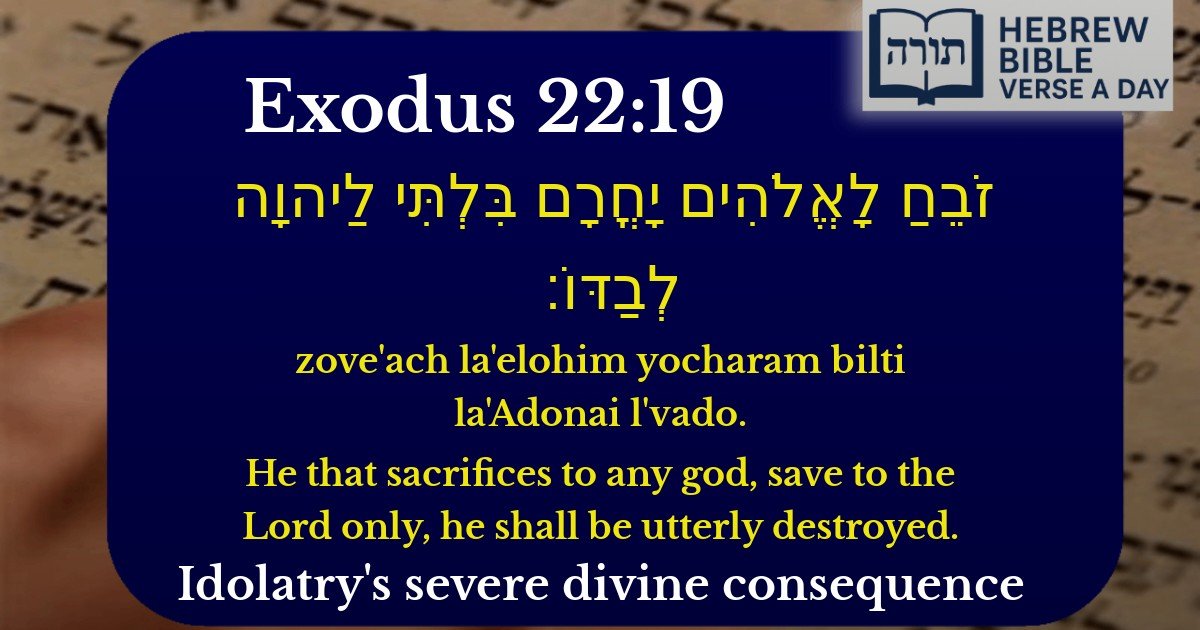

Verse Context (Shemot 22:19)
This verse appears in Parashat Mishpatim, which outlines civil and ritual laws following the revelation at Har Sinai. It serves as a strict prohibition against idolatrous worship, emphasizing the exclusive devotion required for Hashem.
Literal Interpretation (Peshat)
Rashi explains that the phrase "זובח לאלהים" ("sacrifices to gods") refers to one who offers a sacrifice to idolatry, even if they do not explicitly deny Hashem. The term "יחרם" ("utterly destroyed") implies either:
Halachic Implications
The Rambam (Mishneh Torah, Avodah Zarah 3:1) rules that this prohibition applies even if the idolater does not perform a full sacrificial rite—any act of worship (e.g., burning incense or pouring libations) incurs the death penalty. The Gemara (Sanhedrin 60b) clarifies that the severity stems from the fundamental breach of Yichud Hashem (declaring Hashem’s oneness).
Philosophical Dimension (Derash)
The Sefer HaChinuch (Mitzvah 79) explains that this mitzvah safeguards the foundation of Torah: recognizing Hashem as the sole Creator. Sacrificing to other "gods" denies this truth, corrupting one’s soul and society. The Midrash Tanchuma (Mishpatim 5) likens it to a king who tolerates no rivals in his palace—so too, Hashem demands exclusive loyalty.
Contemporary Relevance
While literal idolatry is rare today, the Chatam Sofer teaches that modern "sacrifices" to materialism or ideologies (e.g., prioritizing wealth or fame over Torah) echo this prohibition. The verse thus remains a call to examine where one directs their devotion.