
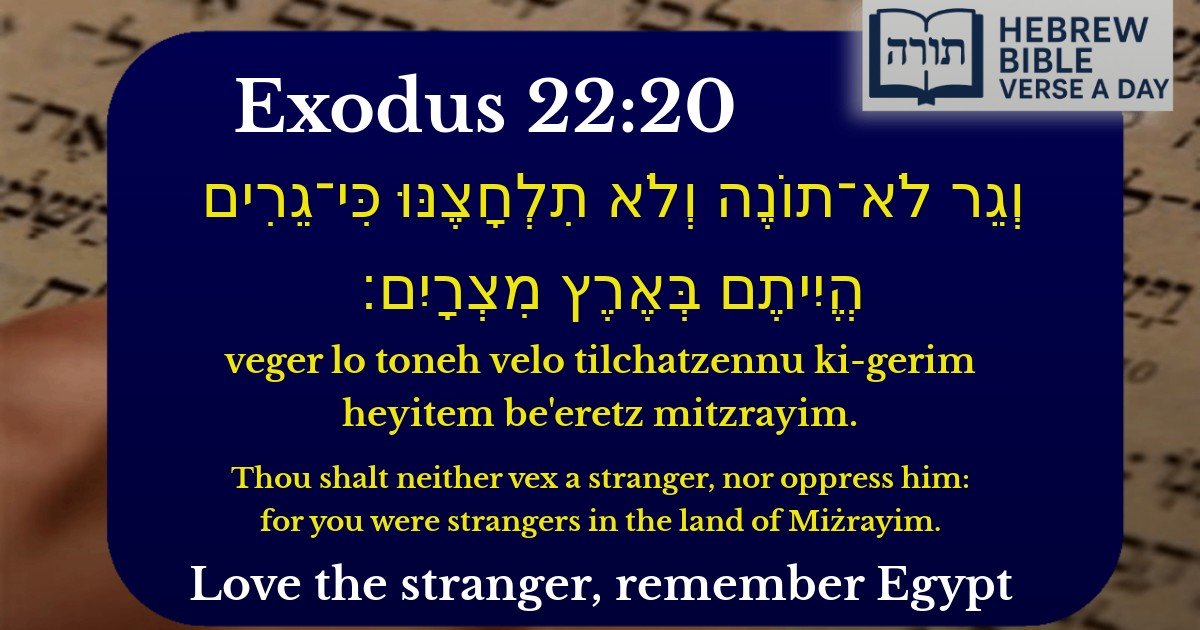

Exodus 22:20 - Love the stranger, remember Egypt

Exodus 22:20 - שמות 22:20

Hebrew Text

וְגֵר לֹא־תוֹנֶה וְלֹא תִלְחָצֶנּוּ כִּי־גֵרִים הֱיִיתֶם בְּאֶרֶץ מִצְרָיִם׃

English Translation

Thou shalt neither vex a stranger, nor oppress him: for you were strangers in the land of Miżrayim.

Transliteration

Veger lo toneh velo tilchatzennu ki-gerim heyitem be'eretz mitzrayim.

Hebrew Leining Text

וְגֵ֥ר לֹא־תוֹנֶ֖ה וְלֹ֣א תִלְחָצֶ֑נּוּ כִּֽי־גֵרִ֥ים הֱיִיתֶ֖ם בְּאֶ֥רֶץ מִצְרָֽיִם׃

🎵 Listen to leining

Parasha Commentary

Prohibition Against Oppressing the Stranger

The verse (Shemot 22:20) commands us not to oppress or mistreat a ger (stranger or convert), emphasizing that we must remember our own experience as strangers in Egypt. Rashi explains that the term ger here refers specifically to a ger toshav (a resident alien who has accepted the Noahide laws) or a ger tzedek (a full convert to Judaism). The Torah repeatedly warns against mistreating the stranger, highlighting the moral imperative to protect those who are vulnerable in society.

Historical Context and Moral Imperative

The Rambam (Hilchot De'ot 6:4) teaches that the commandment to treat the stranger with kindness is rooted in our collective memory of oppression in Egypt. Since we know the pain of being marginalized, we are obligated to act with compassion toward others in similar circumstances. The Sefer HaChinuch (Mitzvah 63) adds that this mitzvah instills humility and empathy, preventing arrogance and cruelty.

Types of Oppression Forbidden

  • Verbal Oppression (Ona'at Devarim): The Talmud (Bava Metzia 58b) warns against causing emotional distress to a ger through harsh words or reminding them of their past.
  • Financial Exploitation (Ona'at Mamon): The Mechilta teaches that deceiving or overcharging a stranger is a severe transgression, as they lack the social protections of native-born citizens.
  • Legal Discrimination: The Sifrei emphasizes that courts must uphold justice for the stranger just as they would for any Jew, ensuring equal treatment under the law.

Spiritual Significance

The Midrash (Shemot Rabbah 19:4) connects this mitzvah to the broader ethical foundation of Torah, teaching that mistreating a stranger undermines the covenant between Hashem and Israel. The Kli Yakar further explains that since we were strangers in Egypt, failing to show kindness to others would be a betrayal of our own history and divine mission.

📚 Talmud Citations

This verse is quoted in the Talmud.

📖 Bava Metzia 59b
The verse is cited in the context of discussing the ethical treatment of strangers and the prohibition against oppressing them, drawing a parallel to the Israelites' experience in Egypt.
📖 Mekhilta Mishpatim 18
The verse is referenced in the Mekhilta, a tannaitic midrash, in the discussion of laws pertaining to the fair treatment of strangers and the moral imperative derived from the Israelites' historical experience.

Frequently Asked Questions

Q: What does the verse 'Thou shalt neither vex a stranger, nor oppress him' mean?
A: This verse teaches us that we must treat strangers (גֵר) with kindness and fairness, avoiding any form of mistreatment or oppression. Rashi explains that this includes both verbal harassment (תוֹנֶה) and financial exploitation (תִלְחָצֶנּוּ). The Torah emphasizes this mitzvah because we experienced being strangers in Egypt.
Q: Why does the Torah mention that we were strangers in Egypt?
A: The Torah reminds us of our experience in Egypt to teach empathy. Since we suffered as strangers, we must ensure others do not endure the same pain. Rambam (Hilchos De'os 6:4) states that remembering our past hardships should inspire us to act with compassion toward outsiders.
Q: Who is considered a 'stranger' (גֵר) in this verse?
A: In this context, a 'stranger' refers to a non-Jew living among the Jewish people who has accepted the Seven Noahide Laws (גֵר תוֹשָׁב). The Talmud (Bava Metzia 59b) discusses the protections they are entitled to under Jewish law, including fair treatment in business and society.
Q: How does this verse apply today?
A: This verse teaches us to treat all people—especially those who are different or vulnerable—with dignity. The Sefer HaChinuch (Mitzvah 63) explains that this mitzvah fosters a just society. Today, this includes fair treatment of immigrants, workers, and anyone in a minority position.
Q: What is the difference between 'vexing' and 'oppressing' a stranger?
A: Rashi clarifies that 'vexing' (תוֹנֶה) refers to causing emotional distress, such as through hurtful words, while 'oppressing' (תִלְחָצֶנּוּ) refers to financial exploitation, like unfair pricing or withholding wages. Both are forbidden, as the Midrash (Shemos Rabbah 1:35) stresses the severity of mistreating strangers.