Frequently Asked Questions
Q: What does it mean that 'God looked upon the children of Israel and God apprehended' in Exodus 2:25?
A: According to Rashi, this verse means that God turned His attention to the Jewish people in Egypt and recognized their suffering. The word 'וַיֵּדַע' (apprehended) implies that God took intimate notice of their pain, as one who truly understands another's distress. This marks the beginning of God's intervention to redeem them from slavery.
Q: Why is Exodus 2:25 important in the story of the Exodus?
A: This verse is crucial because it shows the moment when God actively begins to respond to the Jewish people's suffering in Egypt. The Midrash explains that until this point, the Israelites were in deep despair, but God 'looked' upon them with mercy, setting the stage for the redemption through Moshe (Moses) and the eventual Exodus.
Q: What can we learn from Exodus 2:25 about how God relates to suffering?
A: The verse teaches that God is deeply aware of human suffering. The Rambam (Hilchot Teshuvah) explains that divine providence is connected to human actions and cries for help. When the Jewish people cried out from their oppression, God 'apprehended' their pain, showing that He responds to sincere prayer and hardship.
Q: How does Exodus 2:25 apply to us today?
A: This verse reminds us that even in difficult times, God is aware of our struggles. The Talmud (Berachot 10a) teaches that just as God heard the cries of our ancestors in Egypt, He hears our prayers today. We must trust in divine compassion and never lose hope, as redemption can come at any moment.
Q: Why does the Torah use the word 'וַיֵּדַע' (apprehended/knew) instead of simply saying God 'saw' their suffering?
A: Rashi explains that 'וַיֵּדַע' implies a deeper level of understanding and connection—not just seeing, but fully comprehending their pain. The Sforno adds that this word indicates God's decision to act on their behalf, showing that divine awareness leads to intervention for those who are faithful.


Understanding the Verse
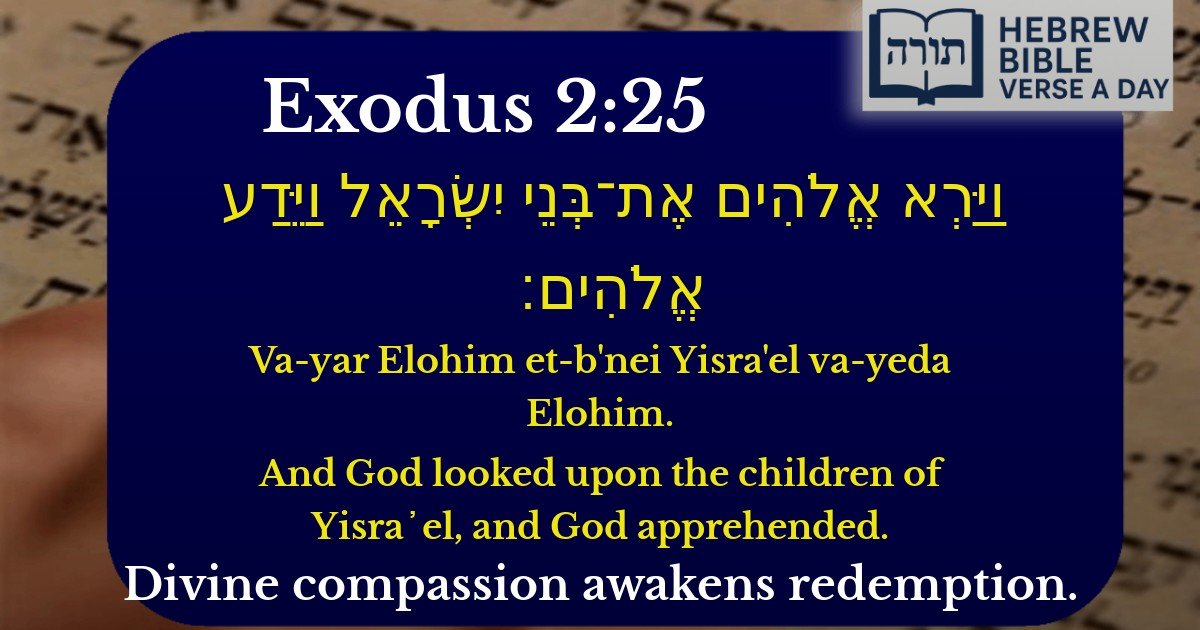
The verse וַיַּרְא אֱלֹהִים אֶת־בְּנֵי יִשְׂרָאֵל וַיֵּדַע אֱלֹהִים׃ ("And God looked upon the children of Yisra᾽el, and God apprehended") appears in Shemot (Exodus) 2:25, describing Hashem's response to the suffering of Bnei Yisrael in Egypt. The phrase "וַיֵּדַע אֱלֹהִים" ("and God apprehended") is rich with meaning in traditional Jewish exegesis.
Rashi's Explanation
Rashi interprets "וַיֵּדַע אֱלֹהִים" to mean that Hashem turned His attention to the plight of Bnei Yisrael and remembered His covenant with the Avot (Patriarchs). He cites the Midrash (Shemot Rabbah 1:28), which explains that this "knowing" refers to Hashem's intimate awareness of their suffering and His decision to act on their behalf.
Rambam's Perspective
Rambam (Maimonides), in Moreh Nevuchim (Guide for the Perplexed), discusses divine providence. Here, "וַיֵּדַע" signifies Hashem's active intervention in history, demonstrating that He is not indifferent to human suffering. This aligns with the principle of hashgacha pratit (individual divine providence) over Klal Yisrael.
Midrashic Insights
Ibn Ezra's Commentary
Ibn Ezra notes that "וַיֵּדַע" here is an expression of action, not merely cognition. It signifies that Hashem moved from observation to decisive involvement, setting the stage for Yetziat Mitzrayim (the Exodus).
Kabbalistic Interpretation
In Kabbalah (e.g., Zohar), "וַיַּרְא... וַיֵּדַע" reflects the unification of divine attributes (middot), where Din (Judgment) is tempered by Rachamim (Mercy), allowing redemption to begin.