Frequently Asked Questions
Q: What does Exodus 23:10 mean?
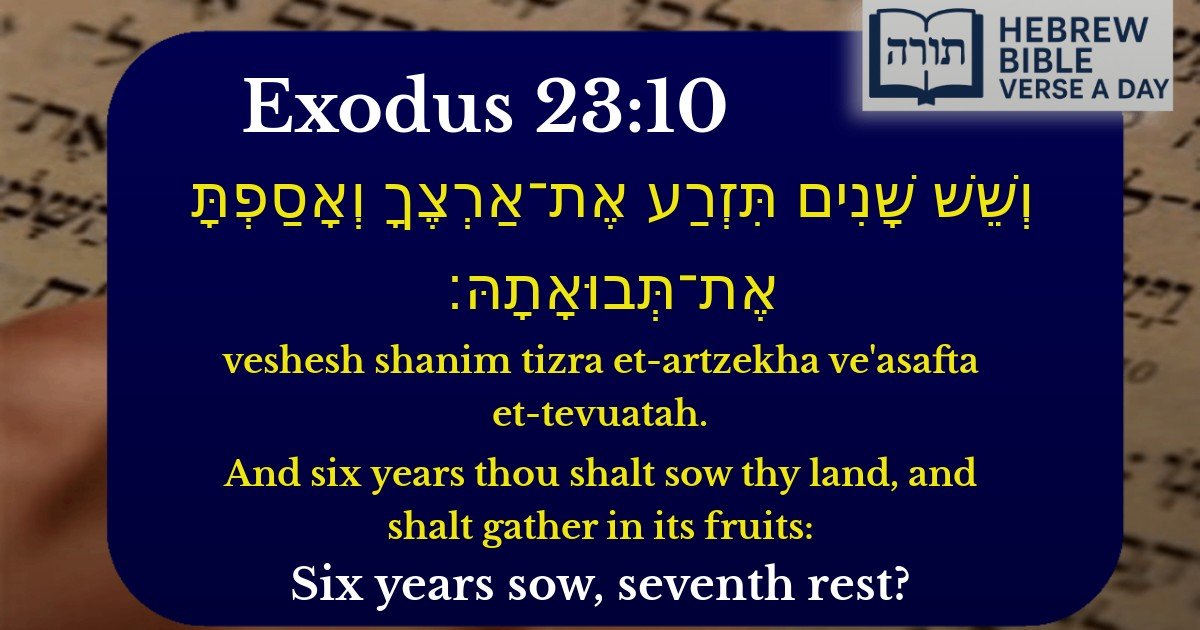
A: Exodus 23:10 commands the Jewish people to work the land of Israel for six years, sowing and harvesting its produce. This verse introduces the mitzvah (commandment) of the Shemitah (Sabbatical) year, where the seventh year is a rest period for the land, as explained in the following verses. Rashi notes that this teaches us about the importance of letting the land rest, just as Shabbat provides rest for people.
Q: Why is the six-year farming cycle important in Judaism?
A: The six-year farming cycle is important because it leads into the Shemitah year (the seventh year), when the land must rest. The Rambam (Hilchot Shemitah) explains that this cycle reinforces our trust in Hashem, as we rely on Him for sustenance during the Shemitah year when we do not work the land. It also teaches us discipline and respect for the land’s natural cycles.
Q: Does Exodus 23:10 apply to farming outside of Israel?
A: According to traditional Jewish law (Halacha), the mitzvah of Shemitah (and thus the six-year farming cycle) applies primarily to the land of Israel. The Talmud (Kiddushin 36b) states that these agricultural laws are obligations only in the biblical borders of Israel. However, some customs of Shemitah may still be observed outside Israel as a remembrance.
Q: What lesson can we learn from Exodus 23:10 today?
A: This verse teaches us about balance—between work and rest, effort and faith. Just as the land needs a cycle of labor and renewal, so do people. The Midrash (Sifra) connects this to the idea that overworking without spiritual reflection leads to exhaustion, while proper rest renews our connection to Hashem and our purpose.
Q: How was Exodus 23:10 observed in ancient times?
A: In ancient times, Jewish farmers in Israel would work the land for six years, planting and harvesting as usual. On the seventh year (Shemitah), they would let the land lie fallow, and whatever grew naturally was considered ownerless (hefker), available to all. The Talmud (Moed Katan 3b) discusses how this practice strengthened community sharing and trust in divine providence.


Context in the Torah
This verse (Exodus 23:10) is part of the laws concerning the Shmita (Sabbatical) year, which commands a cessation of agricultural work every seventh year. The six years of sowing and gathering precede the seventh year of rest for the land.
Rashi's Commentary
Rashi (Exodus 23:10) explains that the verse emphasizes the mitzvah of Shmita by first mentioning the six years of labor, showing that the land's productivity is directly tied to observing this commandment. He notes that the phrasing "six years you shall sow" implies a positive obligation to work the land for six years, not merely permission.
Rambam's Legal Perspective
In Mishneh Torah (Hilchot Shemita v'Yovel 1:1), Rambam codifies this as a Torah obligation, stating that working the land for six years is a preparatory mitzvah for the sanctity of the seventh year. He further rules (4:25) that one who neglects Shmita violates both a positive and negative commandment.
Agricultural and Spiritual Dimensions
Midrashic Insight
The Mechilta connects this verse to Creation: just as Hashem worked for six "days" and rested on the seventh, we emulate this pattern through Shmita. The Torat Kohanim (Behar 1:1) further teaches that observing Shmita affirms our belief in Hashem as Creator and Owner of the land.
Contemporary Application
Modern poskim like Rav Kook (Shabbat HaAretz) emphasize that Shmita remains binding even after the Temple's destruction, with adaptations like Heter Mechira (permitted land sales) addressing agricultural challenges in Eretz Yisrael today.