

Join Our Newsletter To Be Informed When New Videos Are Posted
Hebrew Text
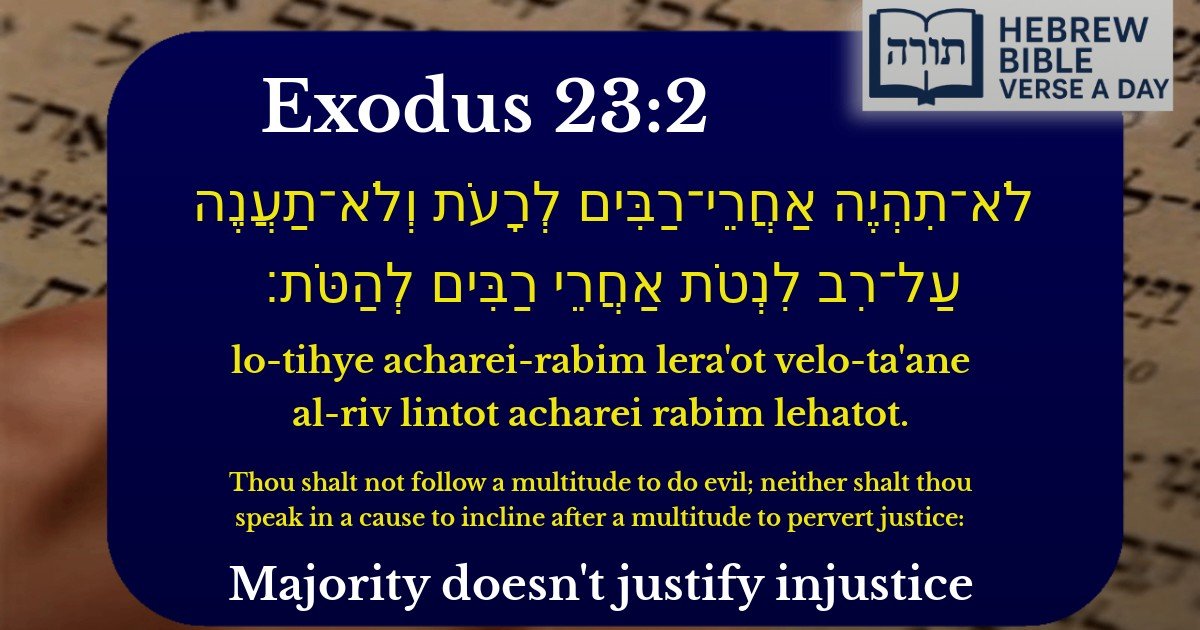
לֹא־תִהְיֶה אַחֲרֵי־רַבִּים לְרָעֹת וְלֹא־תַעֲנֶה עַל־רִב לִנְטֹת אַחֲרֵי רַבִּים לְהַטֹּת׃
English Translation
Thou shalt not follow a multitude to do evil; neither shalt thou speak in a cause to incline after a multitude to pervert justice:
Transliteration
Lo-tihye acharei-rabim lera'ot velo-ta'ane al-riv lintot acharei rabim lehatot.
Hebrew Leining Text
לֹֽא־תִהְיֶ֥ה אַחֲרֵֽי־רַבִּ֖ים לְרָעֹ֑ת וְלֹא־תַעֲנֶ֣ה עַל־רִ֗ב לִנְטֹ֛ת אַחֲרֵ֥י רַבִּ֖ים לְהַטֹּֽת׃
🎵 Listen to leining
Parasha Commentary
📚 Talmud Citations
This verse is quoted in the Talmud.
📖 Sanhedrin 2a
The verse is discussed in the context of judicial procedures, emphasizing the importance of not following the majority when it leads to injustice.
📖 Bava Metzia 59b
Referenced in the famous 'Oven of Akhnai' story, illustrating the principle that truth is not determined by majority opinion in matters of halakha.
Understanding the Verse
The verse (Exodus 23:2) contains two prohibitions related to justice and moral conduct:
Rashi's Commentary
Rashi explains the first clause as a warning against joining a majority when they are engaged in wrongdoing, even if the majority seems to endorse it. The second clause, according to Rashi, refers to a judge who must not rule based on the opinion of the majority if he believes they are wrong in a legal dispute. A judge must declare what he perceives as the truth, even if it contradicts the majority.
Rambam's Interpretation (Hilchot Sanhedrin)
Rambam (Maimonides) applies this verse to judicial proceedings, emphasizing that a judge must not be swayed by the number of colleagues who hold a certain opinion if he believes they are mistaken. In Hilchot Sanhedrin (10:7), he rules that a judge must argue for the truth as he sees it, even if he stands alone against the majority.
Talmudic Discussion (Sanhedrin 2a)
The Talmud discusses this verse in the context of court rulings, stating that a judge must not suppress his own opinion out of deference to more senior or numerous colleagues if he believes they are incorrect. The principle of "אַחֲרֵי רַבִּים לְהַטֹּת" ("to incline after the majority") applies only when the majority is pursuing truth, not when they are perverting justice.
Midrashic Insight (Mechilta)
The Mechilta elaborates that this verse teaches moral courage—one must not justify wrongdoing simply because many others are doing it. Even in societal pressure, a person must uphold righteousness and not participate in injustice.
Practical Halachic Application
This verse serves as a foundational ethical and legal principle in Judaism: