Frequently Asked Questions
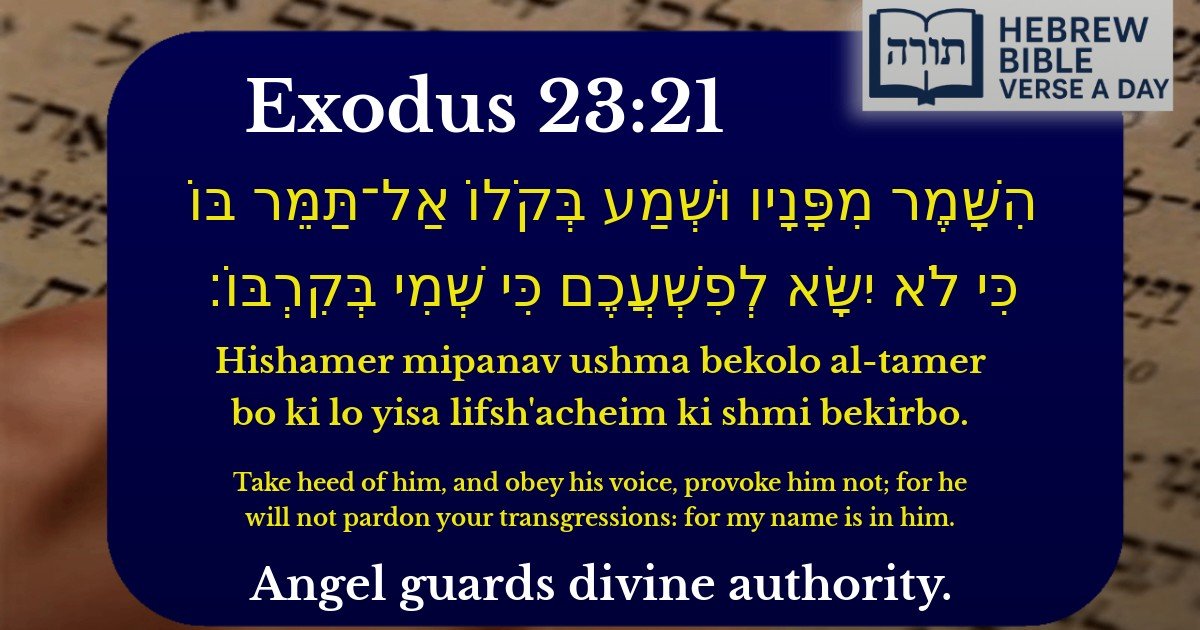
Q: What does 'Take heed of him, and obey his voice' mean in Exodus 23:21?
A: This verse refers to the angel that Hashem sent to guide the Jewish people in the wilderness. Rashi explains that we must listen carefully to this angel's instructions because he speaks with Hashem's authority. The Talmud (Sanhedrin 38b) discusses how this angel carried Hashem's name, showing his divine mission.
Q: Why does the verse say 'for My name is in him'?
A: The Midrash (Shemot Rabbah 32:4) teaches that this angel had special status because he carried Hashem's name, meaning he acted with divine authority. Rambam (Mishneh Torah, Yesodei HaTorah 2:7) explains that certain angels are given missions that reflect Hashem's will, making obedience to them equivalent to obeying Hashem Himself.
Q: What lesson can we learn from 'provoke him not' in this verse?
A: The Sforno teaches that this warns against rebelling against the divine guidance we receive, whether through prophets, Torah scholars, or our conscience. Just as the Israelites needed to respect the angel guiding them, we must respect the Torah's guidance in our lives today.
Q: How does this verse apply to us today without the angel?
A: The Malbim explains that while we don't have this specific angel today, the principle applies to listening to authentic Torah leadership. Just as the angel conveyed Hashem's will, our rabbis and Torah teachers help guide us in fulfilling Hashem's commandments properly.
Q: What does 'he will not pardon your transgressions' mean?
A: Ibn Ezra explains that this angel had no power to forgive sins - only Hashem can grant forgiveness. This reminds us that while we respect Torah leaders and teachers, ultimate repentance must be directed to Hashem Himself, as only He can fully pardon transgressions.


Context and Source
The verse (Shemot 23:21) appears in the context of Hashem's instructions to Bnei Yisrael regarding their journey toward Eretz Yisrael. It refers to the "malach" (angel) that Hashem sends to guide and protect them. The Torah warns the people to heed this angel's instructions carefully.
Rashi's Interpretation
Rashi explains that this "malach" is not an ordinary angel but a special one—Metatron, whose name is like that of his Master (שמו כשם רבו). This is derived from the phrase "כי שמי בקרבו," indicating that the angel carries Hashem's authority. Rashi emphasizes that rebelling against this angel is tantamount to rebelling against Hashem Himself, as the angel acts as Hashem's emissary.
Rambam's Perspective
In Moreh Nevuchim (1:64), Rambam discusses how angels serve as intermediaries for Divine providence. Here, the angel functions as a guide, embodying Hashem's will. The warning "אל תמר בו" (do not provoke him) underscores that disobedience disrupts the Divine plan facilitated through this angel.
Talmudic and Midrashic Insights
Halachic Implications
The Sefer HaChinuch (Mitzvah 80) derives from this verse the principle of heeding Torah leaders and prophets, as they function as Divine messengers. The phrase "שמע בקולו" (obey his voice) extends to listening to legitimate halachic authority, reinforcing the chain of mesorah (tradition).
Kabbalistic Dimension
The Zohar (Shemot 167a) identifies this angel as the manifestation of the Sefirah of Tiferet, representing balance and Divine compassion. The warning against provocation ("אל תמר בו") hints at the need for alignment with this Divine attribute to avoid spiritual consequences.