Frequently Asked Questions
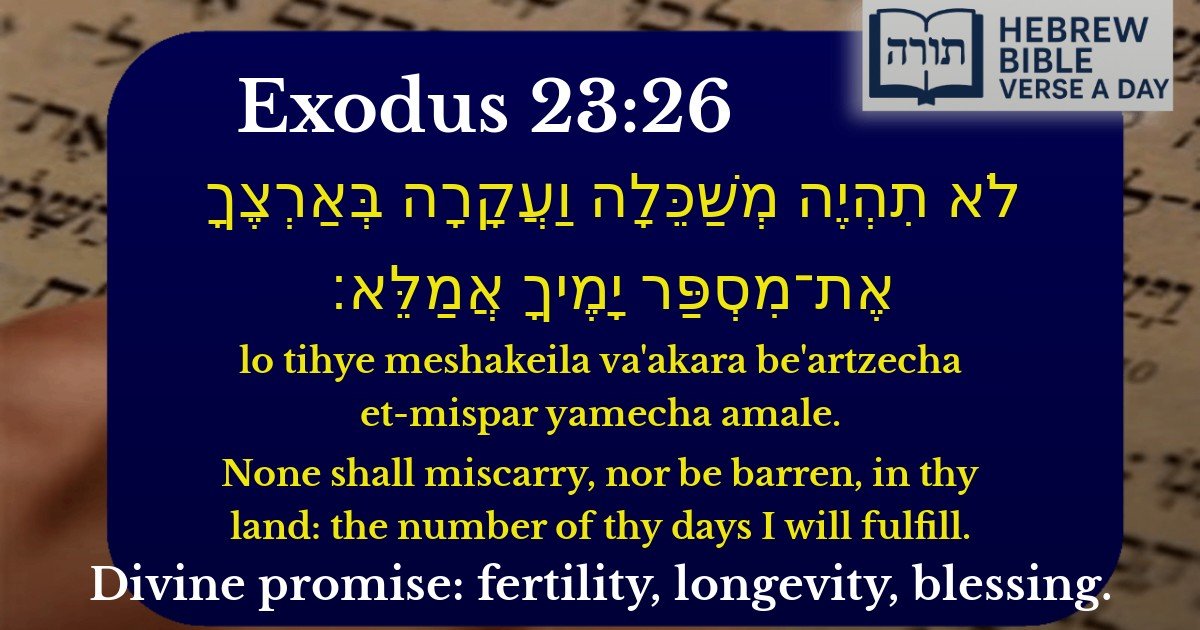
Q: What does Exodus 23:26 mean when it says 'None shall miscarry, nor be barren, in thy land'?
A: This verse is a divine promise that if the Jewish people keep the commandments and follow Hashem's ways, they will be blessed with fertility and health in the land of Israel. Rashi explains that this is one of the blessings for observing mitzvot—Hashem will protect women from miscarriages and ensure that couples are able to have children.
Q: Why is this verse important in Judaism?
A: This verse highlights the connection between keeping mitzvot and receiving physical blessings, particularly regarding family and health. The Talmud (Berachot 20a) discusses how righteousness and Torah observance bring divine protection and prosperity. It reinforces the idea that Hashem rewards those who follow His commandments.
Q: What can we learn from Exodus 23:26 today?
A: We learn that Hashem cares deeply about family and health, and that spiritual devotion is linked to physical well-being. The Rambam (Hilchot Teshuva 9:1) teaches that blessings in this world are often a result of righteous living. While we do not always see direct cause and effect, this verse reminds us of the importance of faith and mitzvot in our lives.
Q: Does this verse mean that righteous people never experience infertility or miscarriages?
A: No—the verse is a general promise of blessing for the nation as a whole when they follow Torah, not an absolute guarantee for every individual. The Midrash (Shemot Rabbah 31:5) explains that while suffering can sometimes occur even among the righteous, the overall well-being of the Jewish people depends on their spiritual state.
Q: How does this verse apply to Jews living outside of Israel?
A: While the verse specifically refers to the land of Israel, the principle—that Torah observance brings blessings—applies everywhere. The Ramban (Nachmanides) explains that the land of Israel has a unique spiritual connection, but mitzvot and divine providence extend beyond its borders. Jews in the diaspora can still experience blessings through faithfulness to Torah.


Verse Context and Meaning
The verse (Shemot 23:26) appears in the context of the blessings Hashem promises to Bnei Yisrael for keeping the mitzvot. It assures that in Eretz Yisrael, there will be no miscarriages or barrenness, and that people will live out their full days. This is part of the broader theme of physical and spiritual prosperity tied to observance of Torah.
Rashi's Commentary
Rashi explains that "לֹא תִהְיֶה מְשַׁכֵּלָה" refers to women not suffering miscarriages, and "וַעֲקָרָה" means no woman will be barren. He connects this to the promise of "אֶת־מִסְפַּר יָמֶיךָ אֲמַלֵּא" – that people will live out their full lifespans without premature death. Rashi emphasizes that these blessings are contingent upon proper observance of mitzvot.
Ibn Ezra's Perspective
Ibn Ezra notes that this verse uses singular language ("בְּאַרְצֶךָ") to address the collective nation, showing that these blessings apply to the entire community when they are worthy. He connects the promise of full lifespans to the ideal conditions of living in Eretz Yisrael under Divine providence.
Rambam's Interpretation
In Moreh Nevuchim (3:36), Rambam discusses how these physical blessings are part of the Torah's reward system that enables proper service of Hashem. The absence of miscarriages and barrenness creates stable family life conducive to Torah study and mitzvah observance.
Midrashic Insights
Halachic Implications
The Sefer HaChinuch (Mitzvah 56) cites this verse when discussing the importance of medical care, noting that Hashem's blessings operate through natural means, and we must do our hishtadlut in health matters while recognizing the Divine source of all bracha.
Contemporary Application
Modern Torah commentators like Rav Samson Raphael Hirsch emphasize that these promises reflect the ideal state when Torah values permeate society. The absence of miscarriages and barrenness represents the perfection of human health and fertility when living in harmony with Hashem's will.