Frequently Asked Questions
Q: Why did only Moshe approach Hashem in Exodus 24:2?
A: According to Rashi and the Midrash, Moshe had a unique level of closeness to Hashem that no other prophet achieved (Devarim 34:10). This verse teaches that while all of Israel received the Torah, Moshe had a special role as the intermediary to receive the Torah directly from Hashem on behalf of the people.
Q: What does Exodus 24:2 teach us about leadership?
A: The Talmud (Yevamot 49b) explains that this verse shows Moshe's unique leadership role. A true Jewish leader must sometimes separate himself to connect with Hashem on behalf of the people, while also ensuring the people don't overstep their spiritual boundaries. Rambam (Hilchos Yesodei HaTorah 7:6) discusses how Moshe's prophecy was different from all others.
Q: Why couldn't the people go up with Moshe to Hashem?
A: The Ibn Ezra explains that the people weren't spiritually prepared for such direct divine encounter. Only after extensive preparation (like at Mount Sinai with days of purification) could they receive Torah, but even then, Moshe alone could approach the highest levels. This teaches the importance of spiritual readiness before approaching holiness.
Q: How does Exodus 24:2 relate to prayer today?
A: The Sforno notes this establishes the concept that while all Jews can connect to Hashem, there are different levels of connection. Just as Moshe had a unique relationship, today some people (like great Torah scholars) may achieve deeper levels of divine connection through their Torah study and prayer, while all Jews can pray directly to Hashem in their own way.
Q: What's the significance of Moshe approaching 'alone' in this verse?
A: The Kli Yakar explains that true divine service sometimes requires solitude. While communal prayer is important (as established later in Judaism), there are moments when individual connection is necessary. Moshe's solitary approach models how each person must ultimately develop their own personal relationship with Hashem, beyond just communal worship.

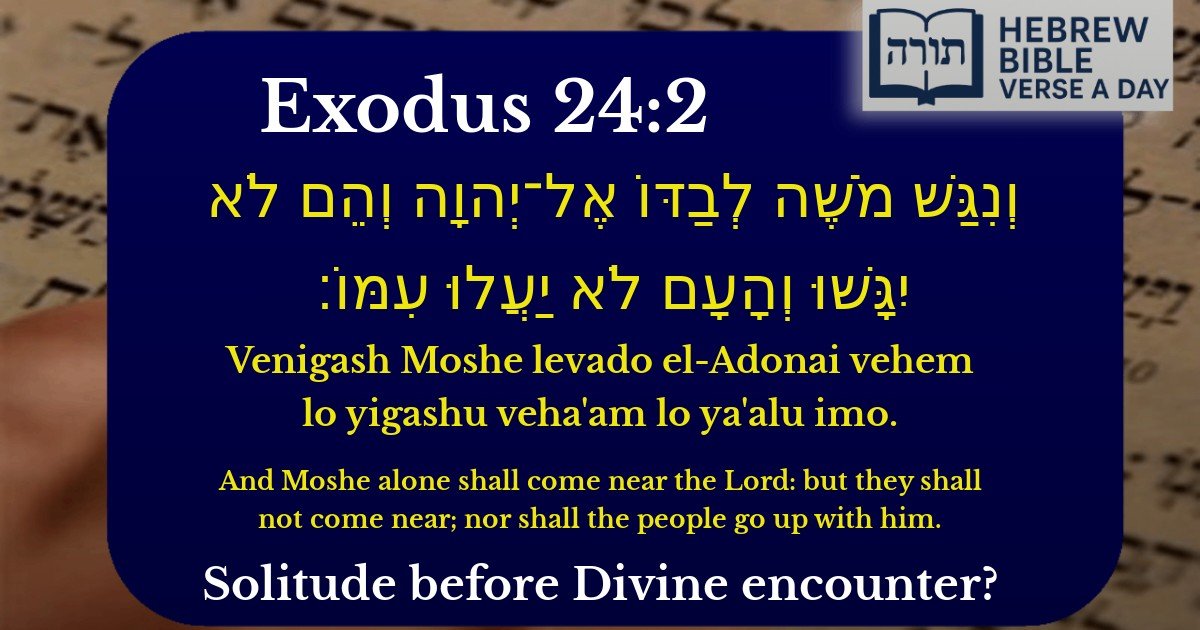

Exclusive Access of Moshe to Hashem
The verse (Shemot 24:2) describes Moshe's unique privilege to approach Hashem alone, while the rest of Bnei Yisrael and even the elders were prohibited from doing so. Rashi explains that this distinction highlights Moshe's unparalleled level of prophecy, as he alone was granted direct and unfiltered communication with the Divine. This exclusivity is further emphasized in Bamidbar 12:6-8, where Hashem contrasts Moshe's prophecy with that of other prophets.
Hierarchy of Kedushah
The Rambam (Hilchos Yesodei HaTorah 7:6) elaborates on this concept, teaching that Moshe's prophecy was fundamentally different from all other prophets. While other prophets received visions through dreams or allegories, Moshe spoke with Hashem "face to face" (Devarim 34:10). This verse establishes the hierarchical nature of kedushah, where:
Midrashic Insights
The Mechilta (Yisro, Massechta DeBaChodesh 9) compares this to a king who allows only his most trusted advisor into the inner chambers. This metaphor illustrates how Moshe served as the sole intermediary between Hashem and Klal Yisrael during the giving of the Torah. The Midrash Tanchuma (Yisro 11) further explains that this separation was necessary to preserve the awe and reverence of the moment, preventing the people from becoming overly familiar with the Divine Presence.
Contemporary Application
The Kli Yakar notes that this model establishes an eternal principle about spiritual leadership - that true connection with the Divine requires proper preparation and inherent greatness. Just as Moshe needed to separate from the people to achieve his unique level of prophecy, so too must individuals seeking spiritual growth recognize the need for appropriate boundaries and preparation in their avodas Hashem.