

Join Our Newsletter To Be Informed When New Videos Are Posted
Hebrew Text
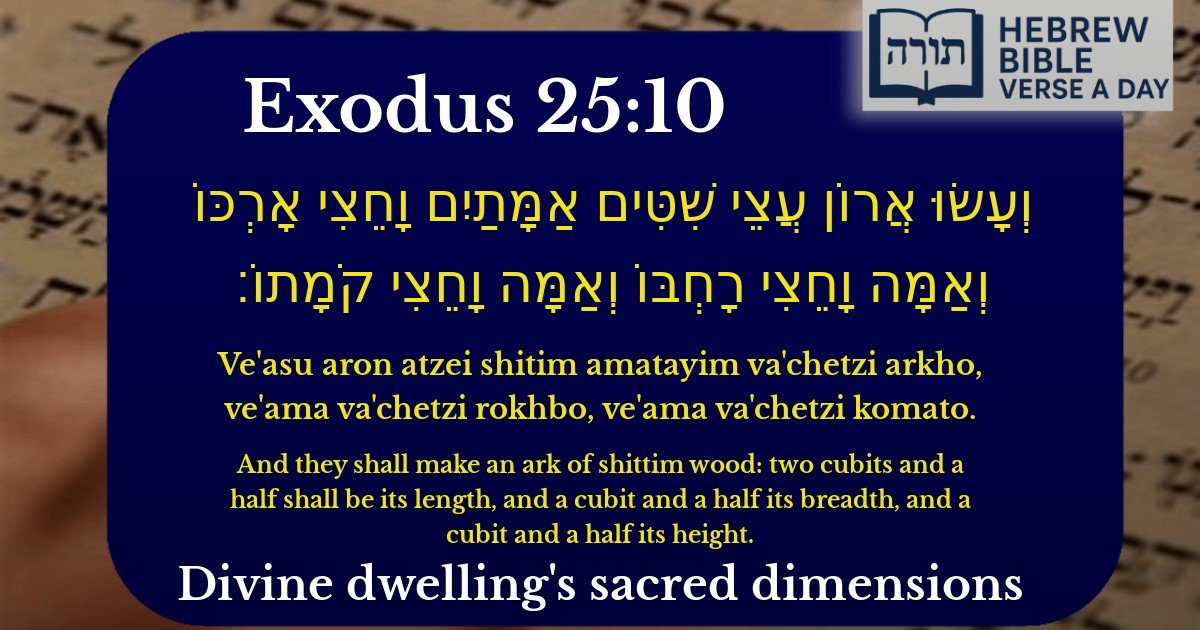
וְעָשׂוּ אֲרוֹן עֲצֵי שִׁטִּים אַמָּתַיִם וָחֵצִי אָרְכּוֹ וְאַמָּה וָחֵצִי רָחְבּוֹ וְאַמָּה וָחֵצִי קֹמָתוֹ׃
English Translation
And they shall make an ark of shittim wood: two cubits and a half shall be its length, and a cubit and a half its breadth, and a cubit and a half its height.
Transliteration
Ve'asu aron atzei shitim amatayim va'chetzi arkho, ve'ama va'chetzi rokhbo, ve'ama va'chetzi komato.
Hebrew Leining Text
וְעָשׂ֥וּ אֲר֖וֹן עֲצֵ֣י שִׁטִּ֑ים אַמָּתַ֨יִם וָחֵ֜צִי אׇרְכּ֗וֹ וְאַמָּ֤ה וָחֵ֙צִי֙ רׇחְבּ֔וֹ וְאַמָּ֥ה וָחֵ֖צִי קֹמָתֽוֹ׃
🎵 Listen to leining
Parasha Commentary
📚 Talmud Citations
This verse is quoted in the Talmud.
📖 Yoma 72a
The dimensions of the Ark are discussed in relation to the construction of the Tabernacle and its sacred objects.
📖 Shabbat 92a
The verse is referenced in a discussion about the size and shape of the Ark and its significance.
📖 Menachot 98a
The dimensions of the Ark are mentioned in the context of the measurements of various Temple vessels.
The Construction of the Aron (Ark)
The verse (Shemot 25:10) commands the construction of the Aron HaKodesh (Holy Ark) from atzei shittim (shittim wood), specifying its precise dimensions. This Ark would later house the Luchot HaBrit (Tablets of the Covenant) and serve as the focal point of the Mishkan (Tabernacle).
Material: Shittim Wood (עֲצֵי שִׁטִּים)
Rashi (on Shemot 25:5) identifies atzei shittim as acacia wood, a durable and insect-resistant material. The Midrash (Shemot Rabbah 34:2) explains that Yaakov Avinu prophetically planted these trees in Egypt, anticipating their future use in the Mishkan. This teaches the principle of hachnasat orchim (hospitality)—just as Avraham planted trees for future travelers, Yaakov prepared materials for the Divine service.
Dimensions: Symbolism of the Measurements
Spiritual Significance
The Zohar (Terumah 2:125a) notes that the Ark's dimensions correspond to spiritual realms: its height (1.5 cubits) alludes to the Shalosh Regalim (Three Pilgrimage Festivals), its width (1.5 cubits) to the Shalosh Avot (Three Patriarchs), and its length (2.5 cubits) to the Two Tablets plus the Five Books of Torah. This underscores the Ark as a microcosm of Divine revelation.
Practical Halachic Implications
The Rambam (Hilchot Beit HaBechirah 2:5) derives from these measurements that sacred vessels require precise dimensions to maintain their sanctity. The Talmud (Yoma 72b) further states that the Ark's gold overlay—both inside and outside—teaches that a Torah scholar must embody integrity inwardly and outwardly (tocho k'baro).