Frequently Asked Questions
Q: What is the 'Testimony' mentioned in Exodus 25:16?
A: The 'Testimony' (הָעֵדֻת) refers to the two tablets of stone containing the Ten Commandments that Hashem gave to Moshe on Mount Sinai. According to Rashi, these tablets are called 'Testimony' because they testify to the covenant between Hashem and the Jewish people.
Q: Why was the Testimony placed inside the Ark?
A: The Ark (אָרוֹן) was the holiest object in the Mishkan (Tabernacle), representing the connection between Hashem and the Jewish people. Placing the Testimony inside the Ark, as explained in the Talmud (Bava Batra 14a), showed that the Torah is at the very heart of our relationship with Hashem and must be protected and cherished.
Q: What lesson can we learn from Exodus 25:16 today?
A: Just as the Testimony was placed in the center of the Mishkan, the Torah should be at the center of our lives. The Rambam teaches that every Jewish home should have a sefer Torah (or at least sacred books) to emulate this idea, keeping Torah study and mitzvot as our primary focus.
Q: Was anything else placed in the Ark besides the tablets?
A: Yes, the Talmud (Bava Batra 14a) states that the broken tablets from the sin of the golden calf were also placed in the Ark. This teaches us that even when we fail, our mistakes remain sacred if we repent sincerely, and we must never discard what was once holy.
Q: How does this verse connect to the purpose of the Mishkan?
A: As the Midrash (Tanchuma Terumah 10) explains, the entire Mishkan was built to house the Ark containing the Testimony. This shows that the primary purpose of the Mishkan - and by extension, our synagogues today - is to be a place where the Torah resides and is studied.

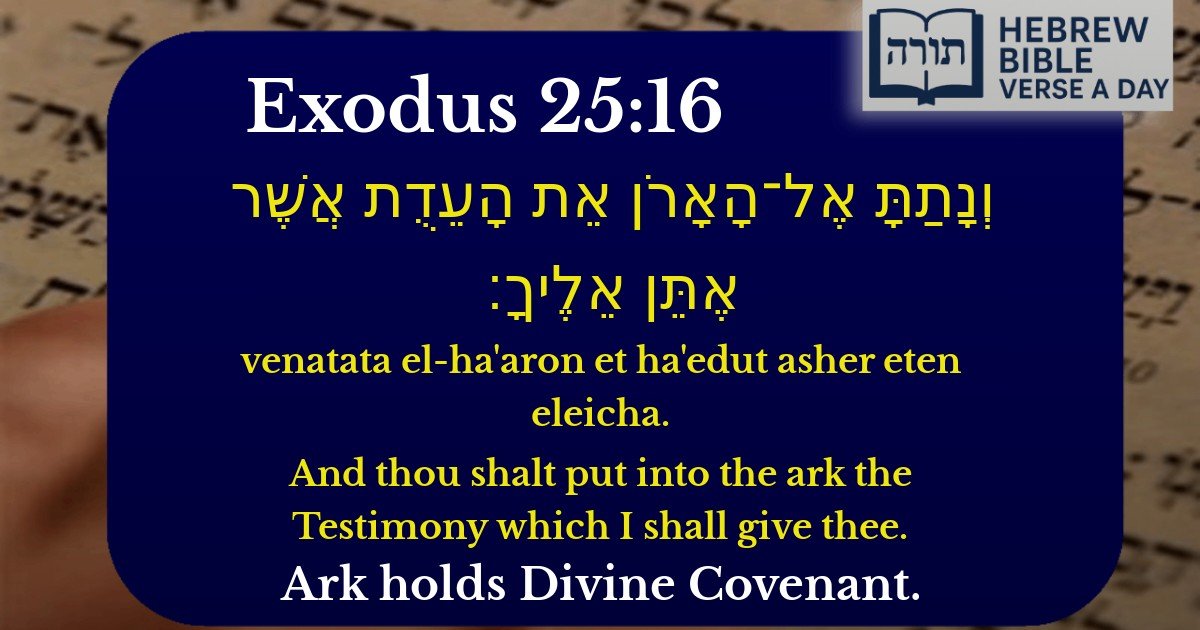

Understanding the Verse in Context
The verse (Shemot 25:16) commands Moshe to place the עֵדֻת (Testimony) into the אָרוֹן (Ark). According to Rashi, the "Testimony" refers specifically to the לוחות הברית (Tablets of the Covenant), which contained the Ten Commandments. This is further supported by the Talmud (Bava Batra 14a), which states that the Ark housed both the whole tablets and the broken tablets, symbolizing the enduring covenant between Hashem and Klal Yisrael.
The Significance of the Ark and the Testimony
Rambam (Hilchot Beit HaBechirah 4:1) explains that the Ark was the central vessel in the Mishkan and later the Beit HaMikdash, representing the Divine Presence. The placement of the Testimony inside the Ark underscores its sanctity and the idea that Torah is the foundation of the Jewish people's relationship with Hashem. The Midrash (Shemot Rabbah 34:2) elaborates that the Ark's construction and the placement of the Tablets signify that Torah must be guarded and cherished at the core of Jewish life.
The Dual Nature of the Testimony
Practical Lessons from the Verse
The Sforno emphasizes that the phrase "אֲשֶׁר אֶתֵּן אֵלֶיךָ" ("which I shall give thee") highlights that the Torah is a Divine gift, not a human creation. This teaches humility in Torah study—recognizing that our understanding flows from Hashem's wisdom. Additionally, the Chizkuni notes that the Ark's role as a vessel for the Testimony reminds us that Torah must be preserved with reverence and transmitted faithfully to future generations.