Frequently Asked Questions
Q: What is the 'covering' (kaporet) mentioned in Exodus 25:21?
A: The 'kaporet' (כַּפֹּרֶת) is the golden cover placed on top of the Ark of the Covenant, as described in Exodus 25:17-21. According to Rashi, it served as a lid for the Ark and was the place where the Divine Presence would rest between the two golden cherubim. The word 'kaporet' is related to 'kaparah' (atonement), hinting at its role in the Yom Kippur service when the Kohen Gadol would sprinkle blood there for atonement.
Q: What is the 'Testimony' (Edut) that was placed inside the Ark?
A: The 'Testimony' (הָעֵדֻת) refers to the two tablets of the Ten Commandments that Moshe received at Har Sinai (Exodus 31:18). The Rambam (Hilchot Beit HaBechirah 4:1) explains that the Ark contained both the whole tablets and the broken tablets (from the sin of the golden calf), teaching us to respect even broken Torah ideals. The Talmud (Bava Batra 14a) also mentions that a Sefer Torah was placed beside the Ark, not inside it.
Q: Why was the Ark designed with a covering on top?
A: The covering (kaporet) with the cherubim served multiple purposes: 1) It physically protected the sacred tablets inside (Ibn Ezra). 2) The space between the cherubim was where Hashem's voice would emanate when speaking to Moshe (Exodus 25:22, Rashi). 3) The Midrash (Shemot Rabbah 34:2) teaches that the cherubim faced each other when Israel followed Hashem's will, symbolizing the relationship between G-d and His people.
Q: How does this verse about the Ark apply to us today?
A: While we no longer have the physical Ark, the Talmud (Berachot 8a) teaches that the synagogue is considered a 'mikdash me'at' (small sanctuary). Just as the Ark contained the Torah, our shuls today center around the Torah ark. The kaporet reminds us that Torah study must be 'covered' with proper reverence (Rambam, Hilchot Talmud Torah). The cherubim teach that Torah is acquired through loving relationships, as the Talmud says (Ta'anit 7a) 'Torah is only acquired through friendship.'
Q: What materials were used for the kaporet and why?
A: The kaporet was made of pure gold (Exodus 25:17), as was the entire Ark. The Midrash (Tanchuma Terumah 7) explains that gold represents both physical purity and spiritual value. The Ramban notes that gold's durability symbolizes the eternal nature of the Torah. The Talmud (Yoma 72b) compares Torah scholars to the Ark's gold - just as gold maintains its beauty, so do those who properly keep the Torah.

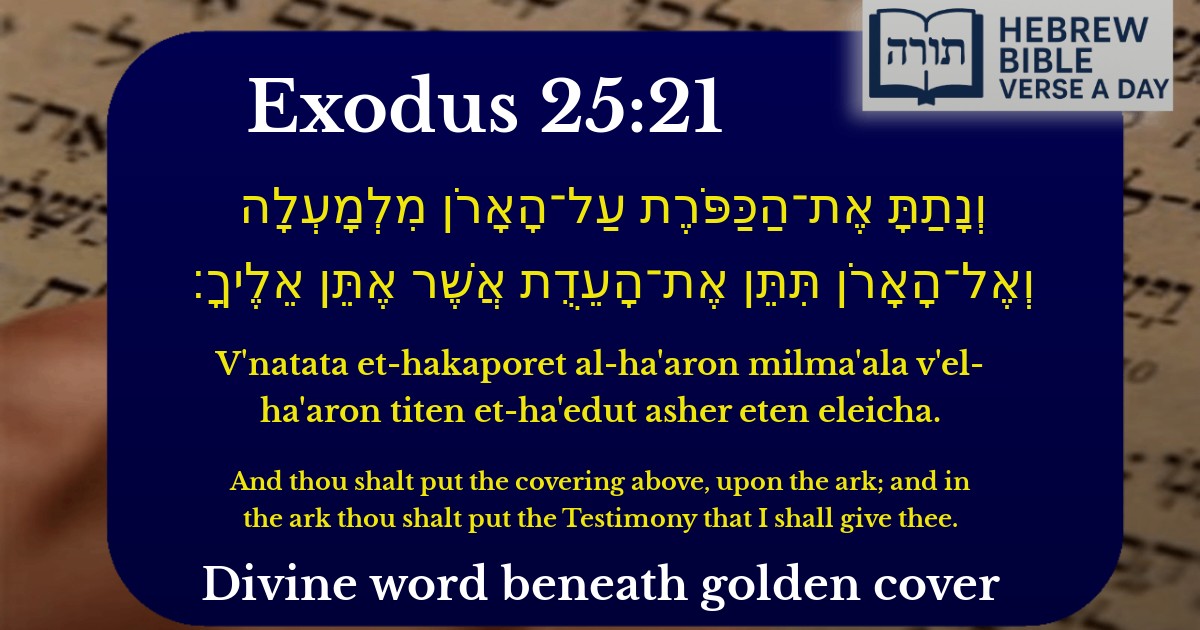

The Placement of the Kapores (Covering) and the Testimony
The verse (Shemos 25:21) describes two key components of the Aron HaKodesh (Holy Ark): the Kapores (covering) placed above the Ark and the Eidus (Testimony) placed inside it. Rashi explains that the Eidus refers to the Luchos HaBris (Tablets of the Covenant), which contained the Ten Commandments. The Ark served as the physical repository for the Divine word, symbolizing the centrality of Torah in Jewish life.
The Symbolism of the Kapores
The Kapores, made of pure gold and adorned with the Keruvim</em (Cherubim), represents Divine protection and atonement. The Talmud (Yoma 54a) teaches that the Keruvim faced one another when Bnei Yisrael fulfilled Hashem's will, symbolizing the loving relationship between Hashem and His people. The Ramban (Nachmanides) adds that the Kapores served as a conduit for Divine communication, as Hashem spoke to Moshe from between the Keruvim (Shemos 25:22).
The Dual Command: Covering and Contents
The Eternal Testimony
The phrase "asher etein eilecha" ("that I shall give thee") underscores the Divine origin of the Torah. The Midrash (Shemos Rabbah 34:2) explains that the Torah is an eternal covenant, not subject to change. The Ark's design—with the Kapores above and the Eidus within—mirrors the Jewish ideal: a life enveloped in kedushah (holiness), grounded in Torah, and guided by Divine wisdom.