

Join Our Newsletter To Be Informed When New Videos Are Posted
Hebrew Text
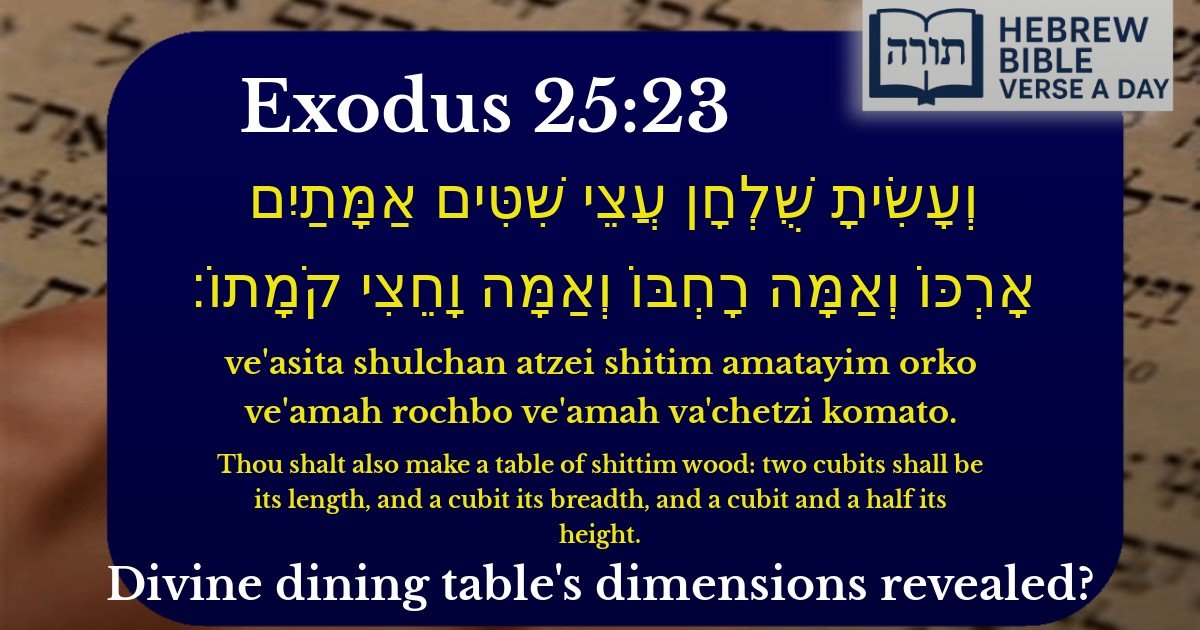
וְעָשִׂיתָ שֻׁלְחָן עֲצֵי שִׁטִּים אַמָּתַיִם אָרְכּוֹ וְאַמָּה רָחְבּוֹ וְאַמָּה וָחֵצִי קֹמָתוֹ׃
English Translation
Thou shalt also make a table of shittim wood: two cubits shall be its length, and a cubit its breadth, and a cubit and a half its height.
Transliteration
Ve'asita shulchan atzei shitim amatayim orko ve'amah rochbo ve'amah va'chetzi komato.
Hebrew Leining Text
וְעָשִׂ֥יתָ שֻׁלְחָ֖ן עֲצֵ֣י שִׁטִּ֑ים אַמָּתַ֤יִם אׇרְכּוֹ֙ וְאַמָּ֣ה רׇחְבּ֔וֹ וְאַמָּ֥ה וָחֵ֖צִי קֹמָתֽוֹ׃
🎵 Listen to leining
Parasha Commentary
📚 Talmud Citations
This verse is quoted in the Talmud.
📖 Menachot 96b
The verse is discussed in relation to the dimensions and construction of the Table in the Temple, as part of a broader discussion on Temple furnishings.
📖 Yoma 33b
The verse is referenced in the context of the daily arrangement of the showbread on the Table, highlighting its ritual significance.
The Shulchan (Table) in the Mishkan
The verse (Shemot 25:23) commands the construction of the Shulchan (Table) for the Mishkan, specifying its dimensions and material. The table was made of shittim (acacia) wood, measuring 2 cubits in length, 1 cubit in width, and 1.5 cubits in height.
Material: Shittim Wood
Rashi (ad loc.) explains that shittim wood was chosen because it is a durable and non-fruit-bearing tree, symbolizing the Torah's eternal nature and its distinction from worldly pursuits. The Midrash (Shemot Rabbah 34:2) adds that the wood was from trees planted by Yaakov Avinu in Egypt, hinting at the continuity of Avodat Hashem from the Patriarchs.
Dimensions and Symbolism
Function and Spiritual Meaning
The Shulchan held the 12 loaves of Lechem HaPanim, representing the 12 tribes. The Talmud (Chagigah 26b) teaches that the table was a source of blessing, demonstrating that material sustenance is sanctified when used in service of Hashem. The Ramban (Shemot 25:23) emphasizes that the Shulchan paralleled the Mizbe'ach (Altar), showing that even mundane acts like eating can be elevated to Divine service.
Gold Overlay
Though not mentioned in this verse, Rashi (Shemot 25:24) notes that the Shulchan was overlaid with pure gold, teaching that material wealth must be "covered" with holiness—used for noble purposes rather than indulgence (Sforno).