Frequently Asked Questions
Q: What is the 'showbread' (lechem hapanim) mentioned in Exodus 25:30?
A: The 'showbread' (lechem hapanim) refers to twelve special loaves of bread that were placed on the golden table in the Mishkan (Tabernacle) and later in the Beit HaMikdash (Temple). According to Rashi, these loaves were arranged in two stacks of six, and they were replaced with fresh bread every Shabbat (Vayikra 24:5-9). The bread symbolized G-d's constant presence and the sustenance He provides to the Jewish people.
Q: Why was the showbread placed 'before G-d always'?
A: The Torah commands that the showbread must always be 'before G-d' to symbolize the eternal covenant between G-d and the Jewish people. The Rambam (Hilchos Temidin u'Musafin 4:12) explains that this mitzvah teaches us that our physical sustenance (represented by bread) comes from G-d and should be used for holiness. The constant presence of the bread also represents G-d's continuous protection and blessing.
Q: What can we learn from the mitzvah of showbread today?
A: Although we no longer have the Beit HaMikdash, the mitzvah of showbread teaches us to recognize that all our sustenance comes from G-d. The Talmud (Menachos 99b) derives from this verse that Torah scholars, who are compared to the showbread, should always be engaged in Torah study. Additionally, the Midrash (Vayikra Rabbah 34:7) teaches that just as the showbread was always present, we should strive to make our connection with G-d constant and unwavering.
Q: How was the showbread prepared and arranged?
A: The showbread was made from fine flour (Vayikra 24:5) and baked in a special mold to maintain its shape (Menachos 94b). According to Rashi (Shemos 25:29), the loaves were arranged on the golden table in two stacks of six, with frankincense placed beside them. The Kohanim would replace the bread every Shabbat, and the old loaves were divided among them to eat (Vayikra 24:9).
Q: What is the significance of the number twelve in the showbread?
A: The twelve loaves of showbread correspond to the twelve tribes of Israel, symbolizing that all of Klal Yisrael is sustained by G-d's blessing (Ramban, Shemos 25:30). The Midrash (Bamidbar Rabbah 4:13) also connects the twelve loaves to the twelve months of the year, teaching that G-d provides for us in all seasons. This unity and divine providence are central themes in the mitzvah of showbread.

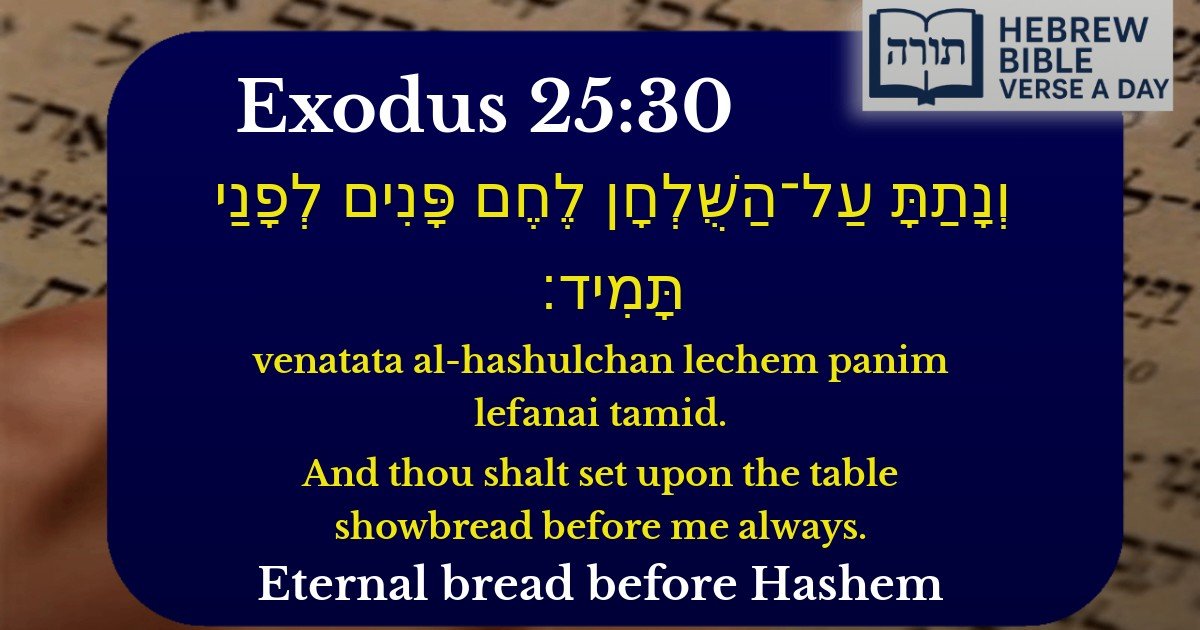

The Commandment of the Lechem HaPanim (Showbread)
The verse (Shemot 25:30) commands placing the Lechem HaPanim (Showbread) on the Shulchan (Table) in the Mishkan (and later the Beit HaMikdash) tamid (always). Rashi explains that "before Me always" means the bread must be present continuously, even when replacing it with fresh loaves. The Kohanim ensured the table was never empty, symbolizing Hashem's constant presence and sustenance.
Symbolism of the Lechem HaPanim
According to the Rambam (Moreh Nevuchim 3:45), the Showbread represents material blessings and sustenance provided by Hashem. The Talmud (Menachot 29b) teaches that a miracle occurred with the bread—though it sat for a week, it remained fresh and warm as if just baked, demonstrating Divine providence.
Halachic Details
The Mishneh Torah (Hilchos Temidin uMusafin 4:12) outlines the preparation: the loaves were baked on Erev Shabbat and placed on the table the following Shabbat. The Kohanim ate the old loaves, emphasizing that holiness does not diminish with time. The Shulchan Aruch (Orach Chaim 318) derives from this that one must always have bread ready for Shabbat and guests.
Spiritual Lessons
The Midrash (Vayikra Rabbah 21:8) compares the Showbread to the Jewish people—just as the bread faced the Ark (symbolizing Torah), we must direct our lives toward Divine service. The Sforno adds that "before Me always" teaches that even mundane acts like eating should be sanctified, elevating physicality to holiness.