Frequently Asked Questions
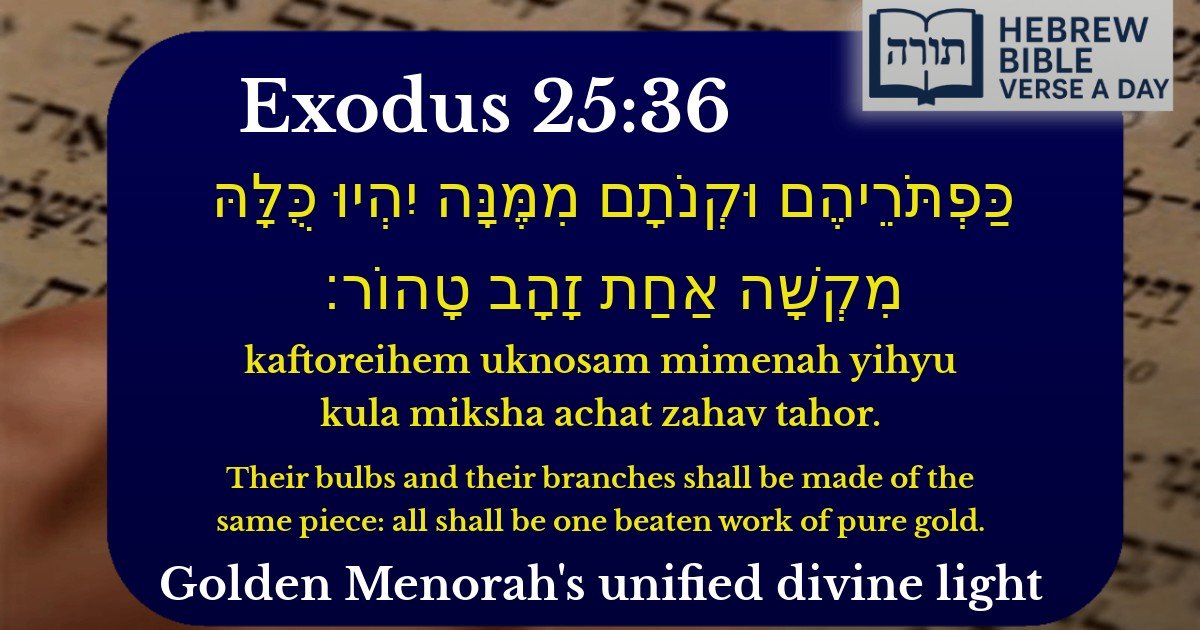
Q: What does Exodus 25:36 mean when it says the menorah's bulbs and branches must be 'one beaten work of pure gold'?
A: According to Rashi, this verse teaches that the menorah in the Mishkan (Tabernacle) had to be hammered out from a single block of gold, not assembled from separate pieces. This reflects unity and perfection in serving Hashem. The Rambam explains that this was a difficult craft requiring great skill, showing the importance of dedicating our best efforts to holy work.
Q: Why was it important that the menorah be made from pure gold?
A: The Talmud (Menachot 28b) teaches that pure gold (זָהָב טָהוֹר) symbolizes spiritual purity and the unblemished light of Torah wisdom. Just as gold doesn't tarnish, our commitment to Torah values should remain untarnished. The Midrash (Shemot Rabbah) compares the menorah's pure gold to the pure intentions we should have in serving Hashem.
Q: What lesson can we learn today from the menorah being made from one piece?
A: The Kli Yakar explains that the unified construction teaches us about Jewish unity - just as all parts of the menorah came from one source, all Jews share one spiritual root. Today, this reminds us that despite our differences, we must work together harmoniously like the menorah's branches to spread Divine light in the world.
Q: What do the 'bulbs and branches' of the menorah represent?
A: Rashi explains that the bulbs (כַּפְתֹּרֵיהֶם) were decorative knobs shaped like apples, while the branches (קְנֹתָם) were the extending arms. The Midrash Tanchuma teaches they symbolize different types of Torah scholars - some bearing fruit (bulbs) through teaching, others reaching outward (branches) to spread light. Together they form one unified structure of Torah wisdom.
Q: How does the description of the menorah's construction apply to personal growth?
A: The Sforno teaches that just as the menorah was formed through a process of hammering from a single piece, our character develops through continuous effort (beating/refining) while maintaining integrity (one piece). The pure gold represents working to refine our nature while keeping our essential Jewish identity intact.


Context in the Torah
The verse (Shemot 25:31) describes the construction of the Menorah (candelabrum) for the Mishkan (Tabernacle). The Torah emphasizes that the bulbs (kaftorim), branches (kanim), and the entire structure must be fashioned from a single piece of pure gold, hammered into shape rather than assembled from separate parts.
Rashi's Explanation
Rashi (Shemot 25:31) clarifies that the kaftorim (bulbs) were rounded protrusions resembling apples, while the kanim (branches) were the stems extending from the central shaft. He emphasizes that the Menorah was not to be made in pieces and soldered together but rather hammered out from a single block of gold, demonstrating the skill required in its craftsmanship.
Symbolism of Unity
The Rambam (Hilchot Beit HaBechirah 3:2) notes that the Menorah's construction from a single piece of gold symbolizes the unity of the Jewish people and their divine mission. Just as the Menorah's branches all stem from one source, so too do the Jewish people draw their spiritual light from the Torah, which is one and indivisible.
Midrashic Interpretation
The Midrash (Bamidbar Rabbah 15:7) connects the Menorah's structure to wisdom and divine light. The requirement for it to be miksha achat (one beaten work) teaches that true wisdom must be integrated and whole, not fragmented or contradictory. The pure gold represents the unblemished clarity of Torah wisdom.
Halachic Significance